




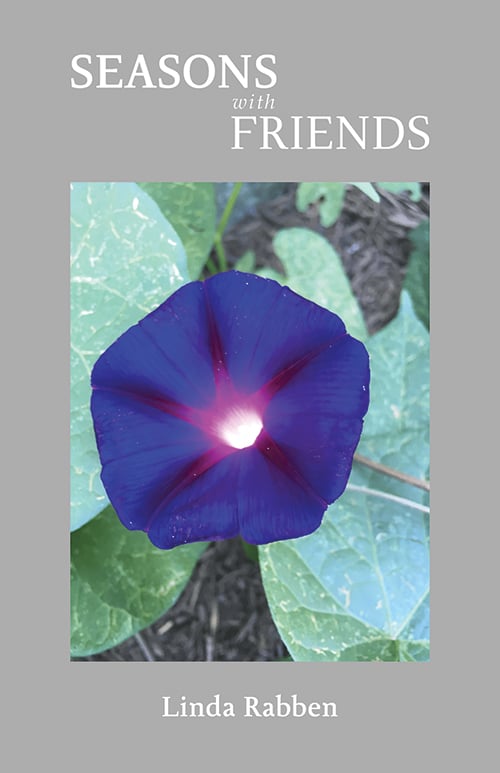
Seasons with Friends
Reviewed by Neal Burdick
June 1, 2026
By Linda Rabben. Self-published, 2025. 75 pages. $15/paperback (available via theivybookshop.com).
Haiku, a traditional Japanese poetic form, follows a strict formula: three lines of five, seven, and five syllables (there are some modern Occidental variations), that typically capture a moment in nature or contain a seasonal reference (a kigo) and a simple but startling observation. All of this—especially that last point—renders them very hard to compose. How can you do all that in 17 syllables?
Linda Rabben checks all the boxes in her Seasons with Friends, a compact collection of haikus, plus an essay about Quakers and the Sanctuary Movement. Rabben, according to her author bio, grew up in Philadelphia, Pa., where she encountered Quakers at an early age, worked for Quaker organizations (such as American Friends Service Committee), and wrote about Quakers and human rights.
Employing Quaker forthrightness, Rabben confesses what many of us will not: that she has had trouble staying awake in unprogrammed meetings for worship. She counters this impulse by crafting haikus; those thus discerned are identified in her book by a modest “Q” in the margin.
Snoozing at meeting
Like a boat drifting from shore.
I hope I don’t snore.
Leaving aside any eldering over the propriety of this strategy, the results are both enjoyable and meaningful to read. One could plausibly argue that they are spiritually generated. I found that some of them spoke more profoundly to me than others, but that’s the nature of poetry—wholly separate from the irrelevancy of whether it’s “good” or “bad.”
In obeisance to the “rules” of haiku, Rabben organizes most of her work by season with anywhere from around 20 to 90 haikus for each; summer gets by far the most. Images that recur include birds, trees in all their annual plumages, flowers, the passage of time, silence, light, and oceans (and George Fox’s ocean of light). Some pose questions, perhaps even queries:
Snowy, wintry day:
“The path itself will warm you.”
Is that really true?
Others expose thoughts in meeting that most of us dare not deliver:
Plain wooden benches
For upright spines, tough bottoms;
No place to hide here.
A handful more are introduced by quotes from “notables” or other writers. In response to biographer Elizabeth Gray Vining’s revelation that Rufus Jones suffered from tinnitus, Rabben imagines the famed Quaker mystic saying,
My ears are buzzing.
Doctors say avoid silence.
How can I worship?
Above, I indicated that Rabben’s poems are “mostly” packaged by season. There’s one additional grouping: “The Narrow Road to the Deep North,” a reference to Japanese haiku master Matsuo Bashō’s travel diary of the same name. Here we have more topical haikus, ones that speak to today’s societal condition and urge us, whether explicitly or implicitly, to action:
Amidst the silence
A voice in the wilderness;
It is my own voice.
Rabben’s essay on the history and significance of the Sanctuary Movement and Quakers’ involvement in it seems out of place in what is otherwise a collection of poetry. But it’s an outspoken passion of hers, and it’s certainly timely in this worrisome ICE age: “Quakers follow the path they have taken since the beginning, led by their Testimonies, conscience, and inner light.”
Friends will find much here to inspire and motivate them, for Quaker beliefs, practices, and principles permeate almost all of the over 200 haikus. Noting that William Penn proclaimed “We are the people that . . . must stand in the gap,” Rabben comments:
“We stand in the gap,”
Unarmed, with only our light,
And morning comes late.
Neal Burdick is the poetry editor of Adirondac, the magazine of the Adirondack Mountain Club, and has seen his poems published in several journals, including this one. He worships (and yes, infrequently snoozes) at Burlington (Vt.) Meeting while maintaining his membership in St. Lawrence Valley (N.Y.) Meeting.

We want to hear from you, not an AI! Please be thoughtful and use your own words. Comments on Friendsjournal.org may be used in the Forum of the print magazine and may be edited for length and clarity.