





Moving Past the Question of Belief
For me to state what I believe would be a relatively straightforward task. But to articulate what Quakers believe is much harder: I quickly become aware that there is probably nothing I believe that would be endorsed by all Quakers—and some of what I believe would likely be rejected by most Friends, even in my own yearly meeting. Hence the dilemma of “what Quakers believe.”
Some years ago, Arthur Larrabee, who was then general secretary of Philadelphia Yearly Meeting, presented the yearly meeting with a document for discussion and discernment: “What Do Quakers Believe?” It was a reasonably clear and concise statement with nine numbered propositions, carefully worded so as to be minimally controversial and answering his desire to have something succinct with which to engage non-Quakers. (See his 2018 QuakerSpeak.com video, “Nine Core Quaker Beliefs.”) In the ensuing discussion, some raised quibbles about specific points, but the more substantive objection was that no group of Friends, not even the yearly meeting in session, could legitimately define what Quakers believe: the question itself was illegitimate.
The issue, of course, was Friends’ traditional witness against formal creeds. Creeds inevitably give authority to verbal formulations, and ultimately to the institution or ideology that produced the creed. Early Friends, however, looked to a different source of authority: the Divine Voice, the Inward Light of Christ: “Truth in the inward parts,” as written in Psalm 51:6. Their rejection of creeds was not (as modern Friends sometimes interpret it) a position that “you can be a Quaker and believe anything you want.” The inward authority that they experienced and came to trust was not self or ego but (in Dietrich Bonhoeffer’s memorable phrase) “the beyond in our midst.”
This yearly meeting exercise led me to wonder if there might not be a better way to get at the core of Quakerism, beyond the seemingly futile search for a short list of propositions to which we could all agree.
At least since the European Enlightenment, our modern culture has distinguished between what we know, established by sense perception, objective measurement, and scientific experimentation (although even here there can be a fair bit of disagreement) versus what we believe, which is thought to exist in the private or subjective realm, and suggesting a much lower level of “evidence.” But Marcus Borg reminds us that prior to the seventeenth century, the word believe did not mean assenting to the truth of a proposition. Up until that time, the grammatical object of “believing” was not a statement or a proposition but a person—as in “I believe in you.” He points out that in premodern English, the context of “to believe” makes it clear it meant:
to hold dear, to give one’s loyalty to, to give one’s self to, to commit oneself. . . . Most simply, “to believe” meant “to love.” Indeed, the English words “believe” and “belove” are related.
In The Heart of Christianity, Borg concludes that belief is not about assenting to propositions or a creed but about “beloving God.”
Beloving God is certainly central to the biblical tradition. When Jesus was asked to name the most important commandment, he replied, from the Hebrew Scriptures, “Love the Lord your God with all your heart, and with all your soul, and with all your mind. . . . And a second is like it: You shall love your neighbor as yourself” (Mt 22:37–39). In the Sermon on the Mount, Jesus instructs his followers to love even their enemies (Mt 5:44). In the Gospel of John, Jesus gives a new commandment: “that you love one another, just as I have loved you” (John 15:12). In his final post-Resurrection appearance, three times he asks Simon Peter (who had denied him three times), “Simon, son of John, do you love me?” (John 21:15–17). Elaborating on this theme, John the Evangelist writes, “Let us love one another, for love is from God. . . . God is love, and those who abide in love abide in God. . . . We love because he first loved us” (1 John 4:7–19).
In the long tradition of Christian spirituality, there is a prominent strain that teaches that we do not become better persons by obtaining more knowledge or different beliefs but by acquiring better loves. Hence, early Quakers exhorted one another to “love the Light”—even when it shows us things we would rather not see.
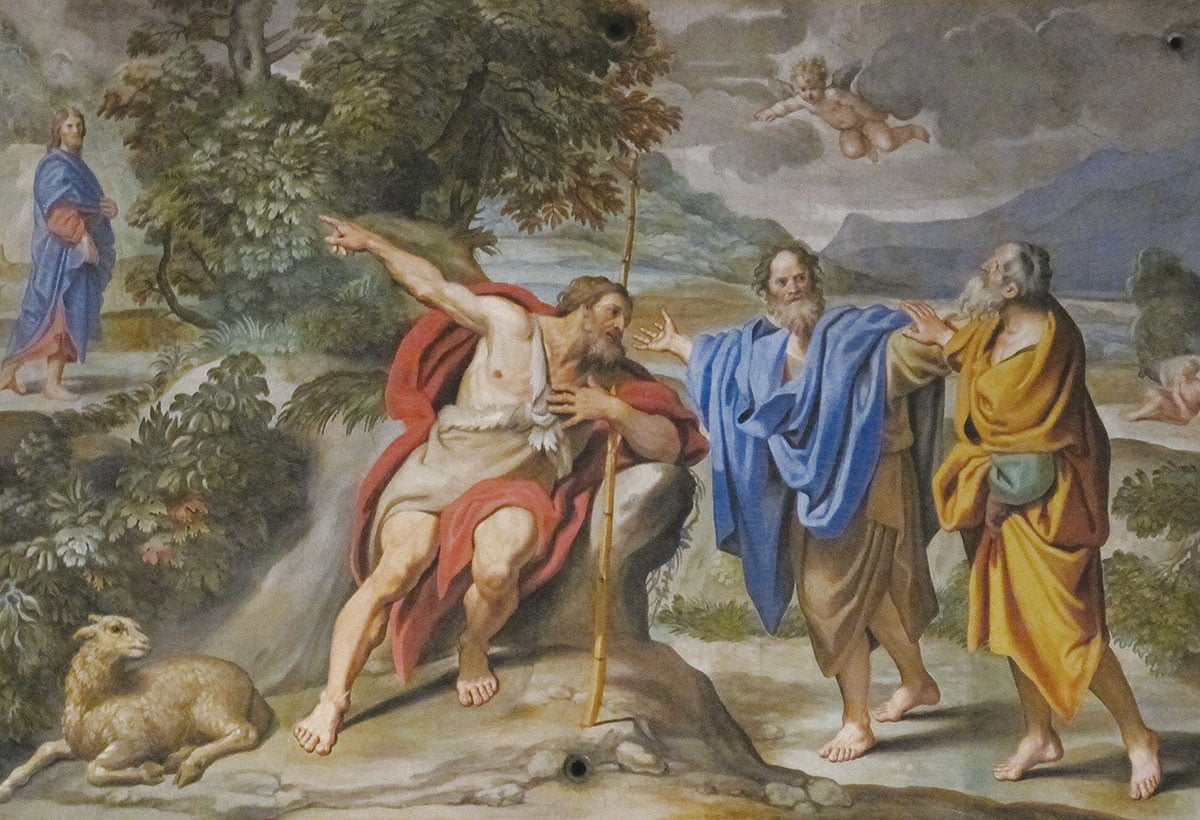
As we seek to grow beyond an understanding of belief as a set of propositions to which we give assent, a story from the first chapter of the Gospel of John can point us in a helpful direction. After the magnificent prologue, the narrative starts with John the Baptist observing Jesus pass by at a distance, and he proclaims to his disciples, “Behold, the Lamb of God.” The same thing happens the next day, and this time two of John’s disciples set out to trail Jesus. Sensing that he is being followed, in John 1:38, Jesus turns to face them, asking: “What do you want?”, “What are you looking for?”, or “What are you seeking?”, as recounted in the New International, New Revised Standard, and King James Versions respectively. Jesus doesn’t ask these two would-be disciples what they know, or even what they believe. Instead, he asks them (and us): what do you want; what are you seeking; what are you yearning for; what is your deepest desire; in a word, what (or whom) do you love?
What do Quakers believe? We have probably all had the experience of being asked some variation of that question and tailoring our answer to emphasize what we think might most speak to the enquirer. Not wishing to antagonize, our reply might depend on whether we think we are speaking with an Evangelical Christian, a Buddhist, a universalist, an agnostic, or a potential Quaker. Such an approach is not always very satisfying—and carries the risk that you might misjudge the beliefs of the person with whom you are speaking.
In recent years, I have taken to answering that sort of question by paraphrasing something Paul Lacey once wrote in his Pendle Hill pamphlet, Leading and Being Led:
[A] Quaker is not someone who subscribes to certain doctrines about God or Christ, nor someone who specifically strives to obey the teachings of Jesus, nor even someone who follows certain inherited testimonies. Rather, “to be a Quaker is . . . to have met the Inward Christ”—by whatever name that reality is known.
For me, those words convey what is most central about Friends: that Quakerism is rooted in an experience, an encounter with the Divine that is “beyond what words can utter,” as Isaac Penington wrote. I have found that this answer resonates with all varieties of Christians, acknowledging our roots in “primitive Christianity revived” while placing the emphasis on the authority of inward experience rather than words in a sacred book or creed. But it also seems to resonate with those from other traditions, including nontheists and agnostics. There is something about “meeting the Inward Christ” that has the ring of universal experience while also giving ample opportunity for translation into whatever words might be most meaningful to those from other traditions.
And this answer also contains an implicit question and a challenge: How have you met the Inward Christ? What is your experience?

Comments on Friendsjournal.org may be used in the Forum of the print magazine and may be edited for length and clarity.