



Margaret Fell for Modern Friends
This is the second of two articles that present the words of Margaret Fell translated for modern-day Friends. The first article appeared in the November 2025 issue.
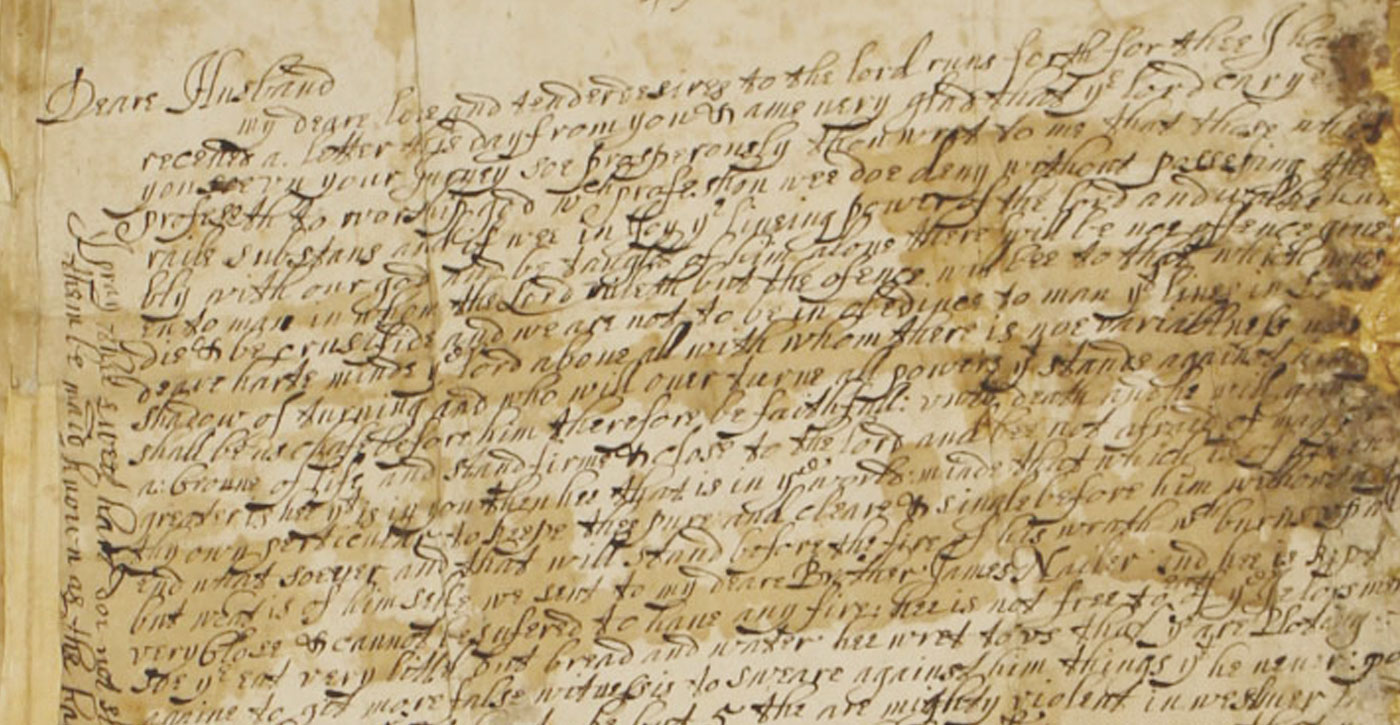
Margaret Fell was affectionately known as the “mother of Quakerism.” One of the ways she nurtured Friends was through her writings. She was prolific, producing sixteen books (five while she was in prison), twenty-nine tracts and public documents, and hundreds of letters and epistles.
Surprisingly, Margaret’s letters speak directly to our needs now.
When Quakers came into being in 1652, there were laws in England that criminalized activities that were central to Friends’ beliefs. Beginning in 1664, new laws were enacted in an attempt to squash Quakerism, along with other forms of non-conformism. Friends were arrested on the grounds of these, and also simply to harass them.
Reasons for arrest included interrupting a preacher (which was unfair because it was a custom of the time for visiting ministers to debate in this way and non-Friends were allowed to do so); blasphemy; refusing to bear arms; attending meeting for worship; disturbing the peace (a false accusation laid on worshiping Quakers); refusing to swear the Oath of Allegiance (forbidden to Friends by the Bible); suspicion of plotting against the King (Friends were accused of this by officials of each king as he came into power); refusal to doff their hats to “their betters”; refusal to pay tithes to support the Church of England; and charges of traveling (to attend meeting) on Sunday.
The judicial system was in the hands of each judge. One jury twice defied a judge’s order to find two Friends guilty: William Penn and William Mead. The enraged judge threw the entire jury into jail, demanding they change their verdict. They did not.
Margaret’s first husband, Thomas Fell, was a judge. That provided protection for Margaret. After his death in 1658, officials in Margaret’s neighborhood came down on her with a vengeance. She went to prison three times. The first time, in 1664, she spent six months in Lancaster Castle Gaol while waiting for a trial at a higher court. She could have waited at her home, Swarthmoor Hall, if she promised not to have any more meetings for worship there, but this Margaret would not do.
The higher court sentenced her to praemunire, the harshest sentence possible, which included loss of her entire estate and imprisonment indefinitely. Friends worked hard to get her out, but it took them four years.
Margaret married George Fox in 1669, when she was 55. She was thrown back into Lancaster Castle just ten days later! George asked two women Friends to speak to King Charles II on Margaret’s behalf. This worked eventually; Margaret was released after about a year.
The last imprisonment was in 1684, when Margaret was 70. She spent three weeks in prison along with her daughter Rachel, and Rachel’s husband, Daniel Abraham. After their release, Margaret was successful in convincing the latest king, James II, to do something about the officials where she lived. The King intervened, and Margaret was finally able to “live peaceably at my house.”
To help go deeper into Margaret’s words, I have adapted them into contemporary English and arranged them like poetry.
This letter was written in 1653 to Quaker prisoners James Nayler and Francis Howgill, the year after Margaret became a convinced Quaker. Most of us are not in prison or having our homes, possessions, and livelihoods taken from us. Yet Margaret’s words can speak to us just as strongly in whatever circumstances feel overwhelming.
I recommend reading only a few lines or a single stanza at a time, out loud and slowly. Then pause to let the meaning sink in. Then read those lines again, and pause again, before going on.
Dear brothers-in-spirit James and Francis, and all of you who are in prison because you are Quakers,
You are abiding faithfully in the will of God.
Standing therein you have peace,
you have joy,
you have boldness.Don’t despair—the secret work of God is going on inside people.
Don’t get caught up in the amount of work to be done,
don’t look at all the briars, or at the thorns, or at the mountains in the way,
don’t lose your way because of the coldness in people.It is this way because no one has been tending the trees
or the fields—no farmer of the Spirit has prepared the ground
or sowed seeds.
Therefore the Great Friend has set you forth to do this work.
Know that you shall not plough or sow in vain.I pray that you all feel the sweet love of the glorious Presence
and know fully Its miraculous power,
so you may continue to stand without fainting
and be guided,
instead of relying on your own wills.Our human will is weak,
but if you keep your mind on what is purely of God within you,
you will be able to continue to stand strong.The Lord is doing great things.
You will see how all the plotting against us will be broken to pieces.
This rule by people living in darkness has long held sway,
but now the Lord is raising up glorious light.Therefore pay attention only to Spirit
and boldly be faithful to the truth you know.Keep treading and trampling on the deceit
that is all around you.Try not to yearn for your outward freedom.
Don’t get stuck on the terrible things people do
or think it a waste of years of our lives.
The divine Friend is doing great work through you.So look only at the Eternal God of Life and Power,
which you will see is always present with you,
supporting and protecting,
lifting you up above whatever occurs.Praises to the Lord God Almighty of Life and Power!
Love is never wasted. Actions you take out of love—even if you see no fruit, even if you feel harmed by the result—are never a waste, not of you, your time, or your life.
Taking action in the name of love changes us. As Sufi sage Bahauddin said, “Your soul is greater than anything you ever lost.”
Additional materials
Laws that put Friends in prison:
A law variously titled “the Religion Act 1592,” “the Act Against Puritans,” and “the Conventicle Act 1593” (sources include some or all of the same text under different names and years) included a ban on “unlawful religious meetings,” which were any that strayed from the Church of England. Failure to reform within three months resulted in imprisonment. The full title of this law was: “An Act For the preventing and avoiding of such great inconveniencies [sic] and perils as might happen and grow by the wicked and dangerous practices of seditious sectaries and disloyal persons.”
The Conventicle Act of 1664 punished any person over 16 years of age for attending a religious meeting of more than five people other than immediate family, outside the auspices of the Church of England and the rubrics of the 1662 Book of Common Prayer. A special clause applied to Quakers who refused to swear an oath in court. They were immediately declared guilty without any further cause.
Friends and the Oath of Loyalty:
The Bible states: “Above all things, my brethren, swear not at all; neither by heaven, neither by the earth, neither by any other oath . . . let your yea be yea, and your nay nay, lest you be condemned: for whatsoever is more than this, cometh of evil.” (Matt. 5:34, 37; and James 5:12)
Quakers were not the first group to refuse to swear: “It must be remembered that the most learned theologians of every sect recognize that the Fathers of the church from the first 300 years after Christ understood these words to be a prohibition of all sorts of oaths.” [Source: Robert Barclay’s Apology for the True Christian Divinity, in a translation in Spanish and English by Susan Furry and Benigno Sánchez-Eppler on their website Raices cuaqueras, or “Quaker Roots”]
The refusal to swear also resulted in the inability of Quakers to work in the legal system, universities, or government. In addition to this, their peace testimony kept them from joining the military, so most Friends made a living through farming, the service industries (such as being a seamstress or a teacher for children), banking, owning stores, importing goods, running factories, and making useful items.
The list of Quaker crimes:
Source: The Quaker Reader, selected and introduced by Jessamyn West (The Viking Press, 1962, page 114).
The jury that was thrown into prison, known as Bushel’s (or Bushell’s) Case:
A startling incident involving the newer Act was the arrest in 1670 of Quakers William Penn and William Mead (this may be the same person as the William Meade who married Margaret’s daughter, Sarah). The jury would not convict them of the charge, and the infuriated judge locked up the jury “without meat, drink, fire [heat], or smoke . . . With God’s aid, we’ll get a decision, or you’ll starve to death.”
Penn protested, shouting to the jury, “You are Englishmen, mind your privilege, give not away your right.” To which juror Edward Bushel replied, “Nor shall we ever do.” The judge ordered Penn bound and gagged.
After two days locked up with no food, the jury again said, “Not guilty.” The judge fined and imprisoned the jury for contempt of court! Penn protested that this violated England’s Magna Carta (the foundational document of citizen’s rights) and was forcibly removed from the court. The jury were released after they paid up. The stalwart juror, Bushel, fought his conviction and fine, and won.
In another version of the story, Jessamyn West refers to “the rip-snorting, knockabout methods of seventeenth-century trials,” and says that the entire jury sued the judge for illegal imprisonment, and won the case before a bench of 12 judges headed by the Lord Chief Justice.
In both versions, the outcome was that the Chief Justice made a ruling that ended judges’ ability to control verdicts, establishing the independence of juries.
Source: The Quaker Reader, page 164; and Bushell’s Case on Encyclopedia.com.
The quote from Margaret’s autobiography about living “peaceably” at her house:
Source: A Sincere and Constant Love: An Introduction to the Work of Margaret Fell, edited by Terry S. Wallace (Friends United Press, 1992, pages 171–2).
Wallace’s source was Margaret Fell’s autobiography, titled A Brief Collection of Remarkable Passages and Occurrences Relating to the Birth, Education, Life, Conversion, Travels, Services, and Deep Sufferings of that Ancient, Eminent, and Faithful Servant of the Lord, Margaret Fell, But by Her Second Marriage, Margaret Fox . . . Published in London, 1710. It is online in the Earlham School of Religion Digital Quaker Collection.
Closing quote by Bahauddin:
Sufi master Bahauddin (born c. 1161) was the father of the more famous Jalaluddin Rumi. The quote is found in The Drowned Book: Ecstatic and Earthy Reflections of Bahauddin, the Father of Rumi by Coleman Barks and John Moyne (HarperSanFrancisco, 2004, page 79).
The reasons James Nayler and Francis Howgill were in prison when Margaret sent the letter:
Francis Howgill and James Nayler were both traveling ministers. Nayler was on trial for blasphemy. Howgill appeared at the trial to offer support, but he antagonized/enraged/infuriated the judges by refusing to remove his hat in deference to them. They burned his hat and imprisoned him for five months as an enemy to “Ministry and Magistracy.” Nayler was convicted of blasphemy, a charge that covered a huge range of actions or non-actions that were part of the ordinary life of Friends ministers.
Source: Lancaster University (of United Kingdom) biography page on Francis Howgill, which lists additional sources, including Journal of the Friends’ Historical Society.
Original letter by Margaret Fell to James Nayler and Francis Howgill (1653):
Dear brethren James and Francis, with the rest who are prisoners of the lord, [Eph. 4:1], called faithful and chosen, abiding faithful in the will of God, and there stand: you have peace, you have joy, you have boldness . . . I do see the secret work of God going on in people’s minds, look not at the work nor look not at briars nor look not at all the thorns, nor at the mountains, nor the coldness, for well it may be so for there has been no vinedresser nor no ploughman there, none to dress the ground, no seedsman to sow the seed, and therefore the lord has set you forth to do his work, and the ploughman shall not plough in vain nor the seedsman shall not sow in vain . . . and the glorious God keep you in his glory, and both of you in his love, keep you wholly in his power up to himself for there is never no fainting, but to that mind which goes from that which is pure within that will faint . . . and stand in the will of God being guided by that which is eternal unto God, who is eternal, out of your own wills . . . will be broken pieces . . . and therefore wait for the lord is doing now great things, for long this darkness and this heathenish ministry has reigned and dark powers of the earth, now God has raised up his glorious light . . . therefore wait on the lord alone and . . . be faithful in what you know, treading and trampling over the deceit and the lord God of power keep you faithful bold, and pure every way in his power . . . therefore look not at your liberty outwardly nor at men nor at time, but at the lord who will be your portion eternally, your reward is in the lord the lord has a secret work there amongst you . . . therefore look at the lord alone, which is ever, therefore look to see, see the lord present with you, with his power and with his supporting . . . lifting up your heads above all your enemies[;] to whom be praises praises honor and glory for ever whose mercy endures for ever.
[unsigned]
This appears as letter 7 (page 23) in Undaunted Zeal: The Letters of Margaret Fell edited and introduced by Elsa F. Glines (Friends United Press, 2003).


We want to hear from you, not an AI! Please be thoughtful and use your own words. Comments on Friendsjournal.org may be used in the Forum of the print magazine and may be edited for length and clarity.