



Springtime Storks: A Migration Love Story
Reviewed by Margaret Crompton with Nicola
December 1, 2025
By Carol Joy Munro, illustrated by Chelsea O’Byrne. Minerva, 2024. 40 pages. $18.99/hardcover; $10.99/eBook. Recommended for ages 4–8.
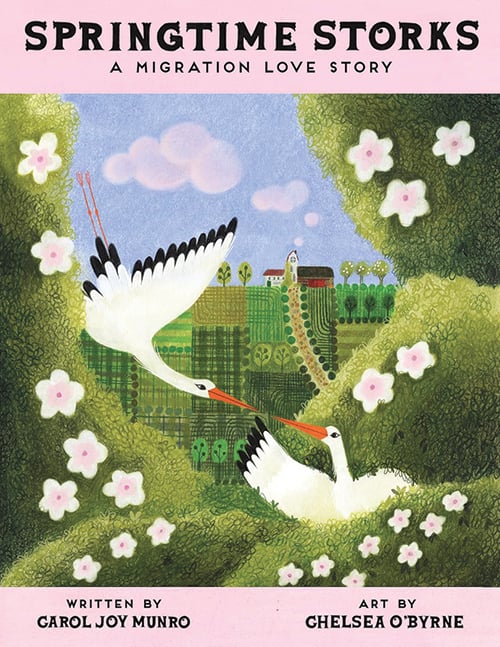
“There’s lots of imagination, lots of nature,” observed my co-reviewer, Nicola (age nine), upon seeing the cover of Springtime Storks for the first time. Two white storks, beaks nearly touching, are surrounded by green leaves and pink flowers against an imaginary landscape of fields, trees, and sky; a farmhouse sits on the horizon.
The book is based on the true story of two storks who became lifelong mates after tragedy. While migrating from Croatia to South Africa in 1993, Malena was shot down by a hunter. A man named Stjepan Vokić took her home to his farmhouse. Although her wound healed, she could not regain the ability to fly distances. In 2002, Stjepan built her a nest on the roof, and there Klepetan mated with her. They raised a total of 66 chicks. After the autumn migration, Klepetan’s return every spring was watched and recorded by over two million observers via a livestream and through photos and videos on social media.
Nicola was impressed that Stjepan was inspired to write to the president of Lebanon asking him to enforce laws protecting migratory birds. The author’s note shares that Lebanon’s Beqaa Valley is where more than two million birds are illegally killed each year while flying their migration routes. There is also information about other birds mentioned in the story, including the collared flycatcher and the moustached warbler.
Nicola liked the way the author adapted true events, introducing imaginary elements such as the farmer’s granddaughter. I see this as a help to connect young readers with the experience of people in the story. Nicola’s parents are Polish. She and her mother, Wioletta, told me that when they’re exploring the Polish countryside, they enjoy searching for storks and their nests.
The sensitive narrative expresses loss and pain, sadness and separation. The female stork, Katerina (the fictional name for “Malena”), tells her story. Although she regains enough strength to fly, she recognizes that her wings will never endure long migratory flights: “Not now, not next week, not ever.” Not even when her mate, Luka (the fictional name for “Klepetan”) takes their fledglings south in the autumn. However, Luka, like his real counterpart, always returns in the spring “when the magnolias bloom.” Storks represent hope and new life.
We agreed that it’s good to include such feelings and experiences. Thinking about loss, Nicola suggested that the story could help children to know that even when you lose someone, you may meet other people and feel happy again. She added that it is helpful for children to know they can express what they feel.
Feelings, both human and avian, are clearly represented in the illustrations, made using chalk pastel and colored pencil. We were impressed by the range of expressions suggested in depictions of the storks, which did not violate their essential “birdness.” Most pictures are double-spread. We found them beautiful, especially the sequence showing five stages of Katerina’s attempts to fly, with encouragement from the farmer’s granddaughter; soft white clouds in a warm blue sky resemble flying storks.
We recommend this sensitive and beautiful book and advise sharing as we did. Nicola suggests extending the publisher’s age range to four through ten, and I suggest to 84 and beyond. My husband and I searched for storks when we lived in Poland, admiring great nests supported on high-set wheels that welcomed storks as they returned in the spring, bringing hope.
Margaret Crompton’s (Britain Yearly Meeting) publications include Children, Spirituality, Religion and Social Work (1998) and the Pendle Hill pamphlet Nurturing Children’s Spiritual Well-Being (2012). Recent publications include poems, short stories and flash fiction, and plays for Script-in-Hand Theatre. Nicola often spends time in Poland, and she has seen storks. This is her first book review.
1 thought on “Springtime Storks: A Migration Love Story”
Leave a Reply
We want to hear from you, not an AI! Please be thoughtful and use your own words. Comments on Friendsjournal.org may be used in the Forum of the print magazine and may be edited for length and clarity.
I happened to find this review when I was looking for something else related to my book, SPRINGTIME STORKS. Thank you, Margaret, for a beautiful review. I was especially touched by Nicola’s comments. Thanks you, Nicola. I hope you continue to review books.