





Reclaiming Queer Quaker History
One thing I appreciate about Quakerism is its emphasis on the importance of reflecting on one’s most sincere convictions and beliefs, so they may influence, shape, and animate one’s efforts to build a more peaceful world. Quakerism is an action-based religious tradition. Quiet listening is essential, but action is how Quaker faith generates impact and makes a difference in the world.
Since the seventeenth century, Friends have earned a reputation for witnessing against violence, discrimination, and suffering. The campfire stories we tell about ourselves as Friends include tales of brave conscientious objectors; bold antislavery campaigners; courageous abolitionists; tenacious women’s rights advocates; and fearless civil rights activists. I have observed and appreciate the ways in which Friends are developing a greater capacity for interrogating and scrutinizing the stories we tell about ourselves as social justice heroes. We sift through our mythologies and look past our pantheons of Quaker saints, in search of what may be true and what may have been told from a source of collective pride, privilege, and misunderstanding. Properly grappling with the real harm Friends have caused marginalized and oppressed people is important work. I am happy to see Quakers practicing continuing revelation as we interpret new findings from our shared history.
What continues to surprise me, however, is how little Friends seem to know (or talk) about the actions Quakers took toward protecting and advocating for the rights and dignity of lesbian, gay, and bisexual people. How many campfire stories have been told about an organization in New York City that protected thousands of gay men from being imprisoned for their sexuality in the late 1940s and early 1950s? How many books by Quaker historians celebrate the publication of a pamphlet written by a small group of British Friends in 1963 which scholars recognize today as the first public and positive evaluation of gay and lesbian sexuality from a religious group? How many Quaker tomes talk about an unofficial statement written at the Annual Gathering of Friends General Conference in 1972 which scholars recognize today as the first public and positive evaluation of bisexuality? Who speaks with knowledge and pride about Quaker involvement in early gay rights activism in the late 1960s and early 1970s, when same-sex desire was so deeply linked in the popular imagination with criminality, perversion, and sin?
In the early 2010s, shortly after I had obtained membership at Gainesville (Fla.) Meeting and at a time when my understanding of my own sexuality as a gay person was expanding, I discovered that I had an appetite for learning about the history of Quaker support for gay liberation. I was curious about what Quakers had done to welcome and affirm lesbian, gay, bisexual, transgender, intersex, asexual, and queer (LGBTIAQ+) people during the mid-twentieth century, especially when queer people were being targeted by law enforcement, the courts, psychiatric and medical establishments, and the church with a level of vitriol that we had not seen before. Were Friends there to respond?
I was not raised in a Christian family, but an experience I had as a teenager in a youth choir at a Methodist church in northcentral Florida taught me that faith communities can be hateful toward LGBTIAQ+ people. A cursory survey of news headlines also revealed to me that while LGBTIAQ+ people were given legal rights and greater recognition in films and television, religious communities continued to terrorize LGBTIAQ+ people with hateful rhetoric, poisonous theology, and—in some cases—abusive ex-gay ministries.
My experience among Friends, however, has been to the contrary. Among Friends, I have felt respect, kindness, and understanding toward my sexuality. By the time I was ready to live openly as a gay man, I was a student at Chicago Theological Seminary, and I was attending worship at Northside Meeting in Chicago, Illinois. The community at Northside impressed me because they had queer Quakers in leadership positions, gay couples introduced themselves to me as romantic partners without reservations, and care for the LGBTIAQ+ community was openly discussed and acted upon by the meeting.
In 2011, the LGBTQ Religious Archives Network (lgbtran.org) asked me to help build a virtual exhibit about Towards a Quaker View of Sex, the 1963 pamphlet by a group of 11 British Friends used to discern and articulate their views on homosexuality. A few years later, I would move to West Chester, Pennsylvania, to begin teaching about Quakerism and world religions at Westtown School, a Quaker day and boarding school, while completing a doctoral program at Temple University in the evenings and on weekends. The focus of my dissertation project was on the role that Quakers played in the advancement of the gay rights movement during the mid-twentieth century. (A condensed version of my dissertation was published as a book in 2025, To Hear and to Respond: The Quakers’ Groundbreaking Push for Gay Liberation, 1946–1973.)
The question driving my research for my dissertation and my book was deeply personal: Was it sheer luck that Quakers upheld my values of nonviolence and human rights, and embraced my relatively new sexual identity? Alternatively, have Quaker testimonies given reason for Friends to stand apart from the hateful religious groups that I feared?
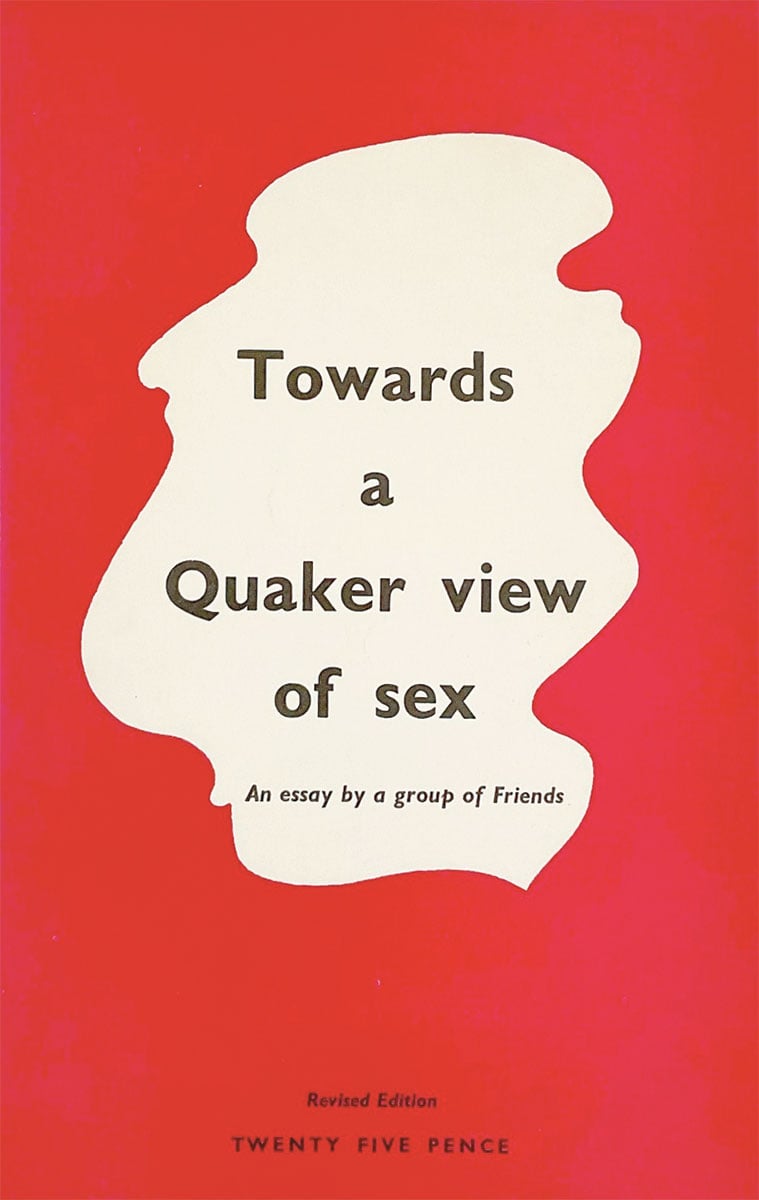
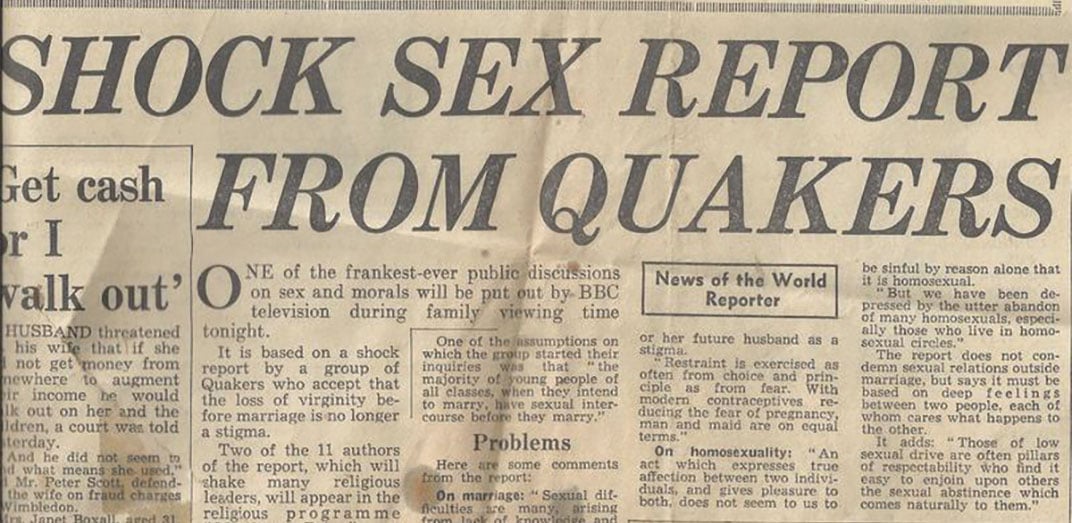
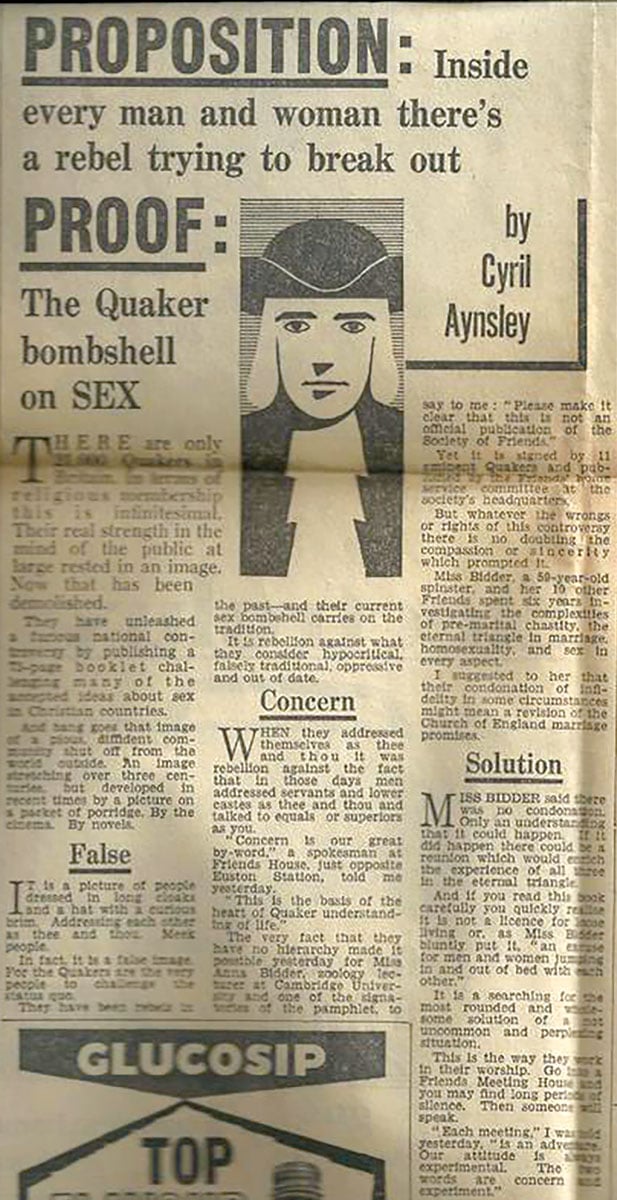
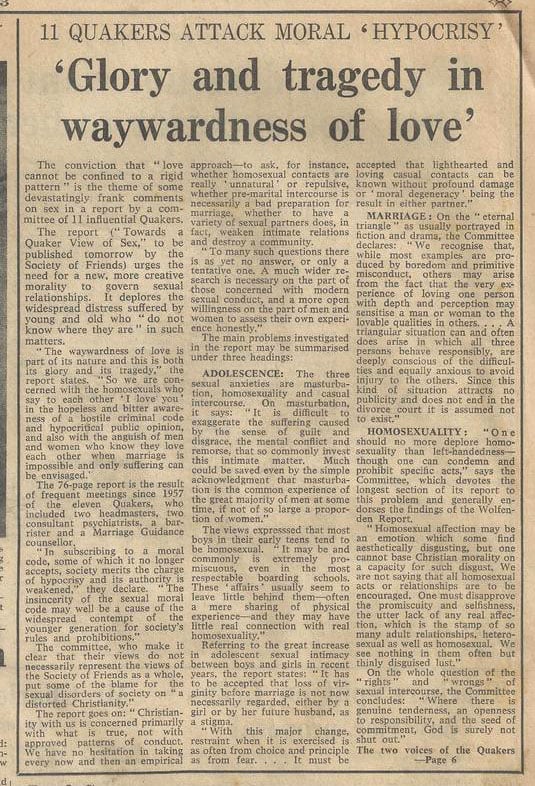
Some of the headlines from newspapers in response to Towards a Quaker View of Sex (1963), far left. Clockwise from top left: News of the World; Sunday Times; and Daily Express. All clippings from Keith Wedmore Papers, courtesy of TQVOS online exhibit.
The first place I looked for answers was in the Friends Historical Library at Swarthmore College. When I started my research at the library in 2022, I learned about a Quaker experiment in the late 1940s that helped thousands of men avoid jail time and a criminal record for their sexual encounters with other men. It was called the Civilian Readjustment Committee (CRC), and it was run by the Quaker Emergency Service (QES) from 1946 to 1951. The Quaker Emergency Service was an organization that operated in a manner similar to the American Friends Service Committee and the British Friends Service Council but on a more local level. It received special authorization by the New York Office of Civilian Defense to offer courses in first aid, home nursing, nutrition, recreation, and childcare, as well as to recruit conscientious objectors to work in hospitals and asylums. QES also provided legal counsel to conscientious objectors, operated three nurseries in Harlem, and funded a mobile clinic for ill and injured people in Syria and Lebanon.
The chairman of QES was Josiah P. Marvel. Marvel was a remarkable Friend, someone we should speak about in the same breadth alongside other Quaker luminaries like Benjamin Lay, Lucretia Mott, John Woolman, and Elizabeth Fry. Marvel was born into a Quaker family in Indiana and was a graduate of Earlham College. Before World War II, he served as the assistant director of the Brooklyn Museum, where he helped produce the first exhibition of Pablo Picasso’s work in America and the first performance of a ballet in an American museum.
To help fund QES, Marvel hosted exhibitions of great artists such as Eugène Delacroix and Paul Cézanne. He also collaborated with fashion designer Elsa Schiaparelli to create anti-venereal-disease posters and helped Margaret Sanger establish the first birth control clinic in the United States. While working for American Friends Service Committee in Paris, he was the only social worker allowed into Gestapo prisons, where he brought food and medical supplies to prisoners. He also arranged to have Belgian families receive life-saving provisions during the British coastal blockade. He established medical services in internment camps for British civilians and Jews, and he handled funds in France for the Jewish Joint Distribution Committee.
After the war ended, Marvel and QES leadership looked for different projects, and the Civilian Readjustment Committee was one of them. It was the first of its kind, an experiment forged out of a cooperative agreement between the Magistrates Court of New York City and QES. It was designed to assuage the practice of sentencing people to conscripted labor or prison for violating Penal Law 722, section 8, a city ordinance against “degenerate disorderly conduct.” In the 1940s and 1950s, thousands of men, known as “D.C. 8’ers,” were arrested by plainclothes officers running sting operations in places where men were known to cruise for sex. In 1925, officials estimated that between 100 and 200 men were arrested annually for violating the ordinance. This number ballooned to around 750 arrests per year when World War I ended. Shortly after World War II, some officials estimated that the number of arrests for disorderly conduct stood at over 2,000. By 1948, that number would rise to 3,289 arrests.
During this period about 15 to 20 percent of men caught for having or soliciting sex with other men in New York City were treated by psychiatrists at “the little Quaker clinic,” rather than being sent to labor work camps or jail. With the CRC clinic, Quakers established what historian Hugh Ryan has coined as “the first and only alternative to sentencing programs for men arrested for their sexuality in the United States.”
The CRC had its first operation at a Quaker meetinghouse at East 20th Street (the structure has since been sold). The agreement that the courts had with the Quakers worked like this: the Magistrates Court would send D.C. 8’ers to the Quaker meetinghouse for examination. Offenders would be screened by a psychiatrist and a report sent to the Magistrates Court before sentencing by a judge. Most sentences included ongoing visits with a psychiatrist at the clinic. Counseling provided by a Catholic priest, a Protestant minister, or a rabbi was sometimes recommended. The staff at the clinic didn’t categorize a patient’s sexual identity as homosexual, bisexual, or otherwise, but rather sought to help men manage what they perceived as a psychological compulsion to seek sex with other men in public spaces.
From today’s point of view, one may wonder if the clinic was operating in a manner similar to the ex-gay therapies we know today. My interpretation is that they were not. The clinic was intentional about not prescribing a cure for homosexuality, nor did they talk about homosexuality as sin. Furthermore, the clinic’s staff (including an openly gay secretary) helped patients with employment, warned them against predatory lawyers, and even set them up on dates with one another!
In 1946, the staff at the clinic saw 441 patients and celebrated that only four were re-arrested that same year. A number of men came to the clinic voluntarily. The medical director of the Society for the Prevention of Crime wrote: “I am sure it does not partake of undue optimism to say that one day in the reasonably near future this type of service will be organically affiliated with the courts and will be publicly operated and maintained.”
Despite the abundance of praise, the clinic experienced operational dysfunction and financial challenges that kept its continued existence in constant jeopardy. To make matters worse, an article about the clinic in Collier’s magazine implied that the clinic was enabling criminal behavior, prompting QES leadership to fire all of the clinic’s staff. The CRC had not yet been in operation for a full two years. QES leadership hired new staff and relocated the clinic to East 53rd Street, a significant distance away from the Quaker meetinghouse and the Magistrates Court. The capacity of the clinic to handle a rising number of cases caused the clinic to spiral away from optimal efficiency and any semblance of therapeutic good.
Some improvements were made, but everything came to a halt in March 1951, when the chairman of Quaker Emergency Service, Josiah P. Marvel, was arrested for soliciting sex from an undercover police officer in a subway toilet. Within three weeks, the Magistrate’s Court stopped sending clients to the clinic, and a week after that the Quakers closed it forever. The New York Times praised the CRC in an article, “Quakers to Close Sex Case Clinic,” for serving over 15,000 people in its short period of existence.
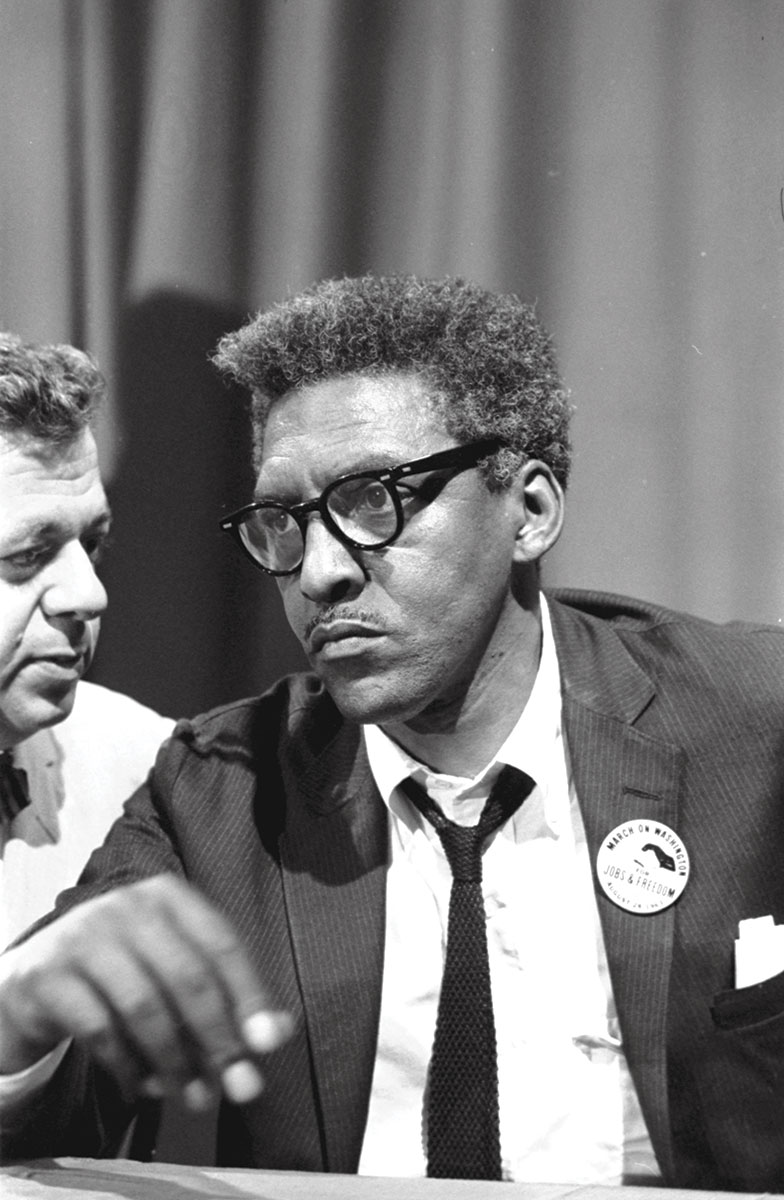
Marvel retreated to a vacation home in Vermont, and lived a relatively reclusive life for the remainder of his years. On July 26, 1959, he would tragically take his own life at the age of 63.
I wonder how Marvel’s story would have impacted me as a young queer Friend who was trying to better understand what lies at the confluence of his sexual identity and Quaker faith. During those early years of coming out, both as a Quaker and as a gay person, it would have been powerful to know about Marvel’s valiant efforts to create safety for gay men and protect them from harm, when others refused to do so. I’ve often wondered why Marvel is not more widely known among Friends. Were the circumstances of his arrest and his untimely death so shocking and humiliating that Friends successfully buried the tale of his courageous faith and actions?
The more research I conducted about Quaker contributions to the gay rights movement, the more stories about my queer Quaker ancestors emerged. I learned about Bayard Rustin’s refusal in the 1940s and 1950s to keep his sexuality a secret and the backlash he experienced from Friends. With the wind of resilience against his back as he endured the twin oppressions of racism and homophobia, Rustin’s openness about his sexuality needs to be honored as a form of gay rights activism. I learned about the portrayal of gay Quakers in Christopher Isherwood’s The World in the Evening (1953), including a Quaker character who was part of the first happy gay couple ever portrayed in an American novel. I discovered Friends like James B. Osgood (also known as Jim Bradford) and Bob Martin (also known as Stephen Donaldson), who were leaders of gay rights organizations in the late 1960s and early 1970s.
I learned that Quakers were present at the Stonewall uprising in 1969! The uprising, also known as the Stonewall riots, is commemorated as one of the most important events in the development of the gay rights movement, and the bartender at the Stonewall Inn told reporters that Quakers were there healing injured rioters.
In 1970, a year later, the organizers of the first gay pride parade invited Quakers to train them in nonviolent de-escalation tactics as preparation for police or bystanders who might respond with violence to a large-scale march of LGBTIAQ+ people. Quakers also participated in direct actions (known as “zaps”) organized by the Gay Activists Alliance. And Quaker yearly meetings and monthly meetings provided space for important gay rights organizations, such as the Mattachine Society, the Gay Activists Alliance, and the Eromin Center (a Philadelphia-based social service agency for LGBT people), when most landlords would not.
Part of becoming a more welcoming and affirming religious community for LGBTIAQ+ entails the retrieval of stories about Quaker resistance to homophobia. The next generation of LGBTIAQ+ Quakers needs to hear these stories, and it’s the responsibility of Friends to tell these stories around our campfires and create space for them on the bookshelves in our libraries. I look forward to a Quaker future where the stories of our queer Quaker ancestors and the allies who strove alongside them to create a better world for LGBTIAQ+ people are much better known.
We want to hear from you, not an AI! Please be thoughtful and use your own words. Comments on Friendsjournal.org may be used in the Forum of the print magazine and may be edited for length and clarity.