




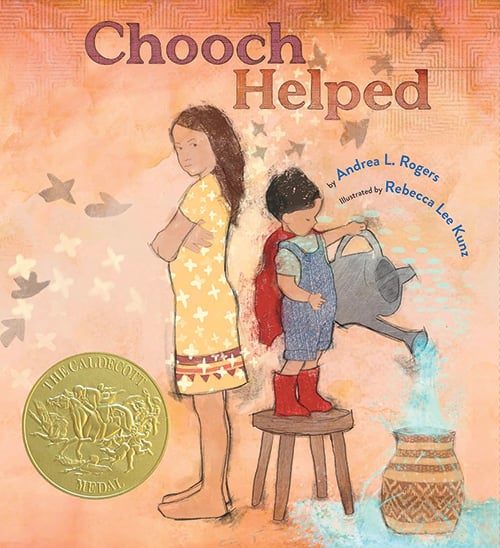
Chooch Helped
Reviewed by Katie Green
December 1, 2025
By Andrea L. Rogers, illustrated by Rebecca Lee Kunz. Levine Querido, 2024. 48 pages. $18.99/hardcover; $11.99/eBook. Recommended for ages 4–8.
This picture book presents a charming story of sibling rivalry in a present-day Cherokee family living in the United States. Both the author and the illustrator are citizens of the Cherokee Nation, and the book includes words and imagery from Cherokee language and culture.
The story is told from the older sibling Sissy’s point of view. Her younger brother, Chooch (a shortened form of the Cherokee word for boy or son, atsutsa, pronounced ah-choo-jah), has just had his second birthday. Like most two-year-olds, he is curious about everything and wants to be included in the family’s daily life. He tries to help many family members: painting a mural with Elisi (Cherokee for grandmother), sewing pucker-toe moccasins with Etsi (mother), making grape dumplings with Edutsi (uncle), and planting the garden with Etlogi (aunt). While Chooch is old enough to want to help in these household activities, he is too young to actually be helpful. Sissy watches him make a mess over and over.
Sissy loses her temper when Chooch ruins a clay pot that she’s making. Her parents tell her, “Shouting is no help!” When Chooch comforts her when she cries, Sissy realizes that Chooch can be helpful after all. The story ends with Sissy teaching Chooch how to make a clay pot. Sissy finds the joy of having a little brother.
There is a glossary in the appendix that provides translation and pronunciation of the Cherokee words used, along with a note about how the word changes according to the family relationship. There are also illustrated instructions for how to make your own pinch pot using air-dry clay.
Andrea Rogers’s author’s note provides the reader with cultural links to the story and the Cherokee experience, such as an explanation of grape dumplings, a Native American dessert made by boiling grape juice and dropping dough in it: “this is probably a dish that came into existence after the Trail of Tears,” Rogers writes, “as it uses flour—a food that was most widely introduced to Native Americans through government rations.” The artist, Rebecca Lee Kunz, explains the significance of some of the tribal symbols infused in her illustrations; we learn, for example, that Sissy’s dress is decorated with ribbons inspired by Cherokee ribbon skirts. The warm palette selection of reds, oranges, yellows, and browns emphasizes family love and the Native American connection to the natural world.
Earlier this year, Chooch Helped was awarded the 2025 Caldecott Medal for the most distinguished American picture book for children, bringing this lovely and deserving book to a much larger audience.
Katie Green is a member of Clearwater (Fla.) Meeting, Southeastern Yearly Meeting, and New England Yearly Meeting. She is a storyteller, an artist, a retired speech and language pathologist, and an activist for social justice issues.
Comments on Friendsjournal.org may be used in the Forum of the print magazine and may be edited for length and clarity.