




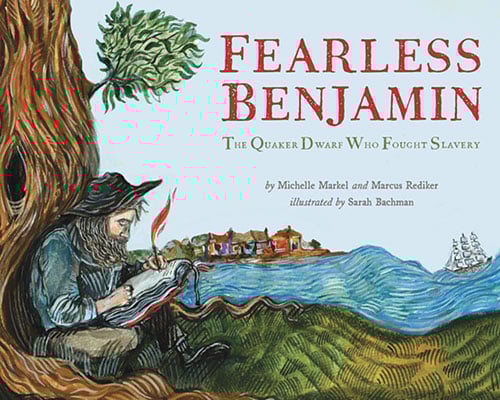
Fearless Benjamin: The Quaker Dwarf Who Fought Slavery
Reviewed by Eileen Redden and Gail Whiffen
December 1, 2025
By Michelle Markel and Marcus Rediker, illustrated by Sarah Bachman. PM Press, 2025. 32 pages. $19.95/hardcover; $9.95/eBook. Recommended for ages 4–8.
This illustrated biography for children is an interesting account of one fearless Quaker’s life and his demand for immediate abolition of slavery. Born in a small farming village in England, Benjamin Lay (1682–1759) became an early abolitionist largely due to his strong religious beliefs. “The lad is fiercely Quaker,” the opening spread reads, “he believes that all humans are born equal, that he should disobey wicked laws, and trust his heart to know what’s right.”
As a young man Benjamin leaves home and has many experiences that shape his convictions. He spends 12 years as a sailor, seeing the world and working alongside shipmates who swap stories and help each other survive: “In the wooden world, it’s ‘one and all.’” He and his wife, Sarah, also a Quaker, spend time in Barbados, where they first witness “the greatest wickedness in all the world. Slavery.” They are horrified at the practice, and Benjamin resolves to “get people to change their wrongful ways.”
He reads and studies ancient philosophers and early Quakers to learn how to effectively protest so the public would pay attention. He and Sarah sail to the Pennsylvania Colony and settle in the “City of Brotherly Love,” Philadelphia. But he soon discovers that “many of his fellow Quakers are enslavers! Some are respected leaders. . . . Benjamin’s fury could fill the Atlantic Ocean.”
Most Friends today know how the story ends: Benjamin’s statements and actions were considered radical, and he was disowned by Friends. Eventually, the Quakers decided to disown members who engaged in the slave trade. It took years, but thanks to activists like Lay, Quakers became the first religious group to ban slavery in their own ranks.
The folkart-inspired painted illustrations by Sarah Bachman feature dreamy brush strokes that draw the reader further into not only Benjamin’s life but the lives and perspectives of those he encounters: sailors, sugar planters, enslaved Africans, and Quakers. Benjamin Franklin is also referenced as the publisher of Lay’s “honest, furious, and courageous” book, All-Slave Keeper . . . Apostates, which greatly aided the abolitionist mission. Readers should be aware that there is a mention of suicide when later in his life Benjamin remembers and weeps for the enslaved people he met in Barbados, including a man “who killed himself because he was beaten.”
Historian Marcus Rediker, a coauthor of this book, seems to be on a quest to bring Lay’s inspiring story to the public in as many forms as possible. He earlier wrote for an adult audience The Fearless Benjamin Lay (2017), which is now available in paperback. He collaborated on a graphic novel, Prophet Against Slavery (2021), and cowrote a play, The Return of Benjamin Lay (2023). He has also given talks and appeared in documentary videos on the topic, including a 2024 QuakerSpeak video. It would be possible for everyone in a meeting to learn about this extraordinary man. And perhaps, that could be followed by a field trip by the community to a museum or exhibit related to slavery.
Eileen Redden attends meeting with the Lewes Worship Group in Lewes, Del. She serves as the young Friends book review editor for Friends Journal. Gail Whiffen is associate editor of Friends Journal.
Comments on Friendsjournal.org may be used in the Forum of the print magazine and may be edited for length and clarity.