




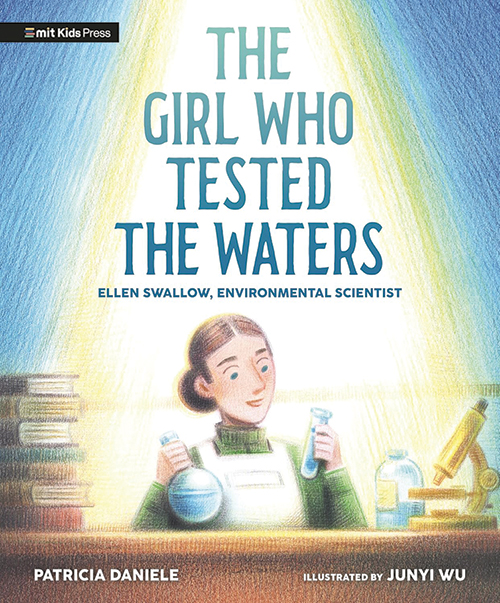
The Girl Who Tested the Waters: Ellen Swallow, Environmental Scientist
Reviewed by Laura Barrosse-Antle
December 1, 2025
By Patricia Daniele, illustrated by Junyi Wu. MIT Kids Press, 2025. 40 pages. $18.99/hardcover or eBook. Recommended for ages 5–8.
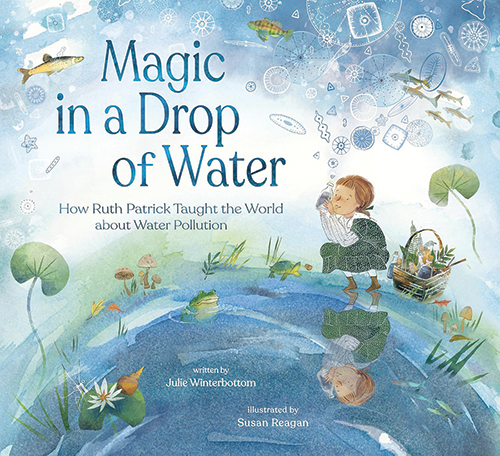
Magic in a Drop of Water: How Ruth Patrick Taught the World About Water Pollution
By Julie Winterbottom, illustrated by Susan Reagan. Rocky Pond Books, 2025. 48 pages. $19.99/hardcover; $11.99/eBook. Recommended for ages 6–9.
Ellen Swallow (1842–1911) and Ruth Patrick (1907–2013) were environmental scientists and pioneers in their fields, and, if you’re like me, you probably never heard of them. Two new books bring these women’s stories to life for the next generation of young scientists: highlighting curiosity, insight, perseverance, and passion for making the world a better place.
Ellen Swallow was the first woman admitted to MIT and was segregated from her male peers for over a year, studying in a basement with lessons slipped under the door for her to complete. Patricia Daniele chronicles Swallow’s childhood education and career with an emphasis on Swallow’s dedication to using science to understand and improve the world around her. In addition to breaking barriers as a woman first studying and then pursuing a career in chemistry, Swallow is notable for completing the first large-scale study of water sources around Boston, Mass., in the 1870s, ultimately helping to establish the first water quality standards in the United States.
The Girl Who Tested the Waters is meant to be read aloud, rich with alliteration and onomatopoeia as well as figurative language playing on Swallow’s name. (She “arrived in the world in 1842, tiny as a bird, with lungs that could hardly pump air.”) Textured illustrations in colored pencil by Junyi Wu help young readers visualize pivotal moments in Swallow’s life.
Magic in a Drop of Water is less biographical and focuses more on ecologist Ruth Patrick’s joy of discovery and the way she thought about the process of science than on the details of her education and career. Patrick “fell in love with pond scum” at a young age and went on to study pollution and biodiversity with a focus on diatoms: ubiquitous single-celled organisms with beautiful crystalline shells that are very sensitive to their environments. As a scientist myself, I loved how Julie Winterbottom described Patrick’s curiosity and scientific problem solving. Winterbottom’s framing of scientific discoveries as stories within the overarching narrative of Patrick’s life is engaging and accessible to young and old readers alike.
While both books emphasize wonder and curiosity, Magic in a Drop of Water is particularly successful in communicating these themes, due in part to the large-scale watercolors by Susan Reagan. Patrick’s first sight of diatoms, for example, is laid out in a zoomed-in illustration spread over two pages, as if we’re also looking through the microscope: “Jewel-like shapes glided to and fro, ovals made of beads, circles filled with pearls, shimmering stars and lacy triangles.” The reader is invited to wonder, as Patrick does, “What [are] these beautiful gems?”
Both women faced discrimination as women breaking into predominantly male-dominated fields. Swallow’s admission to MIT was known within the institution as “the Swallow Experiment,” one that was expected to fail. While Patrick benefited from entering higher education in the 1920s (she got to attend a women’s college) rather than in the 1860s, she worked without pay for over ten years to pursue her chosen career. Gender inequality is a main focus in the text of The Girl Who Tested the Waters, while Magic in a Drop of Water waits until the postscript to detail the barriers Patrick encountered.
Friends will appreciate both books’ focus on stewardship and community. The Girl Who Tested the Waters ends with a quote from Swallow proclaiming the importance of individuals living “in harmony with their environment—defined first as the family, then with the community, then with the world and its resources.” In Magic in a Drop of Water, Patrick’s groundbreaking work on biodiversity as a measure of the health of the ecosystem is presented in terms of getting to know aquatic communities. To understand pollution, “she had to listen to all of them. Not just one voice, but the whole chorus of water dwellers.”
I strongly recommend both books; they both deserve a place of pride on the shelves of the young Friends and scientists in your life.
Laura Barrosse-Antle lives in Washington, D.C., where she has been a chemistry teacher at Sidwell Friends School for 14 years. She is the proud aunt to one curious scientist-in-training.
Comments on Friendsjournal.org may be used in the Forum of the print magazine and may be edited for length and clarity.