



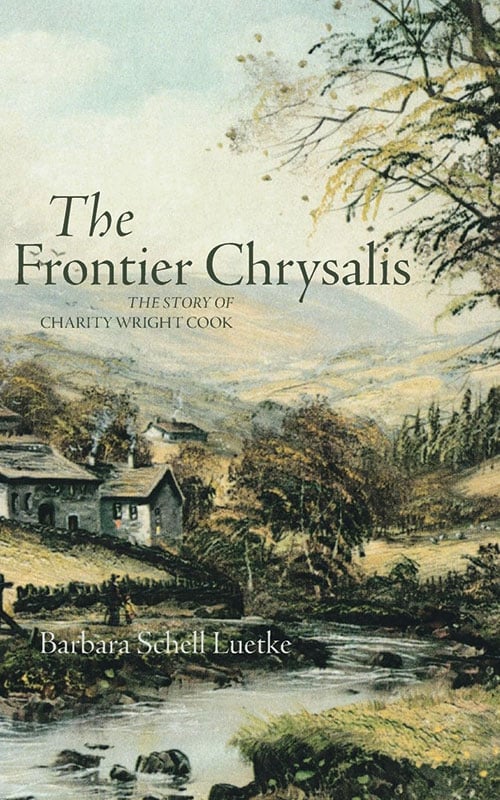
The Frontier Chrysalis: The Story of Charity Wright Cook
Reviewed by Gwen Gosney Erickson
February 1, 2026
By Barbara Schell Luetke. Barclay Press, 2025. 472 pages. $30/paperback.
Charity Wright Cook (1745–1822), a Quaker minister who was based in the Southeastern United States but known internationally through her travels in the ministry, left behind very little tangible evidence. Historian Algie I. Newlin impressively wove together an account of her life in his 1981 biography, Charity Cook: A Liberated Woman. A fictional portrayal of Cook’s lived experience, as we find in Barbara Schell Luetke’s The Frontier Chrysalis, provides space for imagination and inclusion of people and incidents beyond those verified in limited document sources. With creative license, Luetke brings more detail of daily life, expanded Quaker connections, and added characters to connect the lived experiences of an inspiring Friend to new audiences.
While set in the eighteenth century, the themes explored and challenges encountered are relevant today: sexual violence, community dissension, spiritual leadings, and careful discernment. Charity’s family and community include prominent women ministers who balance raising their families and supporting the needs of their local meeting with wider public ministry. There are strong personalities, power dynamics, and seasons of doubt to contend with as well as struggles arising from national and regional political conflicts.
Friends of the Carolina backcountry are woven together with better known eighteenth-century Quakers who the real Charity may or may not have encountered (such as John Woolman and Catherine Payton) and fictional additions that were unlikely but still possible personalities in her life (Black sisters of the heart, including one who is Deaf and communicates with sign language). As is today, there is tension and hesitation regarding the inclusion (or lack thereof) of those who are not white or who may be differently abled. While characters speak openly about injustices in ways that show a wide range of opinion and sometimes impressive awareness, the book illustrates the fear and lack of knowledge Friends on the frontier often had for Native Americans.
Charity Cook’s life story is an appropriate follow-up to Luetke’s first novel, The Kendal Sparrow: A Novel of Elizabeth Fletcher (2019). Both present the underknown lives and ministry of real Quaker women and connect them to better known Friends of their eras to engage modern readers with Quaker history. Luetke includes additional sections at the end that provide biographies, reference sources, and a detailed timeline that delineates fact from fiction. There is also a glossary of Quaker terms at the beginning of the book.
The Frontier Chrysalis humanizes Cook’s life and the timeless challenges she faced. The story is engaging and a good book club selection for those who enjoy novels grounded in a Quaker context. Those seeking a more concise biography are well served by the newly updated 2025 reprint of Newlin’s earlier history, which remains a compelling and complimentary read. Whether told as fact or fiction, Charity Cook’s life is one worth knowing, and it provides lessons and opportunities for deeper reflection today.
Gwen Gosney Erickson is the Quaker archivist at Guilford College in Greensboro, N.C., where she first encountered Charity Cook in the writings and papers of Algie Newlin 30 years ago.

1 thought on “The Frontier Chrysalis: The Story of Charity Wright Cook”
Leave a Reply
We want to hear from you, not an AI! Please be thoughtful and use your own words. Comments on Friendsjournal.org may be used in the Forum of the print magazine and may be edited for length and clarity.
Friends, if your group is interested, I am happy to zoom in for a discussion about the facts in my two historical Quaker novels, the writing process, and grants that might support your own writing. You can find me on Facebook or can obtain my contact information from Friends journal.