



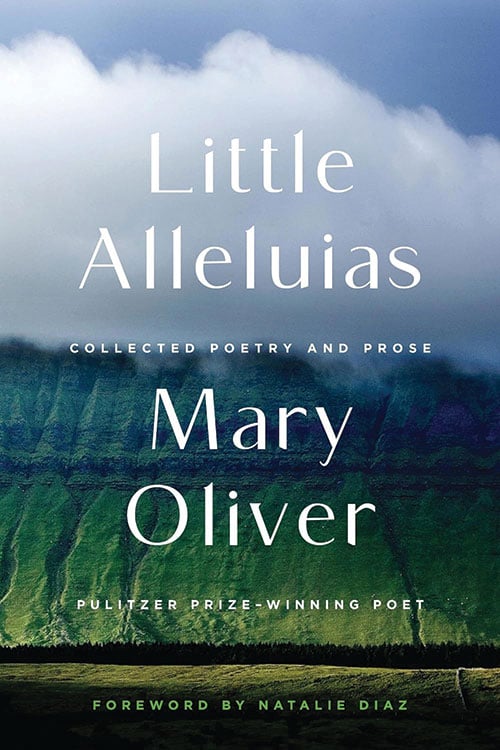
Little Alleluias: Collected Poetry and Prose
Reviewed by Bob Dixon-Kolar
February 1, 2026
By Mary Oliver. Grand Central Publishing, 2025. 208 pages. $23.99/paperback; $12.99/ebook.
The poetry of the late Mary Oliver (1935–2019) will always have many grateful, enthusiastic readers. Little Alleluias brings together three of her books that were published in the first decade of the twenty-first century: The Leaf and the Cloud, a book-length poem; What Do We Know, a collection of 40 poems and prose poems; and Long Life, a work that comprises many of her personal and literary essays. In a lovely foreword, fellow Pulitzer Prize-winning poet Natalie Diaz calls Little Alleluias a “trinity of works.”
That apt label has both a numerical and a symbolic sense. Yes, this book is three books in one, but more significantly, the three modes in which Oliver writes—the lyric poem, the prose essay, and that hybrid form known as the prose poem—together express her one abiding vision: this world that enraptures our mind and senses calls for response. Oliver asks: “What does it mean, say the words, that the earth is so beautiful? And what shall I do about it? What is the gift that I should bring to the world?”
In a verse from “Work” (in The Leaf and the Cloud), Oliver writes:
I am a woman sixty years old and of no special courage.
Everyday—a little conversation with God, or his envoy the tall pine, or the grass-swimming cricket.
Everyday—I study the difference between water and stone.
Everyday—I stare at the world; I push the grass aside and stare at the world.
Note two ways of interpreting the word “everyday.” As it’s used in three successive lines, it seems to mean “every day,” as in daily. This interpretation fits with the public image of Oliver as a resolute inquirer who sets out every day to attend to nature. However, the word as spelled in this verse is “everyday,” which means ordinary. For the poet Oliver, nature’s everyday expressions are revelatory. Her local surroundings provide her with all the delights and mysteries that an alert, sensitive person could ask for. In her essay “Home,” she writes: “People say to me: wouldn’t you like to see Yosemite? The Bay of Fundy? The Brooks Range? I smile and answer, ‘Oh yes—sometime,’ and go off to my woods, my ponds, my sun-filled harbor.”
Nature is a source of wonder to Oliver but also a teacher and guide. In her essay “The Perfect Days,” she recounts an experience she had at the close of a forest walk:
[I]t was the most casual of moments, not mystical as the word is usually meant, for there was no vision, or anything extraordinary at all, but only a sudden awareness of the citizenry of all things within one world: leaves, dust, thrushes and finches, men and women. And yet it was a moment I have never forgotten, and upon which I have based many decisions in the years since.
Oliver realizes that she shares an identity with everything in creation. How this informs her moral choices is illustrated in my favorite poem included Little Alleluias: “Sometimes I Am Victorious and Even Beautiful.” The poem’s persona—surely Oliver herself—describes those times just before sunrise when she wades out into the “black water” of a pond to liberate turtles snared in traps set by some interloper. She tells how she hauls up the trap and looks in to find a turtle, thrashing and hissing. She “gazes into his pink throat,” observes his tongue wagging; she sees his eyes shining. She opens the trap and shakes out the turtle, who swims away. Then she closes the trap with “the heels of my boots” and tosses the trap aside, “wracked and useless.” The poem closes with a note of triumph: “and the pink sun rises and sees me, by the black water, / smiling, / washing my hands.” By her act of compassion, this poet who boasts “of no special courage” shows herself victorious and beautiful.
Nature might even have the power, suggests Oliver, to inspire goodness in others. About the attractive area of Massachusetts where she lives, she writes: “[T]here is always the hope and the chance that the astonishing natural beauty here will open the heart, of both tourist and resident, to a new striving after virtue; such immutable suggestive power the natural world has always had, and offers to each of us.”
Friends, if you have long loved Mary Oliver’s work but don’t own all of the separate publications that comprise Little Alleluias, I recommend this collection to you. Those who are not yet acquainted with Oliver’s poetry might want to start with her 1992 collection, New and Selected Poems, Volume One, which includes the poem that features her most treasured line: “Tell me, what is it you plan to do / with your one wild and precious life?”
Bob Dixon-Kolar is an emeritus professor of English at College of DuPage in Glen Ellyn, Ill. He and his family are members of Evanston (Ill.) Meeting.
We want to hear from you, not an AI! Please be thoughtful and use your own words. Comments on Friendsjournal.org may be used in the Forum of the print magazine and may be edited for length and clarity.