



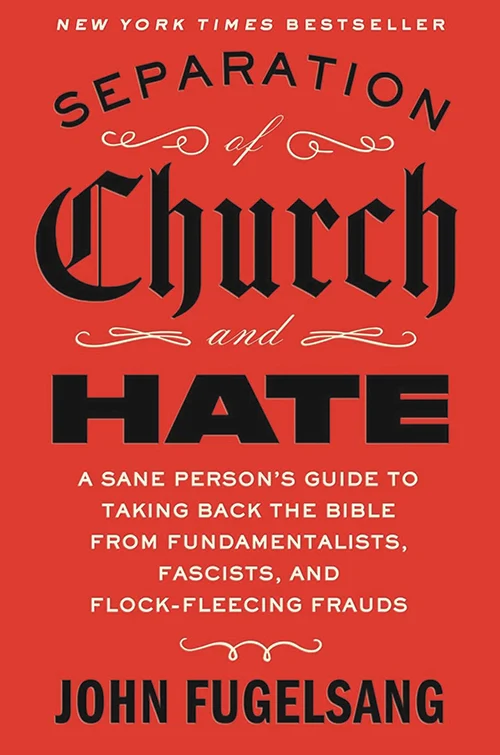
Separation of Church and Hate: A Sane Person’s Guide to Taking Back the Bible from Fundamentalists, Fascists, and Flock-Fleecing Frauds
Reviewed by Ron Hogan
March 1, 2026
By John Fugelsang. Avid Reader Press, 2025. 304 pages. $29.99/hardcover; $14.99/eBook.
“Jesus taught me the joy of calling out pious religious frauds,” John Fugelsang says, “and I’d like to show you how rewarding it can be.”
Fugelsang, the child of a former Catholic nun and a former Franciscan friar, had a strong religious upbringing on Long Island, N.Y.—Mass on holy days as well as every Sunday, “grace before every dinner and our prayers before bedtime.” But he was also taught the importance of nonviolence and social justice, of forgiveness and compassion. Coming of age in the 1980s, he saw the rise of Jerry Falwell’s Moral Majority and the rest of the religious right, and he did not recognize the faith on which he had been raised in their political campaigning. It frustrates him deeply that they’ve become a dominant force in American Christianity. “Modern right-wing Christians have been suckered into an anti-Christian trap of aligning with power, instead of challenging it,” he writes. “But conservative power was what Jesus stood up to—not for—time and time again.”
In Separation of Church and Hate, Fugelsang aims to defang contemporary Christian fundamentalism, particularly of the nationalist variety, by using the Bible against them—and the words of Jesus whenever possible. When right-wing Christians lean on Leviticus to justify their homophobia, for example, he points out all the other things Leviticus condemns that they haven’t renounced—then observes that the law became obsolete when Jesus ushered in a new covenant. (When they turn to Paul for support, he drily notes that Paul wasn’t Jesus.)
Whether he’s tackling broad problems like white supremacy and anti-feminism, or digging into the Christian nationalist take on issues like abortion, immigration, and gun control, Fugelsang sticks to a steady format. He lays out the right-wing position, cites whatever Scripture they might use to support it, and then meticulously explains what the Bible really has to say on the subject—which, in some cases, is nothing at all. He demonstrates a comfortable familiarity with the material, and is able to contextualize it in ways that give readers a deeper understanding of stories whose impact may have been dulled by repetition.
Take the Roman centurion who asks Jesus to heal his ailing servant, an incident reported in both Matthew and Luke. Fugelsang reminds us just how unlikely it would have been for a soldier of the empire that was occupying Judea by force to turn to “a homeless Jewish mystic faith healer” for help with one of his underlings, then invites us to consider that, in the original Greek of the gospels, that servant might have been referred to as “beloved,” adding layers of emotional (and possibly sexual) complexity to the familiar tale.
“I’m choosing to believe, by the way,” Fugelsang adds, “that someone has given this book to their angry right-wing stepdad, and this is the point he finally, disgustedly throws it across the room.” Lines like that, which draw upon Fugelsang’s sharply honed comedic skills, won’t just keep the reader engaged; they give his arguments a distinctive perspective. It’s one thing to call Jesus a martyr, quite another to describe him as “the most famous innocent brown-skinned man ever to be wrongly executed by the state[,] deliberately killed in the most painful and humiliating of ways.” Fugelsang maintains that intensity from start to finish, never giving an inch.
At the same time, he’s realistic about the cultural lay of the land. He acknowledges that, as much as Jesus came out against the death penalty, a majority of people in the United States, most of whom profess an active Christian faith, support state execution. (He does, however, wonder if they appreciate the irony of their position on Good Friday.) And he’s clear-eyed about what a book like Separation of Church and Hate can accomplish. “It’s not your job to deprogram a zealot,” he cautions. No amount of evidence is likely to sway the Christian nationalists from their zealous convictions. Instead, he focuses on “taking Christianity back from the haters,” and following “the only authentic path forward . . . reclaiming the essence of Jesus’s teachings—challenging systems of injustice, caring for the struggling, and embodying love in word, deed, and policy.”
Friends have a concise phrase for “embodying love in word, deed, and policy.” We call it “living testimony.” More than 350 years ago, the Quaker minister James Nayler invited people to “see if your Christ be the same that was from everlasting to everlasting, [or] changed according to the times.” For me, Separation of Church and Hate was a vivid reminder of what Friends—even those without an explicitly Christ-centered faith—are fighting the Lamb’s War for, as Fugelsang guides us toward heeding the summons of our Inward Teacher, whether or not we perceive that Spirit exactly as Nayler did.
Ron Hogan is the audience development specialist for Friends Publishing Corporation and webmaster for Quaker.org, where he writes a weekly message connecting Friends’ faith and practice to Scripture called Look to the Light. He is also the author of Our Endless and Proper Work.

4 thoughts on “Separation of Church and Hate: A Sane Person’s Guide to Taking Back the Bible from Fundamentalists, Fascists, and Flock-Fleecing Frauds”
Leave a Reply
We want to hear from you, not an AI! Please be thoughtful and use your own words. Comments on Friendsjournal.org may be used in the Forum of the print magazine and may be edited for length and clarity.
“I say: Love your enemies, do good to those who hate you, bless those who curse you, pray for those who mistreat you.” Luke 6:27-28.
The title of this book doesn’t quite sound in sync with this teaching.
Hell John, I just read the review and am considering buying the book, although funds are quite limited. I do think the title in perfectly in sync with the teaching you quoted (Luke 6:2728). Nowhere in the review or the title do I see an indication that the author “hates” anything at all. He has written a book to help true Christian’s focus on being Christ centered, not hateful of homosexuals, “outsiders” who are not like us — different colors, different places from which we all immigrated at some point (unless you happen to be Native American). I think the book will be like a roadmap to understanding how to keep our faith strong when we see others using Christ and the Bible to achieve power and control. I would hope you might read it, too, so that you can make an informed opinion about its contents.
What’s wrong with callng a fascist a fascist? It is not moral judgment, just a factual observation.
Buena hipótesis para desmontar tesis funsamentalistas que por desgracia tambien llegan a otros paises como España a través de RRSS y de pastores/presbíteros/ancianos provenientes de latinoamérica influenciados a su vez por las tendencias de EEUU.
Quizás por eso muchas personas se están alejando de este tipo de “iglesias” fundamentalistas buscando alternativas.
El título, coincido, es desafortunado.