



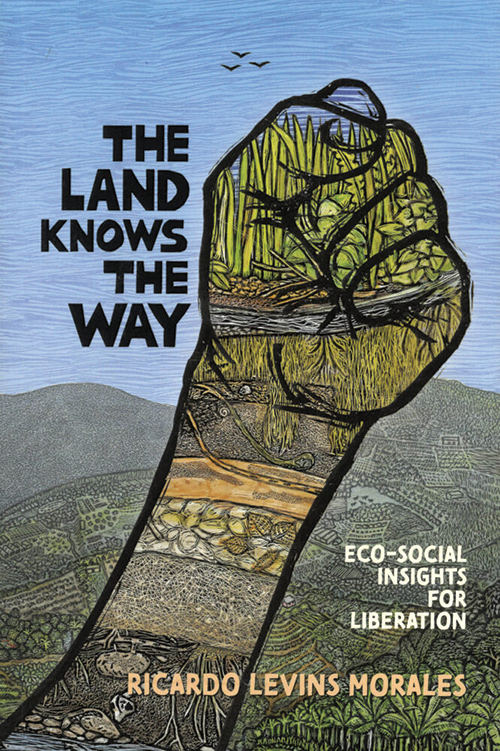
The Land Knows the Way: Eco-Social Insights for Liberation
Reviewed by Lauren Brownlee
April 1, 2026
By Ricardo Levins Morales. RLM Art Studio, 2025. 372 pages. $24/paperback; $12/eBook.
I first learned about The Land Knows the Way last summer when Ricardo Levins Morales gave a talk about his new book at Pendle Hill, the Quaker retreat and study center in Wallingford, Pa. I was moved to learn that Morales, an artist and organizer based in Minneapolis, Minn., wrote some of the book on Pendle Hill’s campus and considers himself to be part of Pendle Hill’s “strong social justice tradition,” which he also mentions in the book’s acknowledgements. I have long admired Morales’s justice-oriented art and was eager to read his reflections as a changemaker. Morales states that he has “written this book as if to introduce [readers] to an ecosystem” of “deep connection” in order to “reverse the life-destroying course that the guardians of greed have set for us.” I believe that he accomplishes his goal.
As the book’s subtitle suggests, Morales draws on nature, culture, and history in finding the way toward liberation. Most chapters have an ecological metaphor (with chapter titles such as “The soil is more important than the seeds,” “Life in the tide pools,” and “What the sweat wasp knows”) that translates to an organizing principle that can be used to help us work toward justice. Those lessons of nature are interwoven with different cultural principles and historical stories that paint a full picture of why each lesson matters.
His discussion of the journey toward liberation makes it clear that the work is intersectional in every way: we have much to learn from both nature and each other, and we are strongest together. He shares his thoughts about the power of movements coming together and encourages readers to recognize that no matter our different identities, “we’re still part of each other’s stories,” and “[w]ith a strong level of unity, [we] can weather crises of weakness or confusion until the damaged elements are restored to health.” The book reads like a tapestry with the thesis that we all, including Mother Nature, belong to each other—or as Quakers might say—that we are stewards of each other and the earth.
The book held important lessons for me. Although Morales and I are both passionate about social justice, he is more radical than I am. He is very critical of the nonprofit industrial complex in which I work and serve. Early in the book, he shares his belief that as nonprofits work toward reform, “[t]he improvements they seek are real” but that our organizations “are programmed to self-destruct if they come too close to addressing the real machinery of power, exposing the real causes of widespread suffering, or proposing a radically different social system.”
That kind of critique made me uncomfortable at first, but as I read on, I discovered that my discomfort was the discomfort of growth as I took in a perspective so different from my own. There was much in the book that did align with my worldview and experience, and so the differences served as a good reminder to keep an open mind and not shut down when I am challenged. That lesson goes back to Morales’s core message of genuinely working to understand and recognize the light in each other, even and especially when we are different. He invites us to be transformed by each other.
I have been genuinely transformed by this beautiful book and the powerful stories it contains. The Land Knows the Way invites us to look to nature, history, and each other for insights into beloved community building. Morales makes it clear that we have what we need within us and around us to build a more harmonious future together.
Lauren Brownlee is a member of Bethesda (Md.) Meeting, where she serves on the Peace and Social Justice Committee. Lauren strives to work toward liberation through her work engagement with Friends Committee on National Legislation, American Friends Service Committee, Quaker Coalition for Uprooting Racism, Quaker Call to Action, and Quakers for Peace in Palestine and Israel.
We want to hear from you, not an AI! Please be thoughtful and use your own words. Comments on Friendsjournal.org may be used in the Forum of the print magazine and may be edited for length and clarity.