



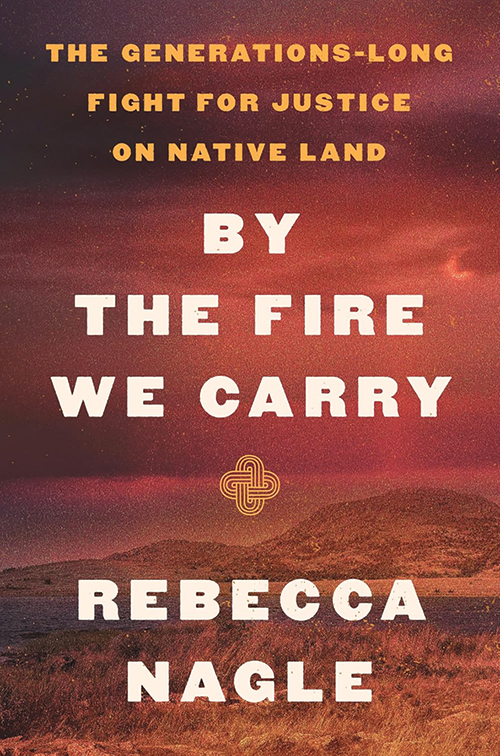
By the Fire We Carry: The Generations-Long Fight for Justice on Native Land
Reviewed by Alicia McBride
April 1, 2026
By Rebecca Nagle. Harper, 2024. 352 pages. $32/hardcover; $19.99/paperback; $9.99/eBook.
Civil rights activist Ella Baker observed, “In order to see where we are going, we not only must remember where we have been, but we must understand where we have been.” In By the Fire We Carry, Rebecca Nagle helps us gain both knowledge and understanding to steer us toward a more just future.
Weaving together history, family and personal narrative, and legal analysis, Nagle tells a story that is vital for us to remember about Native peoples’ quest for recognition and sovereignty. She also helps us understand important truths about doing this work within the U.S. democratic and legal systems. She writes: “The lesson . . . is not that when the law is on our side and we fight hard, justice prevails. The lesson is that although justice for Indigenous nations is rare, in our democracy, it is possible.” This possibility leaves space for hope.
Nagle builds this story by recounting the experiences of the Muscogee and Cherokee people in what is now the United States. Alternating chapters tell of Nagle’s Cherokee ancestors who were forced into exile on reservations and of the 2020 Supreme Court case McGirt v. Oklahoma, which resulted in the largest restoration of tribal land in U.S. history.
Nagle focuses on particular peoples’ experiences, writing in a journalistic style that is both readable and memorable. In the modern timeline, she recounts the 1999 murder of George Jacobs by fellow Muscogee citizen Patrick Murphy and how this case became a vehicle to address Native sovereignty. In the historical narrative, Nagle describes how two of her ancestors, Major Ridge and his son John, resisted, learned from, and were part of negotiation with the U.S. government in an attempt to save Cherokee homeland and identity from ethnic cleansing.
Betrayal and failure of democratic principles are recurring themes. Nagle shows, over and over again, how the U.S. government has contradicted its own laws to take land, agency, and power from Native people. President Andrew Jackson faced no consequences for ignoring a 1832 Supreme Court ruling on Cherokee sovereignty. Systems of guardianship meant to protect have instead deprived Native people of money and resources. Federal laws clearly lay out a process to determine if a reservation still exists, yet courts often ignore those steps. Nagle is surprised when the Supreme Court follows the established process in the McGirt case.
Yet Nagle simultaneously shows how Native people have been resourceful in their resistance, using everything from the education meant to spread Christianity to the legal system established in the U.S. Constitution as tools to advance their cause. Their actions in the face of opposition and violence—with a hope but no promise of success—offer much to inspire Friends daunted by the prospects of working for justice in the United States today.
We can also learn from the nuances and contradictions of this narrative, which frequently employs words such as “complicated” and “tension.” Cherokees were victims of U.S. persecution and also held slaves. Patrick Murphy and Jimcy McGirt both committed awful crimes and were unfairly tried by the state of Oklahoma. I appreciate Nagle’s avoiding the flattening of complex human beings into either villains or heroes. We cannot ignore the places we fall short of our ideals, she suggests, but we also cannot wait on moral perfection to advance the cause of justice.
For Friends unfamiliar with what Nagle recounts, this book is an engaging way to correct an educational deficit. Equally important, however, is what those who are part of any justice work have to learn from Native peoples’ experiences. Indeed, this learning is one of the reasons Nagle wrote the book: “I believe the American public needs to understand that the legacy of colonization is not just a problem for Indigenous peoples, but a problem for our democracy.”
Nagle argues that the treatment of Native people, and the legal doctrines of federal Indian law, expose the contradictory desires of our Founding Fathers to create both a democracy and an empire. These dual impulses continue to affect us. Precedents established in the treatment of Native people and nations now underpin U.S. arguments for how we treat migrants, the people of Guam and Puerto Rico, so-called “terrorists,” and others living at the margins. Immigration enforcement and violence against people exercising their rights in U.S. cities are part of this same legacy.
By the Fire We Carry powerfully shows that past and present struggles for justice for all are interconnected. It is an invitation to remember what has come before, to understand how we have arrived at our present circumstances, and to join the generations-long fight for justice on the Native land that we all inhabit.
Alicia McBride is a member of Sandy Spring (Md.) Meeting, part of Baltimore Yearly Meeting, and lives in Takoma Park, Md. She works as the senior director for Quaker leadership at Friends Committee on National Legislation.

We want to hear from you, not an AI! Please be thoughtful and use your own words. Comments on Friendsjournal.org may be used in the Forum of the print magazine and may be edited for length and clarity.