



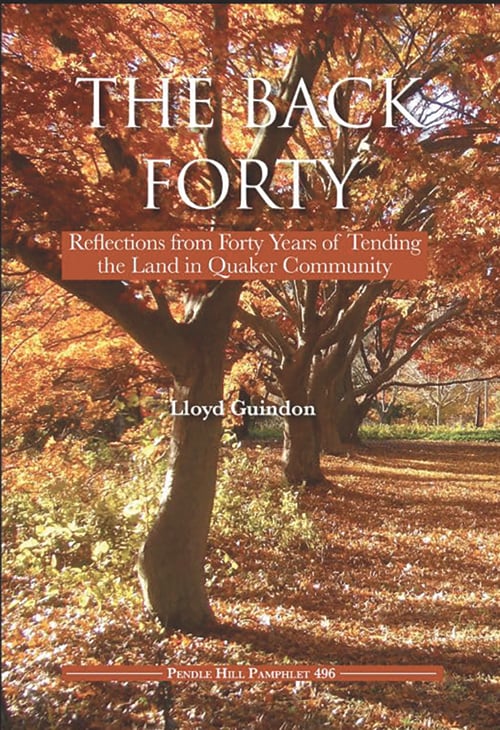
The Back Forty: Reflections from Forty Years of Tending the Land in Quaker Community
Reviewed by John Andrew Gallery
April 1, 2026
By Lloyd Guindon. Pendle Hill Pamphlets (number 496), 2025. 37 pages. $8.50/paperback or eBook.
In one of the reflections in The Back Forty, Lloyd Guindon describes how he once brought some random flowers to a mechanic who was fixing his truck. The normally taciturn mechanic was deeply moved as he had just learned that a close friend had died. Guindon describes this as an example of “everyday people bearing golden wings”: that is, unknowingly serving as God’s angels to bring love into the lives of others.
Guindon is one of those everyday people. “I’m a farmer’s son,” he says, and for the past 40 years, that origin has led him to be the grounds manager at Pendle Hill study center in Wallingford, Pa. In this pamphlet, he is once again bearing those golden wings, bringing an inspiring gift to us readers that reminds us, as Doug Gwyn says in his introduction, “that any moment and circumstance can become sacramental, if we’re paying attention.”
Guindon grew up at Olney Friends School where his Quaker parents worked. His father was the school’s farm manager, and his mother was a cook. He attended the school and became a member of Stillwater Meeting (Ohio Yearly Meeting Conservative) where he still holds his membership. In 1985, he and his wife moved to Pendle Hill when he became groundskeeper, a position brought to his attention by his friend Bill Taber. There they raised three children as Guindon maintained, improved, and learned from the land.
The eight short reflections—there are also several poems—provide glimpses into Guindon’s life and spiritual influences. One reflection, which was written for Thanksgiving, describes the many things he is grateful for, another on how baseball nurtured his relationship with others. Three reflections on Pendle Hill describe his creation of the perimeter path (which I have enjoyed walking), the creation of a garden area in memory of his father-in-law, and his participation in planting memorial trees.
In addition to the reflection on “golden wings,” two others stood out for me. While visiting Olney as an adult, he had a serious accident that left him hospitalized with facial fractures. One night, he was afraid he was going to die and was desperate for someone to be with him, but no one was available. A vision of Bill Taber standing beside his bed and the subsequent arrival of a candy striper volunteer who simply held his hand, got him through the night. “What became real to me in an experiential way,” he writes, “was how I experience God in the everyday actions of fellow humans.”
In the other reflection that stood out for me, he describes how as a boy he watched an older man sitting on the facing bench at Stillwater, nodding back-and-forth from sleep to wake while precariously propped up by his cane. Young Guindon sensed (with some degree of glee, I think) a coming disaster. But when the man’s motions suddenly sent him crashing to the floor on one knee, “he did not miss a beat,” as Guindon notes: he burst into vocal prayer immediately, as if his kneeling was deliberate and not accidental.
The poems primarily celebrate Guindon’s relationship with the natural world; the seasons of the year; and the beauty of leaves, snow, and sunrise. My favorite is “How Do I Love?” in which he refers to the earth, family, and himself (in the latter case, with Ben and Jerry’s Cherry Garcia and an ice pack on a strained hamstring from an attempt to capture lost youth).
Guindon ends his reflections with such inspiring words that I’ll let him speak for himself:
These mentors—the people, the animals, and the trees—have taught me to take time every day to drink in periods of silence and look for opportunities to support the silence. . . . They taught me to stop, to soak in the beauty around us—and to help create the beauty around us. . . . Most importantly, perhaps, they taught me to take seriously the Quaker concept of “that of God” in myself and others, and to grow it. Grow it to be a better friend, a better partner, a brighter light. Grow it to strive to be the candy striper, to be the slide into second base, to be the autumn fire on the tree. . . .
Get The Back Forty; read it. It will inspire you as it did me.
John Andrew Gallery lives in Philadelphia, Pa., where he attends Chestnut Hill Meeting, with frequent attendance via Zoom at Middletown Meeting in Lima, Pa. He is a frequent contributor to Friends Journal, and the author of four Pendle Hill pamphlets and two self-published spiritual books. Website: johnandrewgallery.com.
We want to hear from you, not an AI! Please be thoughtful and use your own words. Comments on Friendsjournal.org may be used in the Forum of the print magazine and may be edited for length and clarity.