




The Media Ministry of a New Generation of Friends
Since the arrival of the first workers as colporteurs (door-to-door peddlers of religious books and tracts) traveling throughout the territory of Guatemala, the movement of the Religious Society of Friends has continued to advance without stopping. We remember the first two young men, Thomas T. Kelly and Clark T. Buckley, who planted the first seeds of the gospel in the eastern lands. Their arrival in Chiquimula reminds us of the entry of the gospel into the city of Philippi, with the manifestation of the power of preaching to liberate, which led to imprisonment as narrated in Acts 16. The young Kelly and Buckley were likewise imprisoned, though later released to continue their evangelistic journey.

In the 123 years since the first Friends entered Guatemala, the church has gone through different stages in which God has borne fruit, shaped character, and allowed the advancement of the gospel. From its beginnings, the Friends Church was established in the northeastern region of the country, specifically in the city of Chiquimula, becoming a strategic training center from which the gospel spread to other regions, also reaching western Honduras and El Salvador. In the beginning, travel was done on muleback due to the lack of road access.
Soon the need for written materials became evident. Thus, the first printing press in the northeastern region of the country was established, where reports sent to the annual meeting that supported them were printed, as well as the first teaching booklets.
Since 1921, when the missionary Emma Burk Stanton had the vision to establish the Colegio Biblico (the Bible School), as it was first called, the training of workers for the abundant harvest has never ceased. In addition, primary and secondary schools have been established, where thousands of children and young people from all parts of the country have been educated. One of these is the Evangelical Friends School, with more than 100 years of uninterrupted education.

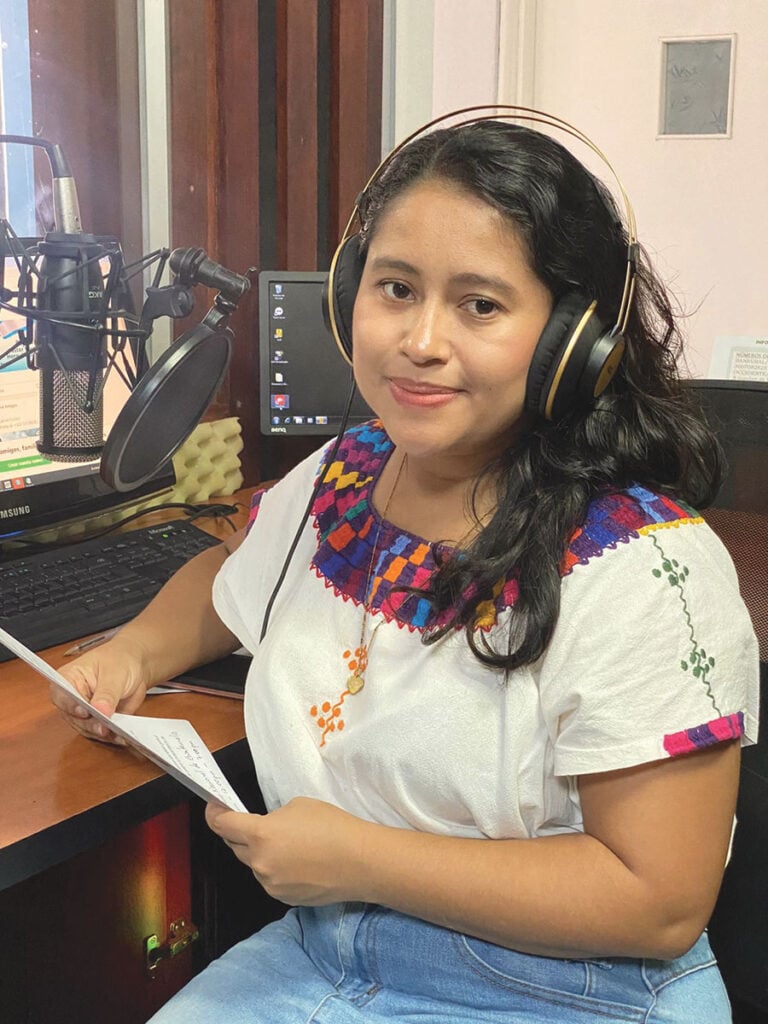
Zoila Hernández, director of Radio Cultural Amigos; Maritza Hernández, radio host at Radio Cultural Amigos.
The gospel has spread through families and individuals to such an extent that there are now believers, leaders, and workers from third and fourth generations who continue as faithful followers of Christ. I myself am a third-generation pastor in a family where my grandfather founded the monthly meeting in the village of Bethel, Gualán, Department of Zacapa, which he pastored until the day of his death.
My parents received the testimony of the gospel and died professing it. My mother was trained as a worker at Berea Seminary in the 1950s and served as a pastor for more than 30 years in the church my paternal grandfather had started. Her life influenced thousands because she had primary education (grades 1–6) and theological training. She was also trained as a health promoter and faithfully carried out this work in her home, caring for hundreds of people affected by malaria. My grandfather Benito Leiva believed in the gospel through the preaching of the young missionary Miss Ruth Esther Smith, one of the pioneering women God used to establish churches in Guatemala, Honduras, and El Salvador. Thus, we have a generational impact that has endured.
With the help of a generation of missionary men and women who came from Southern California as workers, teachers, church planters, and educators, the first generation of leaders in the northeastern region of the country was formed (Chiquimula, Zacapa, Izabal, Petén, and Guatemala City). It was not until the 1960s that the decision was made to start churches in the capital, due to respect for an agreement made with other pioneering denominations called the Reciprocal Pact, established in the early-twentieth century. Presbyterians, Central Americans, Nazarenes, and Friends divided the country in order to reach it with the good seed of the gospel. Since Friends were already working in the northeast, that region was assigned to them. We were the last to leave the assigned territory, which is why growth has been more concentrated in the northeastern region and along its borders with El Salvador and Honduras. Currently, we have about 280 monthly meetings and a population of approximately 13,000 to 14,000 in Guatemala alone, according to a verbal report at the 2025 yearly meeting session).
Friends have continued to advance, multiplying the means of preaching and teaching. The Friends School has more than a thousand students enrolled. Since the 1980s, Radio Cultural Amigos has expanded its efforts to strengthen its reach through programming. The first monthly meeting in the city of Chiquimula, El Tabernáculo, operates the channel Amigos TV, with daily programming that reaches thousands of households through cable providers in Guatemala. All available forms of media are being used to proclaim the gospel of the kingdom to all possible nations.

How is the Friends church today? There are several ways to answer this question, but I would like to address two of them. In the 1990s, the church began to understand that the evangelization of the world is a responsibility we must fulfill. This way of thinking about God’s mission came as a result of the congress known as COMIBAM ’87, where it was decided that Latin America would no longer be “a mission field but a missionary force.”
This vision sparked an emphasis that encouraged Friends in Guatemala to take responsibility for preaching the gospel from Guatemala to the ends of the earth. Until the 1990s, the church had shown great passion and commitment to local evangelism, resulting in the planting of many churches. But now a new emphasis was added: going beyond Guatemala to the rest of the world, from the local to the transcultural. We began by establishing churches in Nicaragua as a first effort. Currently, there are four organized churches there and several preaching fields for the establishment of new monthly meetings. This effort was carried out in partnership with Friends churches in El Salvador and Honduras.
After about five years of work in Nicaragua, it was decided to adopt the Khmer people in Cambodia, where the first family was sent in 2003, with additional families joining four years later. God has blessed the preaching, and two monthly meetings and several preaching fields have been established. The missionary consciousness continues to grow stronger, and we have moved beyond the stage of dependence on others to carry out the commission to all nations. This has taken about 25 years of work. This new missionary emphasis has led us to rethink the training of workers, as changes demand new tools. The question of a new generation of workers leads us to ask who the new sowers will be that God will raise up. The Lord of the harvest has told us that there are always fewer workers than needed, but there are always some whom God has prepared to gather the harvest in this new stage.

We have realized that the generation born 40 to 50 years ago is reaching the point of passing the baton to the next. Those of us who are stepping aside are concerned not only about the state of the church but also about the changes the world has undergone, which have affected the composition of the body of Christ everywhere, as well as society itself. We do not feel ready to let go of the plow handle, but there is no alternative; we must do so. A younger generation is preparing, whose leadership will assume this new stage. The outgoing generation must empower, affirm, and equip them. The rest will be done by God, who walks with His people, guiding their steps in this new phase.
Jesus told us that although the workers are few, there are always some whom God calls, and the church must prepare them so that the unchanging gospel may be carried by workers who are adaptable to generational changes in society and the church (Matthew 9:35–37).
This generation will have the task of taking what has been received, gained, and established, and working so that they may become agents of the necessary change in people’s lives. This is change that will significantly impact the social, local, and global environments.
I realize that I did not think this moment would come so quickly, but we continue to trust in the Lord’s redemptive plan, as He continues to write the story of His people. We are tempted to think that it will not be the same without us, yet we return to the One who has said: “Lord, You have been our dwelling place throughout all generations. . . . our life is like yesterday that has passed” (Psalm 90:1, 4, New International Version). The Lord’s people will continue in victory even in valleys of shadow and death, because God sustains those who trust in Him (Psalm 23:4).
Always be ready in Christ🏞️