



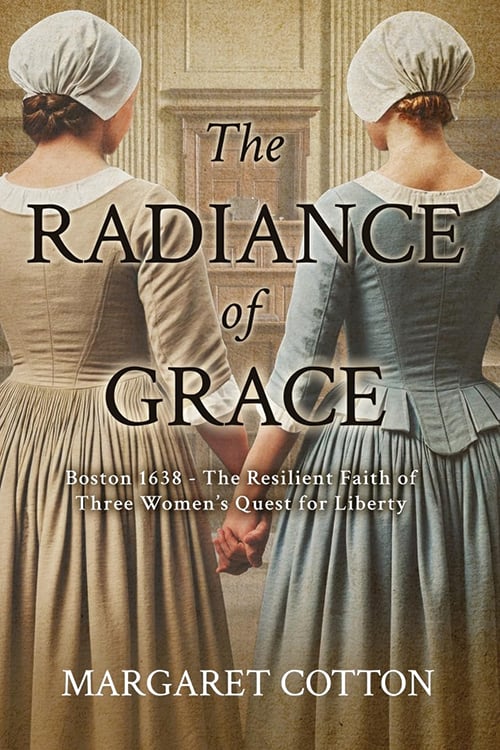
The Radiance of Grace
Reviewed by Diana Sacerio
June 1, 2026
By Margaret Cotton. Self-published, 2025. 344 pages. $31.99/hardcover; $19.99/paperback; $8.99/eBook.
The Radiance of Grace is a compelling and deeply researched historical novel that focuses on the struggles and tribulations of three women in Puritan Massachusetts. The author, Margaret Cotton, is a retired school teacher and wife of an Episcopal minister. In the author’s note at the end of the book, Cotton states that the novel is her “debut historical fiction” and that she is “starting at 0 to build support and awareness of the amazing women of The Radiance of Grace. They have been forgotten before. Let’s not let it happen again.”
The three “amazing women” are Marie Dyer, Anne Hutchinson, and Anne’s sister Katherine Scott. Marie (or Mary) Dyer is perhaps not such a forgotten name to those readers who have some knowledge of the early history of Quakerism. Dyer is, of course, one of the four Boston martyrs: Quakers executed in 1659, 1660, and 1661 for following the teachings of George Fox. (A statue of Dyer was erected in 1959 outside the Massachusetts State House.) Anne Hutchinson was a midwife, healer, and a spiritual leader in colonial Boston. Both she and her younger sister, Katherine, acted as mentors and spiritual guides to Marie Dyer when she first arrived from England in 1635.
The novel begins in October 1659 (when Marie Dyer is first sentenced to death, but following a reprieve of her sentence, she is banished from Massachusetts) and ends in June 1660 (when Marie returns to Boston, is sentenced a second time, and is executed by hanging). The intervening chapters take the reader back to Marie’s early years in England (1620–1634); her marriage to William Dyer; and the Dyers’ decision, given the religious tensions in England, to emigrate and sail to Massachusetts.
Their first experiences in Boston were positive. The Dyers were Puritans and were initially greeted with prayers and blessings by the Boston clergy. Marie is befriended by Anne Hutchinson and Katherine Scott, and she begins to attend the coventicles, or Bible study sessions, led by Anne. Anne believed that women could interpret the Bible as well as men, and she emphasized the importance of faith over good works: beliefs that contradicted rigid Puritan doctrines. She was tried in 1637 for heresy and banished to Rhode Island. Her dissenting views and independence of thought make her an early exemplary figure in this country’s quest for religious liberty.
The Radiance of Grace has a polyphonic structure; each chapter is narrated (in the first person) by a different character, allowing the reader to enter into the thoughts of Marie, Anne, and Katherine, along with other characters such as Marie’s husband and son. We become a witness to the spiritual journeys of each major character and the reactions of their family members. The chapters that are narrated from the point of view of Marie Dyer should be of particular interest to modern-day Quakers, since Dyer’s evolving ideas (during the 1630s and 1640s) about religious freedom, the separation of church and state, and direct revelation anticipate the beginning of the Quaker movement. Marie travels to England in 1652, meets George Fox and discovers a deep affinity between her beliefs and his teachings about simplicity, peace, and the Inner Light. She then returns to New England as a Friend, determined to share Quaker principles and to advocate for religious tolerance.
As a historical novel, The Radiance of Grace is replete with details about life in colonial New England. Some are quotidian (the herbs that are used to mend wounds or alleviate the pains of childbirth); others are more gruesome (the punishments inflicted on those who dissented from Puritan orthodoxy). In a reader’s note at the end of the novel, Cotton states that she researched journals and court records in order to ground the novel in factual events (i.e., the civil and church trials of Anne Hutchinson in 1637 and 1638 and the decision in 1658 by the General Court in Boston to impose the death penalty on any Quaker that returned to Massachusetts after being banished).
As a novel, a work of fiction, The Radiance of Grace is a powerful narrative in which historical facts have served as inspiration for the creation of complex and courageous characters. Friends are not likely to forget the stories of Anne Hutchinson; Katherine Scott; and most of all, Mary Dyer after they have been privy to their deepest thoughts on faith and freedom.
Diana Sacerio is a longtime attender at Haverford (Pa.) Meeting. She lives in Rosemont, Pa., and teaches Spanish at the Baldwin School in Bryn Mawr, Pa. She is an avid reader and lover of literature.

We want to hear from you, not an AI! Please be thoughtful and use your own words. Comments on Friendsjournal.org may be used in the Forum of the print magazine and may be edited for length and clarity.