



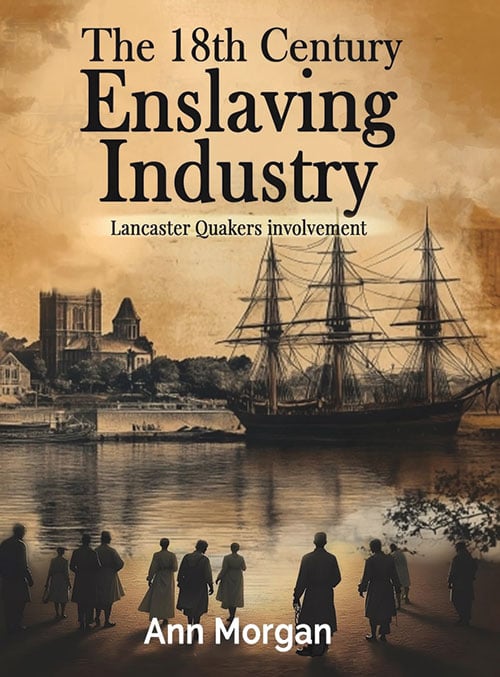
IN BRIEF: The 18th Century Enslaving Industry: Lancaster Quakers Involvement
Reviewed by Addi Schwieterman
June 1, 2026
By Ann Morgan. Self-published, 2025. 144 pages. $33.99/hardcover; $18.99/paperback; $10.99/eBook.
Ann Morgan, a Friend from Lancaster Meeting in England, had been researching Quakers’ involvement in slavery for about a year when, in August 2020, her meeting entered into discernment regarding how they might be led to witness in relation to that summer’s racial reckoning and rise of the Black Lives Matter movement. In a piece written for the Lancaster Black History Group, Morgan shares part of the minute passed that day: it declares they would “develop as clear a picture as is possible” of how Quakers in Lancaster benefited from the exploitation of enslaved people.
Morgan continued her research, tracing the lineage of prominent Quaker families to track how wealth accumulated from the labor of enslaved people. The result is the fascinating study The 18th Century Enslaving Industry: Lancaster Quakers involvement.
Morgan looks at five Quaker families who had ties to slavery: the Lawsons, Townsons, Dilworths, Satterthwaites, and Rawlinsons. Through marriage and business dealings, many of these families became interconnected over generations. Their involvement in enslavement ranged from selling goods produced by enslaved people to owning plantations in the Caribbean.
William Dilworth was deeply involved in Lancaster Meeting. In 1782, nearing old age, he asked to be released from his duties, but the meeting struggled to fill all the roles he had once filled. Despite his faithful dedication as a Quaker, Dilworth worked regularly to trade goods produced by enslaved people and was part owner of a ship that trafficked enslaved people from Barbados.
Lancaster Quakers’ involvement took place against the backdrop of London Yearly Meeting’s (LYM) increasing apprehension toward slavery. In 1727, a minute banning members from trading slaves was published. By 1783, LYM called for slavery to be abolished worldwide. Despite LYM’s continuous calls for the abolition of slavery, Lancaster Meeting never challenged or revoked membership of any of their members who were clearly participating in the enslavement industry.
This book meticulously documents the extent to which Lancaster Quakers were involved in enslavement despite their yearly meeting speaking against it. Morgan’s work is valuable in preserving an honest history of Quakers.
Addi Schwieterman is Quaker Voluntary Service Fellow (2025–2026) at Friends Journal.
We want to hear from you, not an AI! Please be thoughtful and use your own words. Comments on Friendsjournal.org may be used in the Forum of the print magazine and may be edited for length and clarity.