




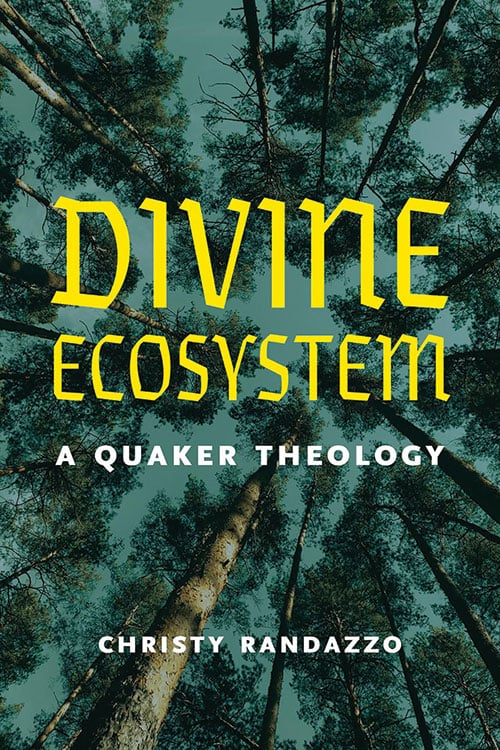
Divine Ecosystem: A Quaker Theology
Reviewed by Pamela Haines
August 1, 2026
By Christy Randazzo. Fortress Press, 2025. 320 pages. $47/paperback; $43.99/eBook.
Divine Ecosystem alerts us right from the start to the creativity of the author’s mind. The table of contents, sprinkled with the names of watersheds, is organized by ecological and theological pairs: Climate/Story; Bodies/Experience; Leaves/Interpretation; Flowers/Testimony; Fruits/Doctrine; Seeds/Hope. It turns out that the watersheds—mostly located in the Eastern United States, from the Chesapeake Bay down to the Alabama River—are where different parts of the book were written, a delightful way of grounding the text in place.
The purpose of this book, writes Quaker theologian, professor, and author Christy Randazzo, is to offer “one way of imagining a new world, a new state of being in the world.” This new way, according to Randazzo, is urgently needed in order “to heal the broken narratives of empire, power, and individual self-interest.”
Divine Ecosystem is both a personal exploration and theology, deeply rooted in Quakerism; informed by extensive scholarship; and full of history, current events, people, and connections. Water, trees, fungi, and electron clouds all have their place. Bayard Rustin, Elise Boulding, and Rufus Jones join early Quakers and other non-Quaker theologians in the text. Early Quakers’ enmeshment with the chattel slavery system is compared to our current enmeshment with the fossil fuel system.
Beginning with experience and ecosystems, rather than with the Bible or tradition, readers are offered a fresh take on theology. I loved how the section on leaves explores photosynthesis. Transforming light into the energy that life depends on gives new meaning to Friends’ practice of turning toward the Light as the ultimate source of power for our lives. Considering the beauty of flowers and the plainness of our meetinghouses, we are invited to reflect on how—when less distracted by surface ornament—we can more easily experience the beauty of light. Before leaving the flowers, we are reminded of how the pollen from Martin Luther King Jr.’s testimony fertilized the world with the life-affirming truth of his life.
As a non-theologian, I found many parts that were dense, where I had no experience to which the ideas could attach, especially in the chapter Fruits/Doctrine. But the final reflections in Seeds/Hope were deeply affirming. I loved Randazzo’s commitment to hope as theirs to claim, and the understanding that “[b]uilding community is our task, and hope is the main resource God has provided for us to fulfill it. . . . The church isn’t a place; it’s hope itself.”
I would recommend this book to Friends who are hungry for a long, deep, and serious exploration of theology, with a Quaker guide who is rooted in place, widely read, endlessly curious, creative in making fresh connections, and fearlessly their own self.
Pamela Haines, a member of Central Philadelphia (Pa.) Meeting, is passionate about the earth, relationships, integrity, paying attention, and repair of all kinds. She is the author of Money and Soul, three Pendle Hill pamphlets, and three volumes each of essays and poetry; her blog and podcast can be found at pamelahaines.substack.com.
1 thought on “Divine Ecosystem: A Quaker Theology”
Leave a Reply
We want to hear from you, not an AI! Please be thoughtful and use your own words. Comments on Friendsjournal.org may be used in the Forum of the print magazine and may be edited for length and clarity.
I am interested in Quaker ideas. As a Christian Anglican ✝️ I feel open to learning from other traditions. Only recently I met someone who is Quaker, different but so similar to my faith in many ways. BLESSINGS JB 🙏🏽