



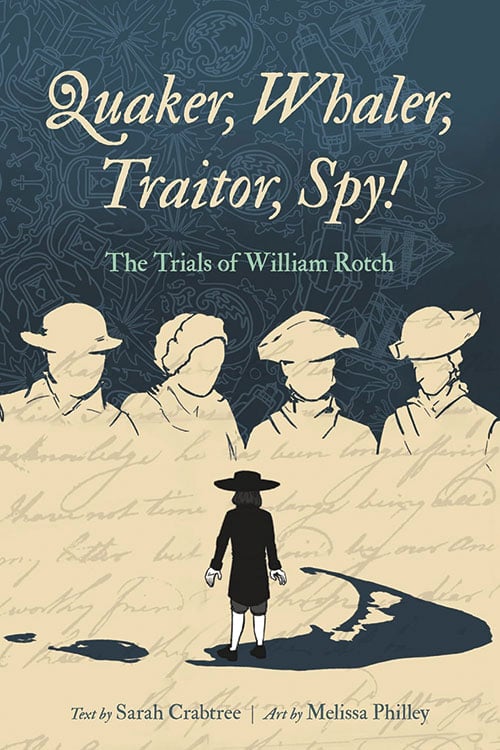
Quaker, Whaler, Traitor, Spy!: The Trials of William Rotch
Reviewed by Cameron McWhirter
September 1, 2026
By Sarah Crabtree, illustrated by Melissa Philley. Penn State University Press, 2026. 120 pages. $79.99/hardcover; $24.99/paperback; $19.99/eBook.
Historian Sarah Crabtree published a book in 2015 in which she explored how Quaker missionaries traveled from Europe across the Atlantic along trade routes to spread and adapt their faith. I reviewed her Holy Nation: The Transatlantic Quaker Ministry in an Age of Revolution (in FJ Sept. 2016), and I found it to be a carefully researched, well-written academic work. I’m used to hefty histories, and Holy Nation, at 304 pages, fit the bill. So I wasn’t sure what to make of her latest when I sat down to read a graphic history (a mere 91 pages of story) on the life of Quaker whaler William Rotch.
Quaker, Whaler, Traitor, Spy! is excellent. Crabtree could have done a service by simply turning the forgotten Rotch’s memoir into a briskly paced graphic history (with great art by Melissa Philley). She does that but then adds so much more, including inserting herself as an illustrated character to address her audience directly: “This is a story about how I was wrong,” she begins. History can be viewed from many perspectives, and many can be correct at the same time. As Crabtree seeks the truth about Rotch, she learns how elusive the “real story” can be.
I am reluctant to give away too much of the story, as that would reveal the book’s ingenious format. With twists and turns, the book raises fundamental questions about the nature of history, the motivation of early Quakers, and how more than one truth can exist simultaneously. Many Quaker testimonies—from George Fox, Thomas Ellwood, and many others—can be inspiring, but what really happened? How much do people gloss over their financial interests or self-motivation with the patina of religiosity? What if a person’s motivations are both self-serving and religious? Crabtree explores these themes in an intelligent way that works hard not to be judgmental or didactic.
The book is grounded in facts, heavily quoting from primary sources where possible (all listed in the endnotes), though Crabtree makes clear that her many years in archives hit limits: there is plenty she will never know about Rotch and his battles with various governments. In his own memoir, Rotch presented his life story as that of a beleaguered yet faithful Quaker, suffering for his beliefs at the hands of vindictive bureaucrats and ignorant mobs. At one point, she quotes Rotch’s memoir that officials were “playing with our lives as with a tennis ball.”
But as Crabtree makes clear, there is a lot more to the story. I really can’t go into it much more—it would be giving too much away. But read this clever, well-researched graphic history.
Cameron McWhirter is a journalist. He is coauthor of American Gun: The True Story of the AR-15 and the author of Red Summer: The Summer of 1919 and the Awakening of Black America. He is a member of Atlanta (Ga.) Meeting. He has served on the Board of Trustees of Friends Publishing Corporation, publisher of Friends Journal.

We want to hear from you, not an AI! Please be thoughtful and use your own words. Comments on Friendsjournal.org may be used in the Forum of the print magazine and may be edited for length and clarity.