





Discernment Mistakes to Avoid
A common query in Quaker circles asks: What is unique about Quakerism that makes you continue to choose it as your spiritual path? For us, the answer is the following: the way Quakers discern allows the revealing of Truth, which speaks to our condition. The word “Truth” is used here in the same sense as it was used by early Friends: divine authority that we can turn toward to guide our lives, and that is revealed to us through the Quaker way of discernment. This, we believe, is the genius of Quakerism.
Quaker Discernment and Testimony
Quakers discern by using a process that often includes clearness committees. We use them when we want to understand a leading or concern, become a member, or get married. Clearness committee members don’t tell us what to do but instead help us with our own discernment. They ask queries and let Truth work in us; they help us understand how we are led individually and help with any necessary commitment of support from the meeting.
Quaker discernment also takes place during worship, committee meetings, and worship on occasion of business. At these meetings, especially in worship on occasion of business, we try to get the sense of the meeting, which is the revealing of Truth that is coming through the entire group.
Paul Buckley, in his pamphlet Quaker Testimony: What We Witness to the World, states that for Friends, testimonies traditionally meant testifying about how Truth is affecting our lives: how we live our lives are our testimonies. In Baltimore Yearly Meeting’s Faith and Practice section on Quaker experience, Ben Pink Dandelion states: “We are transformed individually and collectively in order to become agents of transformation in the world.” So, if we attend worship regularly, and five years later we’re the same person, are we Quakers? Or is there something that actually changes us as we live the Quaker way?
We make discernment mistakes due to three things: our socialized mindsets, our fallibility as individuals, and our corporate groupthink.
Faulty Discernment and Failure to Follow Truth
If Quaker discernment leads to the revealing of Truth and living the Quaker way means following Truth, then why do Quakers make big mistakes, both individually and corporately? Quakers owned and traded enslaved persons, settled on lands stolen from Indigenous peoples, administered residential boarding schools for the forced assimilation of Indigenous children, and were instrumental in the creation of a prison system that included solitary confinement. We have benefited both individually and collectively from being part of the empires of England and the United States. Both are imperialistic and capitalistic countries that have histories of oppression and exploitation.
Why do we make big mistakes like these? We think mistakes are caused by faulty discernment and failure to follow the Truth that has been revealed to us.
We make discernment mistakes due to three things: our socialized mindsets, our fallibility as individuals, and our corporate groupthink.
First, we all have been socialized and assimilated into the dominant society where caste and class distinctions—such as being White, male, able-bodied, cisgender, Christian, and adult—are centered while everything else is marginalized. Many of us are not aware of the extent of our own socialization.
Many of us are assimilated into the middle-class way of living, with its comfort and predictability lulling us into a trance. For example, when we get in a car, we push a button or turn a key, and it starts. Many people don’t own a car, or they have one with a history of frequent breakdowns. Our expectation and entitlement of getting to where we want to be at a certain time is different from those who don’t own a reliable car. When we bring these dominant assumptions and socialized norms into Quaker worship on occasion of business, we expect to complete agenda items in short time frames. We don’t want the agenda to be interrupted even when harm occurs and the beloved community is fragmented.
Our straying from Truth is compounded by Quakers’ close association with higher education. The culture of higher education teaches us to listen for what we disagree with and then to defend our position. We learn logic and debate skills in college. We’re unaware that we have been socialized to defend our position instead of settling into the sense of the meeting as we seek Truth.
Second, we need community to discern Truth because as individuals we are sometimes misled and our discernment is faulty and fallible. Individually, we each have a will, an intellect, desires, and the ability to think, all of which can get in the way of discernment. We need to learn to use our will and intellect to support the implementation of Truth as it is revealed in our lives and community.
Our individual discernment is also fallible because each of us sees the world through lenses colored both by our lived experiences and our socialization. These lenses act like a veil, obstructing our understanding of Truth. We need each other to lift this veil so that we can see Truth more completely. “For our knowledge is imperfect and our prophesying is imperfect; but once perfection [we would say Truth] comes, all imperfect things will disappear” (Jerusalem Bible, 1 Cor. 13:9–10).
Third, Friends are vulnerable to groupthink. This is partly the result of the lack of diversity of life experiences in our meetings due to our demographics. In addition, Quaker spaces—like other spaces dominated by societal norms—often marginalize the needs and voices of those with diverse life experiences. As a result, although many Friends may have had firsthand experiences of marginalization at some point in our lives, we do not acknowledge them, because we want to fit into “the beloved Quaker community.” Sometimes, this assimilation submerges our own capacity to access or speak Truth through life experiences that are edgy. Truth is made more robust when all the different life experiences are fully in the room. Think about Benjamin Lay’s ministry against enslavement. If he had had a clearness committee, would they have been supportive of his ministry? Would there have been more Benjamin Lays if Friends were fully living their Truth? How has the lack of Black and Indigenous voices in the Religious Society of Friends affected Quaker discernment in actions concerning African Americans and Indigenous peoples?
Consider the Bantu African idea of ubuntu, often translated as “I am because we are.” Within the collective “we” is our true and complete humanity. We need each other to be whole: to be fully awake to the movement of the Spirit and the revealing of Truth. When we lack and marginalize diversity, our “we” is incomplete. When we discern with an incomplete community, our communal discernment is fallible, just like our discernment is fallible as individuals. We need to ask ourselves: who is our Quaker “we”? Who is fully in the circle, truly equal, with all of their lived experiences acknowledged, as we gather to discern how we are led as a community??
Besides making discernment mistakes, we also make mistakes because we fail to follow Truth that has been revealed to us. A big part of this failure to follow Truth has to do with livelihoods and vested interests getting in the way. For example, many of us in the United States are aware of the destructive power of our military–industrial complex, but we still invest in the stock market and pay federal income taxes that fund war. Sometimes this failure is a lifestyle choice. For example, many of us still travel for pleasure without regard for carbon pollution, even though we know that by doing so we are contributing to the climate crisis.
Living the Quaker way means following Truth that is revealed to us, both individually and corporately.
Avoid Discernment Mistakes: Embrace Diversity; Wake Up to Socialization
This mantra kept going through Diego’s mind in the morning of his 2023 Carey Lecture at Baltimore Yearly Meeting: You can’t do what you want until you know what you do. Then it changed to: You can do what you want once you know what you do.
Just as we need our spiritual community to help us discern Truth, we also need this community to nudge us along the path to follow Truth that is revealed to us. But what can we do to avoid making discernment mistakes?
First, we need to embrace ministries carried by Friends with diverse life experiences and levels of suffering: Friends who have been marginalized by the dominant society and have experienced harm firsthand. These lived experiences foster a unique awareness and understanding of Truth, which people living in privilege and comfort may grasp only intellectually. This privilege and comfort act as a veil that hides Truth. This veil can be lifted by Truth revealed through ministries informed by first-hand experiences of marginalization.
Ministries informed by firsthand experiences of marginalization can challenge the status quo, those dominant worldviews, practices, and unspoken norms that dominate today’s Quaker culture. When this Truth is spoken, we need to be aware of our fight/flight/freeze/appease reactions: feeling defensive, taking the ministry as a personal attack, focusing on our own discomfort, using Quaker process as an excuse for dismissing or objecting to the ministry, or correcting others’ statements. These reactions can lead to harm and the fragmentation of the beloved community. For example, Diego has a friend of African descent raised in the South who would at times say “Hallelujah” when deep ministry was given in worship. People in the meeting got shook up by this ministry and told this friend afterward that “Quakers don’t do that.” How is saying “Hallelujah” different from saying “this Friend speaks my mind”?
We have to differentiate what is core to Quakerism from the dominant societal norms that have been incorporated into our Quaker culture. When we’re feeling uncomfortable, we need to determine if it’s coming from the essence of Quakerism or something else. If we want our beloved community to be one in which diversity thrives and Truth prospers, we must be willing to move beyond our personal comfort zones. We need to become comfortable with being uncomfortable in the presence of revealed Truth.
The Religious Society of Friends has difficulty in attracting people that come from marginalized life experiences. It is also losing those who do come because of their experiences in our community. Many times we’re not even aware of their experiences. To understand the experience of harm, we need to make space to identify, address, and heal harm when it occurs. We need to adopt a process to identify fragmentation in the beloved community, and implement a process to address and heal harm when it occurs amongst us. To this end, the Racial Justice Subcommittee of Pacific Yearly Meeting’s Ministry Committee has put together the Sacred Space Process for identifying and healing harm, using “ouch, oops, and whoa” as the stepping stones. (See “Sacred Space” by Thistle Hofvendahl and Diego Navarro in the October 2022 issue of Friends Journal.) Other processes in use include Friends General Conference’s Guidelines for Addressing Racial Wounding and New England Yearly Meeting’s Noticing Patterns of Oppression and Faithfulness.
Second, we need to wake up to our socialized mindsets. Joseph Pickvance, a George Fox scholar, told Diego this story about George Fox. When Fox was an itinerant preacher, he would go into churches and speak after the sermon was over. Sometimes he would be thrown out of the churches. He’d get up off the ground and dust himself off. People would surround him, say he’d spoken to their condition, and asked how they could follow his teaching after he’d left their village. Fox gave them two instructions: first, sit in total silence for as long as it takes to feel the Spirit of Christ among you on First Day; second, at midweek, come together and share with each other how Truth is manifesting amongst you.
Early Quaker worship was an open-ended search for Truth and could last for hours. How is the revealing of Truth and the development of our sensitivity to Truth affected by limiting worship to a prescribed one-hour period? The idea of the midweek meeting was to communally become more attuned to society norms that weren’t aligned with Truth (such as tipping hats) and to bring their lives into greater alignment with Truth. What practices do we have today that are similar to these midweek gatherings to help us wake up from our socialization and come into alignment with Truth?
Besides the revival of midweek gatherings, there are other approaches to help us wake up from our nonalignment with Truth. We can do consciousness raising. One way to do that is contained in the concept of the Johari Window. This model breaks our self-knowledge into four windows, organized by what’s known and unknown to ourselves and to others. When our group interactions fall in the Blind Spot, we can unknowingly harm one another. When they fall in the Hidden Area, we miss the opportunity to deepen connections by disclosing one’s vulnerability.
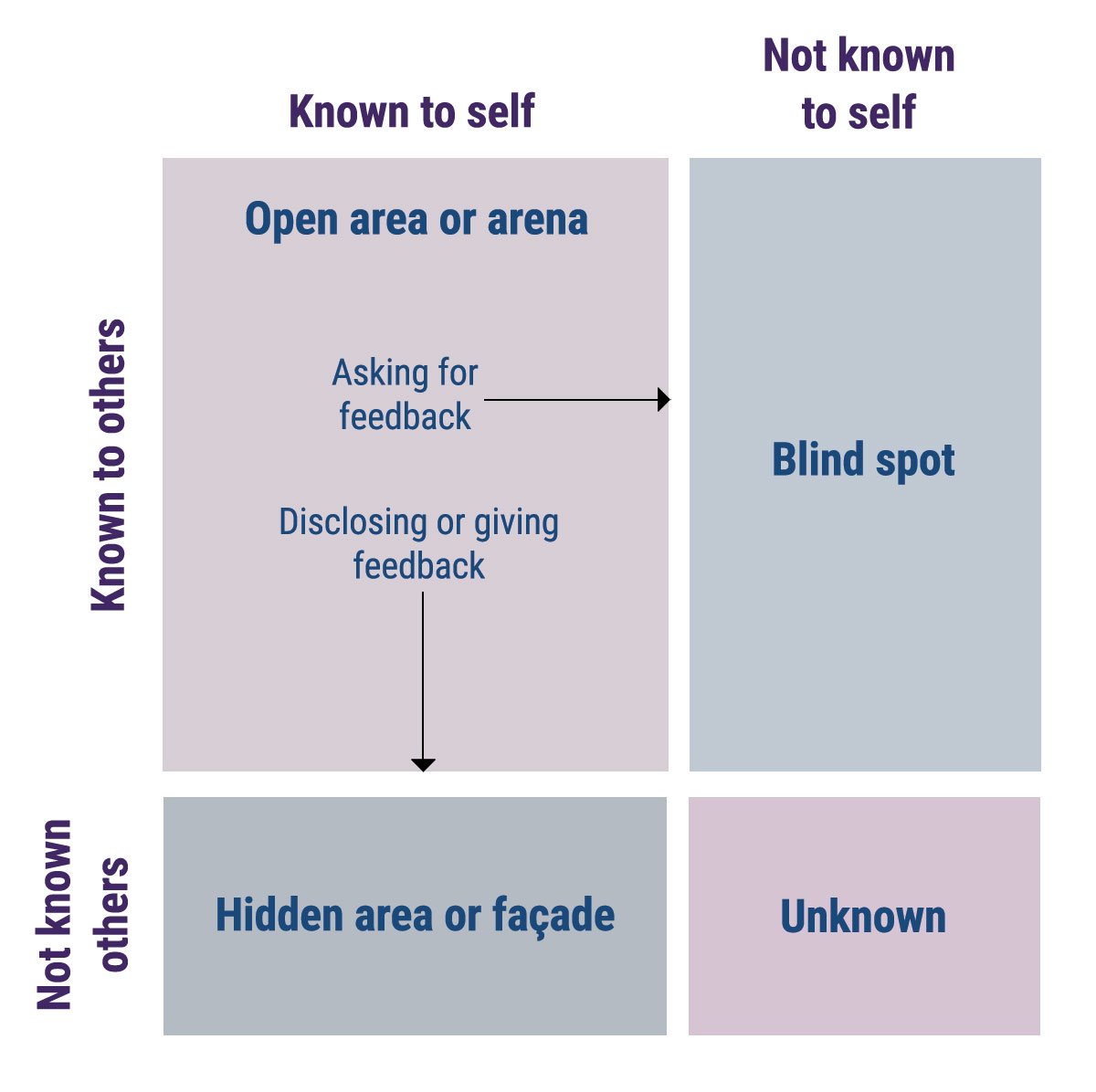
To raise our collective consciousness, we need to understand our blind spots and decrease our hidden areas. The way to accomplish this is to receive feedback, provide feedback, and hold each other accountable. The Sacred Space process and Noticing Patterns of Oppression and Faithfulness both have elements of consciousness raising aligned with this model.
Another way to help us wake up from our nonalignment with Truth is to develop body awareness. Our bodies don’t lie. They can give us biofeedback to Truth as we become more somatically sensitive. There are a number of somatic methodologies, psychotherapies, and mindfulness practices that we can use to help us become more sensitive to our bodies and what they are trying to tell us. For example, yoga practice can teach us to pay attention to breathing by relating our movements to our breath. In the Feldenkrais method, we can learn to rely on our skeletons to hold our weight against gravity and use our muscles to move us from one position to another.
Parting Thoughts
As Quakers, we believe our communal discernment can lead to the revealing of Truth. We know this process is not risk-free, and we have made many mistakes. To avoid making discernment mistakes, we need to wake up to our socialized mindsets, and foster a culture where diversity thrives and Truth prospers. Living the Quaker way means following Truth that is revealed to us, both individually and corporately.
Diego’s Carey Lecture ended with suggestions for further action, which can be found at tinyurl.com/FJ-TruthDiscernment.
Comments on Friendsjournal.org may be used in the Forum of the print magazine and may be edited for length and clarity.