



Connecting Spirit to Spirit as a Hospital Chaplain
If you knew I had been an interfaith hospital chaplain for 20 years, you might think I had an easy relationship with, and understanding of, prayer. But that wasn’t the case. As a youngster who attended church very rarely, I understood prayer to be what the minister did with his eyes closed and head down during church services. It was never clear to me whether God was listening, and, if I’m honest, I wasn’t even sure who God was. Early on, I understood that prayer was something you didn’t want anyone doing for you. I couldn’t tell you why I believed that; I just knew it as one of the truest things in my family. And, except for the briefest pause before holiday dinners to express gratitude for relatives gathered from distant places, our family didn’t pray. I knew the childhood prayer “Now I lay me down to sleep,” but instead of giving me comfort, it made me afraid of dying in the night and I worried about where God would take me.
From an early age, I was engaged in deep questions about life’s meaning and why there is suffering. Or maybe more accurately, I was in despair about how much cruelty is in the world. I was drawn to chaplaincy as a way to be with people in the midst of the hard times in their lives: when they too might be wondering about life’s meaning and why they were suffering, and when the deepest conversations might take place. I didn’t expect to have answers for anyone, but I did expect that it would be meaningful to them and to me. Maybe a little kindness and a listening ear would help; maybe some of my own questions would be answered; or maybe we would feel held by the “something bigger than we are” that I have experienced at times in my life. It’s what I mean when I say “God.”
Naively, I had no idea that prayer would be part of the experience of chaplaincy. I never considered whether I would pray with people. I knew only the Lord’s Prayer and was twitchy whenever the topic of prayer came up, given my familial aversion to it. It hadn’t yet occurred to me that I could make one up on the spot. I didn’t yet know that prayer with someone could be an intimate and tender time.
Because being in the hospital can be a vulnerable time for patients, my inclination was to shelter them from any unwanted intrusions, including my own. My upbringing and protectiveness combined to keep me from suggesting prayer very often. I wanted to spare anyone the feeling of being trapped by a visit or an offer of prayer. Occasionally, people assumed I was there to proselytize or pray for them and declined my offer to visit as soon as I introduced myself as a chaplain. In contrast, a few other times, I was sent away for not being “religious” enough. Most of the time people received me with surprising openness.
Prayer sometimes came up as an expectation and sometimes as an opening. If the person had spoken about prayer or about God’s presence or absence in their life, I learned from my colleague Ann to ask, “Would you like a prayer, or are you all set?” That way, they would have an easy out.
If the answer was yes, I asked what they wanted held in prayer. From our time together, I usually had ideas of what I would say, but often they still had unspoken concerns. The offer of a prayer—or not—gave them the chance, when my hand was on the metaphoric doorknob, to say what might be the most important thing on their mind. Then I would ask if they wanted me to say a prayer with them now or later, when I was on my own.
For me, the offer to pray with someone came only after connecting spirit to spirit, after we had already entered a focused time together: a time when the person could speak without judgment, when gentle questions and listening enabled them to trust me enough to reveal the depths of their heart. It is an incredible gift when it happens. In those instances, prayer had already begun before I had offered it.
When praying with a patient, I would ask God or Beloved—or whatever name or quality seemed right—for a blessing and for strength, courage, and special oversight of their worries. I always ended by thanking Spirit for the gift of our time together and for the qualities I’d seen in the person, such as courage, resilience, trust, or humor. I wanted them to know I’d seen the fullness of their condition, not just the troubles and fears they were facing now. Being with the truths of where they were, they sometimes became still enough to listen to inner guidance from the “still, small voice of God.” There was often a sense of peace within the eye of the storm, finding a lifeboat when the swirling waters threatened to drown them.
The effectiveness of prayer isn’t measured by whether we get what we ask for; rather, it is by how much we are opened up in the process. And whether or not I ever offered a spoken prayer, the intimacy I’ve been privileged to enter, when I have accompanied people through illness or death, feels sacred.
When someone asked me to keep them in my prayers, I of course promised I would, and the intention toward prayer started silently right then. But to be honest, I usually forgot my promise, not having cultivated a habit of prayer. The closest I came to a prayer practice was the six-week period decades ago during a Friend’s daily radiation treatments when I held him in the Light, which, after all, is Quaker for keeping him in my prayers. Every day I imagined loving hands holding him while rays of sunlight streamed down to escort the cancer out of his body.
After years of repeating the pattern of promising, forgetting, and then feeling guilty once I remembered, it finally dawned on me that the moment I recognized that I had forgotten could be the time to turn to prayer. Or, rather, the instant of remembering could become the prayer itself. Now, instead of feeling guilty when I remember that I have forgotten, I turn my attention to the person who made the request, beginning a process sometimes ascribed to Julian of Norwich of first looking to God, looking to the person being remembered, then looking again to God. Because I’ve come to believe that prayer travels backward and forward in time, as well as across distance, there is a small satisfaction at having fulfilled my promise. Of course, this might be magical thinking, but it does work some alchemy in me, transforming self-focused guilt into other-focused occasions for connection.
During 20 years of chaplaincy and 45 years as a Quaker, my notions of prayer have expanded. Instead of seeing prayer as a solitary activity or a corporate recitation of prescribed words, I have come to think of prayer as anything that brings us closer to a felt-sense experience of Spirit, anything that connects us to that which is larger and more meaningful than ourselves, and anything that gives us a sense that we are being companioned.
Prayer can be both the yearning and its fulfillment. When journaling about the deepest truths of my life, I feel accompanied by a loving presence. When I have been the recipient of prayer, my sense of being kept company is even greater. When I clean up after a meal and remember to turn my attention to family, friends, and the world, doing the dishes becomes the prayer. And prayer is that ping of familiarity when I meet a kindred traveler on the spiritual path.
In meetings for worship, I begin the hour by looking at every person in turn, silently saying to each one, Friend, I hold you in the Light; please hold me in the Light. I blanket the room with blessings while opening myself to receive others’ prayers. When I get snagged in that ritual by someone who rubs me the wrong way, finding affection for them feels like an answered prayer, or what some might call grace.
In the late ’90s when I was having radiation for breast cancer, friends kept me company on the daily drive to the hospital, and I always invited them to join me in the lead-lined room to see what the set-up was like. Jan Hoffman, the New England Friend who introduced me to the concept of prayer moving backward or forward in time, declined the invitation, saying, “No thanks. I think I’ll stay in the waiting room to swish a few prayers to the people here.” Now, instead of seeing prayer as the act of addressing God directly in anguish, gratitude, or supplication, I understood that prayer can be the gentle whisper of goodwill sent to strangers across a room, or the beam of protective love directed toward a passing ambulance.
In my experience, the effectiveness of prayer isn’t measured by whether we get what we ask for; rather, it is by how much we are opened up in the process. And whether or not I ever offered a spoken prayer, the intimacy I’ve been privileged to enter, when I have accompanied people through illness or death, feels sacred.
When a nurse I’d known over the years—through many personal and professional joys and crises—was dying from cancer, I visited her at her hilltop home. Judy was skeletal and barely able to walk, but the light still shined through her eyes. Her family and I were gathered in their living room. They were leaning back into the cushions of the deep sectional couch, trying to take a break while I visited. I was sitting on the floor next to Judy, wondering how we might connect since we clearly couldn’t have our usual rich conversation. Because they were exhausted and trying to be good hosts, they were also trying to get Judy to stay put. But she was restless and wriggled forward from the couch onto the footstool.
As she scooched forward, I got up on my knees to face her and found myself asking, “Would you like to dance?” Without hesitation, she put her arms around me. Judy on the ottoman and me on my knees, I returned her gentle embrace. She leaned into me, and I could feel her restlessness dissipate as I hummed into her ear and we swayed. Her husband told me they always sang on their way to church.
I didn’t grow up singing hymns, but I knew “Amazing Grace” and a few other songs from my childhood and sang those softly into her ear. Her daughters and husband joined in when we got to “Happy Birthday.” They sang with just the right amount of playful and serious, not the usual dirge that it can be. I could feel Judy’s smile against my face. When we came to the end of that song, her older daughter said, “One of her favorite songs is ‘Peace Is Flowing like a River.’” I wish I had thought fast enough to ask them to sing it to her, which I imagine would have been sweet for all of us. Instead, I sang a similar-sounding song from my camp days:
Peace I ask of thee o river, peace, peace, peace.
When I learn to live serenely, cares will cease.
From the hills I gather courage, visions of the days to be.
Strength to lead and faith to follow, all are given unto me.
Peace I ask of thee o river, peace, peace, peace.
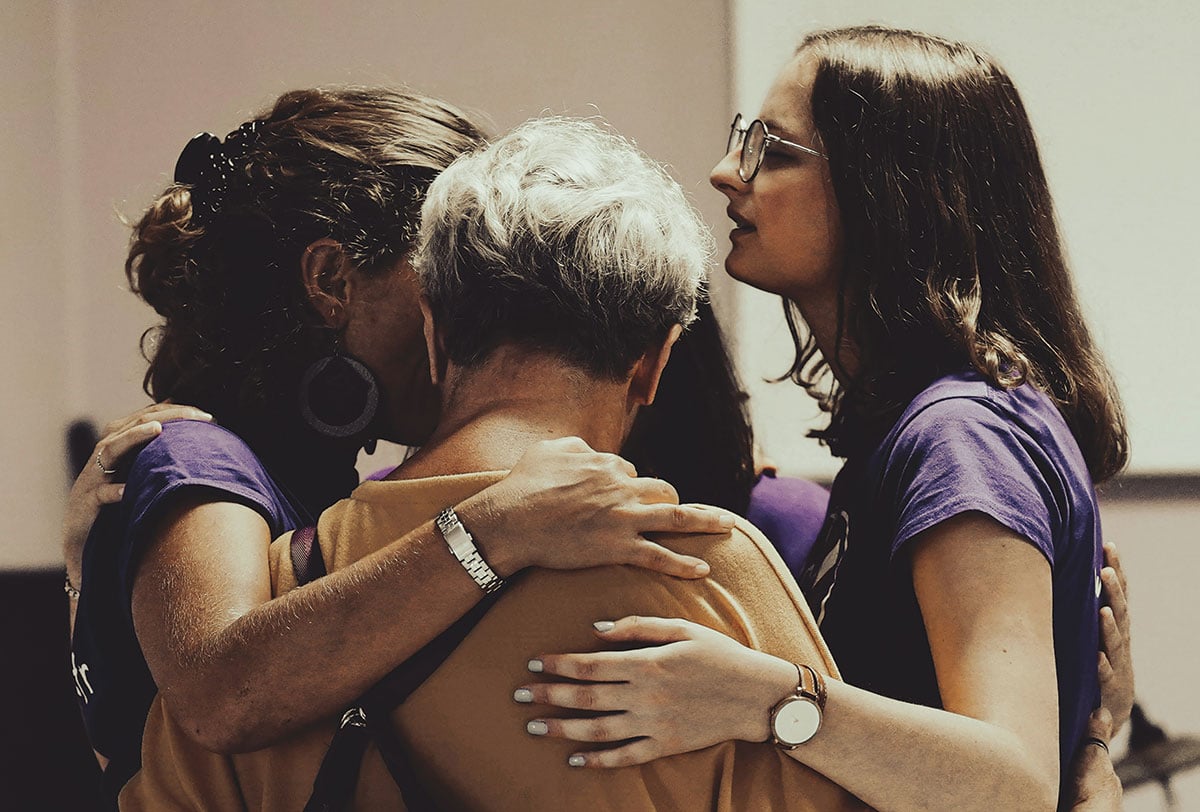
I sang the song three times, each time a little more slowly and a little more quietly. We were a prayer in motion, swaying our dance in time with the music until we eventually came to stillness, the doors of our spirits wide open to each other. When I got ready to go, Judy and I looked deeply into each other’s eyes and smiled. With no need for words, I kissed her cheek and enfolded her, her husband, and their two daughters in a warm group hug, all of us blessed to be accompanied by the Presence that is greater than us.


Thank you Becky for that sharing.
Thank you Becky – this is a beautiful piece. Like you, I grew up in a household that didn’t have prayer as part of its daily routine, and in fact the very notion of a God or higher power was scorned. I love the way you let the concept of prayer be bigger, gentler, and more communal than anything I’d thought of. It’s so inviting! My head & heart both feel warmed – thank you.