



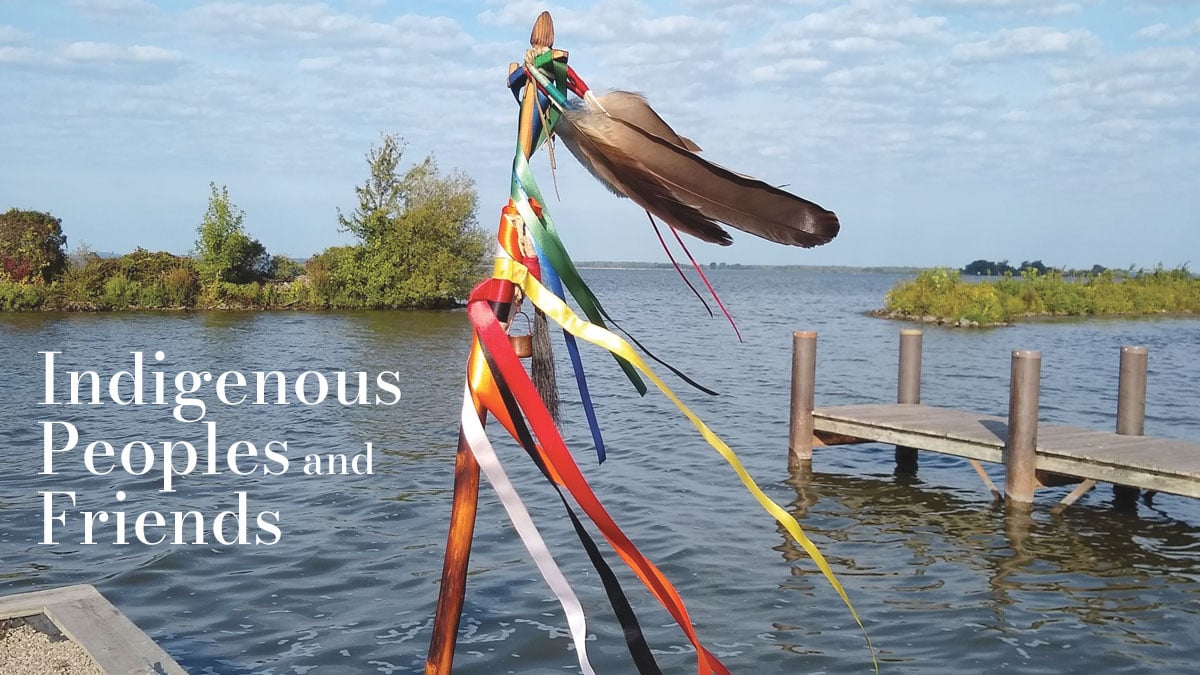
Where I live, in one of the colonial-era Quaker colonies of the Mid-Atlantic United States, there has long been a benevolent portrayal of Quakers’ relations with the local Indigenous Peoples. We are told that early Friend William Penn negotiated the Treaty of Shackamaxon with Lenape leader Tamanend, a moment memorialized by parks, statues, and a famous painting by Benjamin West. The great French philosopher Voltaire declared it “the only treaty never sworn to and never broken.” The new settlers bought each plot of land from the local Lenape bands. Violence in the first half-century of Quaker governance was rare; cooperation and good will were the norm.
And yet: there is no federally recognized Indigenous Nation left in this former Lenape territory. Every boatload of Quakers that sailed up from Delaware Bay brought the threat of another round of deadly smallpox. Every creek dammed to power a mill cut off the spawning fish runs that stocked upland creeks. Every pig let loose from an English farmstead ate through nearby Lenape maize and squash plantings.
It is estimated that over 80 percent of the Lenape Nation died in the first century of contact, despite all the peaceful relations, and most descendants now live far away in Oklahoma, Wisconsin, and Ontario. It is not enough for individuals to have good intentions. We must also see how our institutions and lifestyles fuel systems that deny life, agency, and dignity to others.
About a decade ago, Paula Palmer helped raise awareness of the problems of nineteenth-century Quaker-run Indian boarding schools, including by writing a Friends Journal article in 2016. She returns now to our pages with co-author Paula Keeth to share reconciliation efforts with the Cheyenne and Arapaho Nation in Oklahoma. Some of it is the heartbreaking work of repatriating the remains of Native American children who had died alone in far-away boarding schools.
I’m grateful to have the perspective of Rachel Overstreet, a member of the Choctaw Nation who works for Friends Committee on National Legislation. She brings a number of queries for non-Native Friends looking to address the legacy of Quaker-run Indian boarding schools. Mary Zwirner and Gordon Bugbee share stories of travel to the former locations of these schools and the bonds they’ve been able to forge with Native Americans in the area.
Regular contributor Kat Griffith talks about her surprise in discovering that there was an Indian nation in her part of Wisconsin—and the subsequent process that local Friends went through to become allies in the nation’s quest for federal recognition.
Bolivian Friend Rubén Hilari Quispe tells the tale of what happened when Quaker missionaries came to Bolivia a hundred-or-so years ago and tried to stamp out the Native Aymara wisdom of jiwasa, a “collective we,” so deeply woven into their culture that it permeates even the language.
In the quest to right past wrongs, it is good to remember that there have been true and deep and lasting friendships. My colleague Sharlee DiMenichi profiles some of the handful of Indigenous-majority Friends meetings that exist in North America. Reconciliation is possible, but it is hard work. We must take the time to listen, to own our collective past, and to work to right the ongoing legacies of past injustices.

We want to hear from you, not an AI! Please be thoughtful and use your own words. Comments on Friendsjournal.org may be used in the Forum of the print magazine and may be edited for length and clarity.