



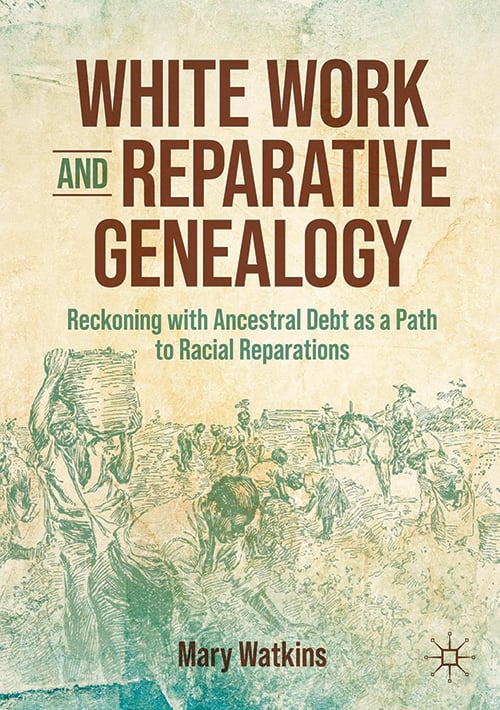
White Work and Reparative Genealogy: Reckoning with Ancestral Debt as a Path to Racial Reparations
Reviewed by Lucy Duncan
January 1, 2026
By Mary Watkins. Palgrave Macmillan, 2025. 362 pages. $24.99/paperback; $19.99/eBook.
White Work and Reparative Genealogy documents a psychic and spiritual journey toward reparations. Mary Watkins’s memoir, historical reckoning, and guidebook walks readers on a path to confront denial and mythologies of whiteness, so they might become agents in intergenerational healing and transracial reparative action.
A liberation psychologist inspired by Paulo Freire and Ignacio Martín-Baró, Watkins developed “A Pedagogy for the White Non-poor” that parallels Pedagogy of the Oppressed by Freire (1968). In this work, Watkins turns her attention to transforming white consciousness in the United States toward reparations and creating a just society. The book is organized in three parts: The Price of Becoming White; The Afterlives of Slavery; and Collective Remorse and Repair. She includes study guide questions at the end of each chapter to support readers in creating their own reparative journey.
In part 1, Watkins explores radical or reparative genealogy: the process of discovering how your European-descended ancestors were complicit in constructing and perpetuating white supremacy and racial capitalism. “I decided to turn toward racial injustice,” she writes, “and ask just how my ancestors—and I myself—were directly connected to it.” She examines her ancestors’ complicity in Indian removal as early Jamestown settlers, along with one ancestor who was an overseer on a plantation in 1623. This exploration includes the story of her Quaker ancestors (who enslaved people), and she traces Quakers’ prioritization of social acceptance over abolition. One piercing chapter explores white pathology, reading narratives of enslaved people as a way to document enslavers’ disconnection and violence: “While cleaving to thinking of themselves as Christian, gracious, and generous, they enacted or were complicit with torture, rape, and theft.” She proposes that reparative genealogy and action is the pathway to heal from the legacies of racial violence and the narcissism of whiteness.
In part 2, Watkins explores oppressive systems that followed emancipation, systems which maintained apartheid and transmuted slavery into equally brutal subjugation. She examines her family’s connection to Fayette County, Tenn., where in 1840, her ancestor Richard Watkins enslaved 36 people. After emancipation, white people refused to release those they had enslaved; vigilante gangs kept folks in bondage until the summer of 1865. She documents Reconstruction’s demolition through racial violence and describes the 1866 Memphis Massacre, the first large-scale racial massacre after the Civil War. When federal troops withdrew from Tennessee in 1877, Jim Crow emerged with brutal sharecropping, convict leasing, normalized lynchings, and violent exclusion from voting rights. Watkins interweaves this localized history with memories from her own family and childhood, rendering history deeply intimate. She shares what wasn’t said: one way white supremacy is transmitted among white families.
In a recounting of her maternal great-grandfather’s fortune amassed by clear-cutting Mississippi Delta forests, largely through convict leasing, Watkins illuminates how brutalizing human beings connects to brutalizing land and ecosystems, reducing both to commodities rather than treating them as sacred. She writes, “One way to approach reparations is to retrieve and strengthen the possibility of sacred regard, of treating what is alive as though it matters and should not be reduced to its use value. Reparation is about committing ourselves to relationships of respect and reciprocity.”
In part 3, on remorse and repair, Watkins describes truth-telling and “descent into the hellhole of horrific violence inflicted by white people on people of color as well as everyday complicity with normalized racist practices that continue to create deadly and unjust racial wealth, well-being, and opportunity abysses.”
She lays out a process of metabolizing shame and developing critical consciousness toward repair: confronting specific history with curiosity; de-ideologizing cultural assumptions, like individualism and whiteness; engaging in prophetic imagining; and resolving to return excess wealth, land, and power to the common good. She points to “ascetic antiracism” (a term coined by Musa al-Gharbi) where one makes personal sacrifices that change “patterns of action, interaction and resource allocation across time.” She describes projects like the Cooperative Community of New West Jackson to which she has devoted reparative capital and directs the book’s proceeds. She documents the history of Black calls for reparations and includes an accessible description of UN reparations components.
Watkins closes by discussing “unsuturing” the white self as we confront truth. “Unsuturing, like reparations, is not an event, but a process, a decision to commit to defect from fictions about oneself that have harmed people of color, even if it leaves one disoriented and lost.” She describes returning to visit ancestors’ graves and washing their stones while recounting their histories. She writes:
White work. Ending in utter disdain of our ancestors will not do, though we must reject their complicity with white supremacy. To disavow them would assist us in pretending that somehow we are made from altogether different stuff than they, that they were the racists and we are the redeemed.
She speaks of joy found in letting go of excess and stolen wealth, describing reparations as a portal to healing for white folks.
This book has worked deeply on me. As someone who works with white congregations to support them in moving toward abolitionist reparations, this is the manual I’ve been longing for. It is a map, a spiritual provocation, and an invitation to the deepest level of working toward racial repair and healing. I hope Quaker meetings will study it together. Racial justice to me is reparations; Watkins’s book is a way to move toward it with integrity, specificity, and personal transformation.
Lucy Duncan is a codirector of reparationWorks (www.reparation.works), which coordinates the Rise Up for Reparations Campaign of congregations moving toward abolitionist reparations. She is a member of Green Street Meeting in Philadelphia, Pa., and clerk of its Reparations Committee.
We want to hear from you, not an AI! Please be thoughtful and use your own words. Comments on Friendsjournal.org may be used in the Forum of the print magazine and may be edited for length and clarity.