



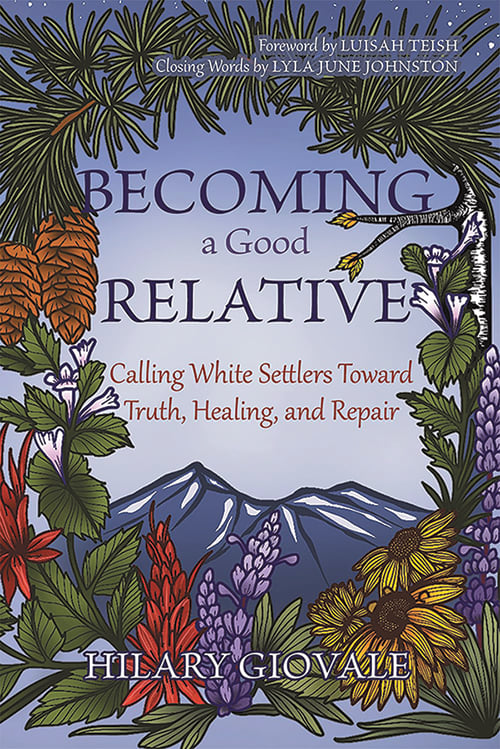
Becoming a Good Relative: Calling White Settlers Toward Truth, Healing, and Repair
Reviewed by Michele Sands
January 1, 2026
By Hilary Giovale. Green Writers Press, 2024. 376 pages. $21.95/paperback; $9.99/eBook.
“My impulse was to keep a low profile and hope that someone else would figure out how to make reparations, someday.” So wrote Hilary Giovale during her journey that culminated in Becoming a Good Relative: Calling White Settlers Toward Truth, Healing, and Repair. A ninth-generation settler, raised as a middle-class white woman who liked hot showers and clean sheets, Giovale married into wealth and was invited to assist with the family’s giving. As a philanthropist, wife, mother, and community organizer living in Flagstaff, Ariz., on land originally inhabited by Hopi, Diné, Apache, and other Indigenous Peoples, she made a point of learning about her neighbors and their cultures. From there, she investigated her own ancestors. To her horror, she found she was a descendent of plantation owners who had enslaved African people. But rather than shun or berate her, her new BIPOC (Black, Indigenous, and People of Color) friends invited her to go beyond guilt and “normality,” into truth-telling to become an active relative of the earth and all the people who have protected it for millennia.
The bulk of this book recounts Giovale’s four-year journey of contemplation, discovering her ancestors in Scotland and Ireland, and her relatives in the Indigenous Southwest. She found corresponding histories and customs; she honored dreams in her own dream journal, as well as more global dreams, as inspired by the work of the Pachamama Alliance in the Ecuadorian rainforest “to ‘change the Dream of the Modern World’ within one generation.” When invited, she joined BIPOC movements, such as the Standing Rock Water Protectors’ opposition to the Dakota Access pipeline in 2016.
One through line of the book is that many ancient peoples were pushed out of their homelands (for example, the Picts and Celts were colonized by the Vikings and Romans), and their language and rituals were erased as they were coerced by other cultures. Another is that women who protected the land and customs were often demonized. Perhaps most important is the fact that Indigenous people offer compassion to seekers, because the human and natural world were once seen as one and, for our mutual survival, must be seen that way again. She does call out “spiritual bypassing,” however: such as the attempt to erase guilt of one’s ancestors’ choice to move to the suburbs by claiming people “thought differently” back then. Such erasing of our ancestral histories prohibits unpacking of our own generational trauma.
Giovale is thoughtful and exacting in her language throughout the book and in a glossary. For instance, Turtle Island, as Indigenous people recognize, is the land people in North America live on; and “Water” is always capitalized. Witnessing (wit(h)nessing), which she attributes to the work of Freudian scholar Bracha Ettinger, is looking at and experiencing life and all its forms: “an empathetic practice that . . . is relational, compassionate, and intuitive.” She also distinguishes among terms like “cultural appropriation,” “cultural sampling,” and “cultural appreciation”; and “white supremacy,” “White Peril,” “white privilege,” and “whiteness.” The book’s appendices also include historical notes, questions for reflection, and “practices to accompany” the reading. Quakers often balk at rituals, but I was particularly inclined to try those practices involving relationships with Water, Moon, and specific aspects of nature.
The author bases her work on hundreds of personal discussions on three continents and over her kitchen table, and she is generous in acknowledging each. She says the book is more of “what I did, than how to.” Yet the rich sources she cites—from historic documents around Manifest Destiny, to the canon of BIPOC struggles (e.g., Black Elk Speaks, My Grandmother’s Hands), to websites and online videos—make this a valuable resource for study circles and individuals.
This is a book for learning to know your ancestors beyond DNA. It is a book for doing important work: with Indigenous movements around Standing Rock and reconciliation for Indian boarding schools. It is a book for people struggling with their whiteness, for those who want to be better philanthropists, and for those who like a good story. I also recommend Becoming a Good Relative for inspiration in these difficult times.
Michele Sands comes from the land of the Lenape and currently lives where the Potomac people once cultivated land and where an enslaved man named “Nace” once toiled and had a son, also named “Nace,” who eventually won his freedom on October 1, 1819. She worships with Collington Worship Group in Bowie, Md.
We want to hear from you, not an AI! Please be thoughtful and use your own words. Comments on Friendsjournal.org may be used in the Forum of the print magazine and may be edited for length and clarity.