



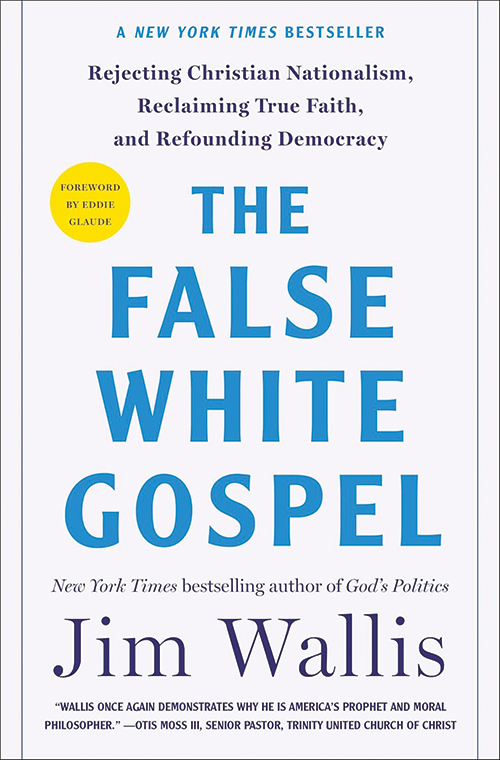
The False White Gospel: Rejecting Christian Nationalism, Reclaiming True Faith, and Refounding Democracy
Reviewed by Mark Jolly-Van Bodegraven
January 1, 2026
By Jim Wallis. St. Martin’s Essentials, 2024. 304 pages. $30/hardcover; $19/paperback; $11.99/eBook.
In The False White Gospel, preacher Jim Wallis cites multiple academics who conclude, as many have feared, that the religious right or Christian nationalism are indeed driving people away from religion, and those of us who try to hang on to Christianity, while rejecting the ways it has been used, often find it easiest to do so by staying quiet, by maintaining a private faith, by keeping it to First Days, and in keeping our conversations confined to coreligionists.
In this book, Wallis provides an example of an alternative approach, and he makes clear that if we take our religion seriously, we are obligated to attempt it. He boldly identifies the “great heresy of American religion, and evangelical Christianity in particular” to be this idea: “You can focus on your own relationship to God, to the point where your religion has no relationship to the people around you—especially to people of color.” Although The False White Gospel was published nearly two years ago, the biblically grounded challenge to “the false religion of white Christian nationalism” is even more essential today.
I don’t think I am alone in having a visceral feeling that the religious right that has effectively co-opted religion for its conservative social program is fundamentally a misrepresentation of Christianity. Wallis’s book provides evidence of why that is the case from both biblical passages and a historical perspective, with particular attention to the Civil Rights Movement. Wallis notes that “their individualistic, nationalistic, and racial interpretation of religion—leading to the prosperity gospel, the embracing of military power, the white ethnocentricity, and pride of nation—all directly conflict with Jesus’ teachings about the kingdom of God.”
The False White Gospel is structured around six instructional passages from the Bible, with Wallis writing individual chapters on each that provide additional context and guidance for the ways that living by that passage could allow Christians who have been misled into white Christian nationalism to find their way back. The first one is the Parable of the Good Samaritan (Luke 10:25–37); Wallis notes that answering the question of who is our neighbor is central to both our faith and democracy. He lifts up Genesis 1:26, that we are all made in God’s image—akin to the Quaker belief that there is that of God in everyone—and this compels us to treat all people with love and compassion. Wallis also points to Jesus’s promise in John 8:32, “the truth will make you free”; two passages in Matthew: “the parable of the sheep and the goats” (25:31–46) and “Blessed are the peacemakers” (5:9); and, finally, Galatians 3:28, there is unity in Christ Jesus, which promotes the kinship of all people by repudiating social divisions by race, class, or gender.
The book concludes with Wallis’s call for a “remnant church” to emerge as people of faith bring the elements of their own traditions, which build common ground, to face today’s challenges. He issues a call to action around ten commitments, from pastoral education and truth-telling to safety, security, and stewardship. Arguably the most useful part of the book is Wallis’s interpretation of the six passages listed above; these are at its core. They provide a potential common ground to engage Christians, including those who have embraced dogma that takes our society away from the principles Jesus taught.
The False White Gospel directly engages today’s political climate, although it was published before the 2024 election that returned Trump to the presidency. Wallis notes in the book that Christianity and the founding fathers shared “a common vision: one body and a more perfect union.” Galatians 3:28 is again useful here, showing “the unity and diversity of the kingdom of God” in one simple line: “There is neither Jew nor Gentile, neither slave nor free, nor is there male and female, for you are all one in Christ Jesus” (NIV).
Wallis is an evangelical Christian, and so calling out misuse of Scripture and calling in people to be faithful are basic elements of his movement. He is not aiming for conversions or insisting that Christianity is the only true religion. But he doesn’t shrink from his own belief in the Bible and in the value of engaging society around him through that lens. “Pulling humanity together, by reconciling them to God and to one another, was the purpose for which Jesus gave his life and the calling of all those who would follow in his footsteps.”
Mark Jolly-Van Bodegraven came to the Religious Society of Friends through the lived witness of peace activists and other Quakers; the space that Friends hold for unprogrammed worship and universalism; and Quakers’ literary tradition of journals, pamphlets, and this magazine. He works in higher education communications, and lives in Newark, Del.

1 thought on “The False White Gospel: Rejecting Christian Nationalism, Reclaiming True Faith, and Refounding Democracy”
Leave a Reply
We want to hear from you, not an AI! Please be thoughtful and use your own words. Comments on Friendsjournal.org may be used in the Forum of the print magazine and may be edited for length and clarity.
Dear Friends
I write as a member of the Southern Africa Yearly Meeting of Quakers.
Would it be possible for us to re-publish this excellent review in our biannual newsletter DurbanSouthern Africa Quaker News?