



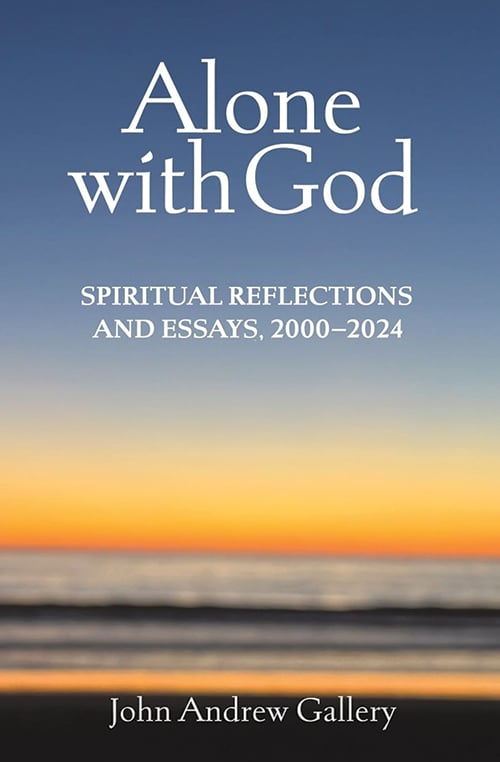
Alone with God: Spiritual Reflections and Essays, 2000–2024
Reviewed by Barbara Birch
January 1, 2026
By John Andrew Gallery. Self-published, 2025. 278 pages. $20/paperback; $4.99/eBook.
This collection of 56 essays and reflections is a box of chocolates worthy of Forrest Gump; each piece holds unexpected surprises for the reader. John Andrew Gallery attends Chestnut Hill Meeting in Philadelphia, Pa., and is an active writer on Quaker themes. Alone with God gathers works previously published as Pendle Hill pamphlets or in Friends Journal. Gallery’s long practice of faithfully participating in a prayer vigil for peace on Independence Mall in Philadelphia beginning in 1999 inspired written introspection in the evenings. In his introduction, Gallery writes that at the end of the day, “I sat in a small pool of light, an island in that darkness, seemingly alone but not alone. There was another presence that was the source of the words that came to me.”
In more recently written essays, Gallery describes his experiences of worship alone in his apartment during the pandemic, where he often took inspiration from his eclectic keepsakes and books. Gallery explains the fruits of his spiritual practice with examples from contemporary culture as well as other religions. The characters in the movie The Motorcycle Diaries inspired thoughts on the testimony of honesty and integrity. Another movie, Field of Dreams, formed the framework for a long discussion on the ins and outs of spiritual leadings and journeys. He also draws inspiration from other spiritual paths, his own imagination, and sacred reading and writing.
Gallery notes that many faiths fuse the spiritual and the physical. In Buddhist meditation, body posture is important because “to be spiritually grounded is to be physically grounded as well.” He discusses two types of pilgrimage in Islam: the Umrah, a personal single-day pilgrimage, and the Hajj, the multi-day pilgrimage required of all Muslims who are capable of making it. His own practice during lockdown was a routine of walking, meditation, prayer, and a simple form of tai chi on the roof deck of his apartment building. He gave each movement of the tai chi exercise a meaning: rootedness with flexibility, energy and love, uncertainty with readiness to receive the future, and so on. With a simple and succinct instruction to “be a walking prayer”—gleaned from an overheard comment by a stranger—Gallery summarizes George Fox’s advice to “walk cheerfully over the world answering to that of God in everyone.”
In the essay “Holy Saturday Meditation,” previously published in Friends Journal, Gallery confesses to a failing that may be common among modern Friends: “My intellectual side has prevented me from making the leap of faith even though in my heart I might want to.” To counter this tendency, he uses imagination as a devotional practice. Drawing on his Christian background, he meditates on what might have been the first disciples’ experience of emptiness and uncertainty on Holy Saturday, the day between Good Friday (death) and Easter (resurrection).
Another essay, “Black Jesus,” begins with a description of a 12-inch statue portraying Jesus as a Black man. Purchased from a vendor at 30th Street Train Station, the item had an “immediate and powerful impact,” and took on even greater meaning at the time of Gallery’s writing: July 2020, right in the midst of that summer’s racial reckoning. In reflecting on the color of Jesus’s skin, Gallery asks himself probing queries like “Would my conception of God be the same if I was a homeless Black man living across the street in a tent? . . . Or a Black woman trying to raise two children while living in public housing?”
The Yom Kippur holiday inspired an essay on forgiveness in which Gallery discusses his problems with conventional concepts of “God” and “prayer.” Praying for forgiveness is not asking an external God to pardon his mistakes. Instead, it is “praying for help in being able to extend unconditional love to everyone in my life and thereby making apology and forgiveness unnecessary.” In this way, Gallery made forgiveness a proactive practice. True forgiveness is love that occurs before and instead of giving or taking offense, and thus it lessens the need for apology and forgiveness. Although people often feel a call to perfection, Gallery makes a strong case for embracing imperfection as the path to accepting oneself, to loving others as they are, and to unity with God.
If Friends are looking for an easy-to-read book chock full of Universalist and thought-provoking insights, they should look no further than Alone with God.
Barbara Birch is a member of Strawberry Creek Meeting in Emeryville, Calif., and a board member at Ben Lomond Quaker Center. She facilitates workshops through Friends General Conference and Woodbrooke. She is the author of Lectio Divina: Revelation and Prophecy, newly released in the Quaker Quicks series.
We want to hear from you, not an AI! Please be thoughtful and use your own words. Comments on Friendsjournal.org may be used in the Forum of the print magazine and may be edited for length and clarity.