



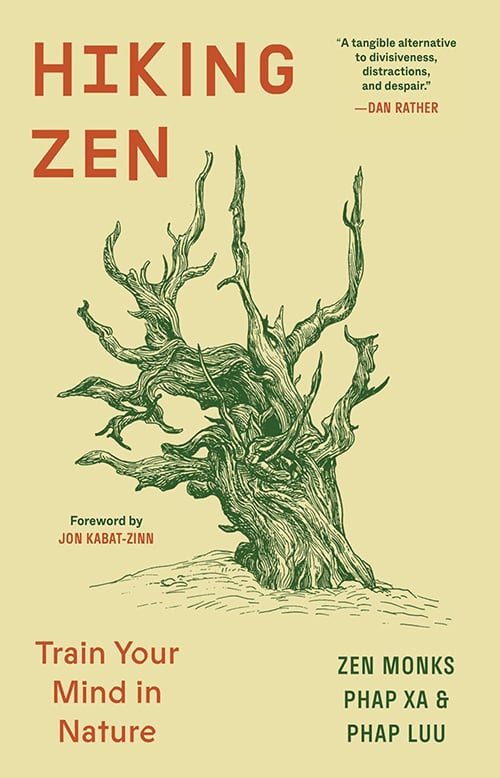
Hiking Zen: Train Your Mind in Nature
Reviewed by Trevor Brandt
January 1, 2026
By Phap Xa and Phap Luu. Parallax Press, 2025. 172 pages. $18.95/paperback; $12.99/eBook.
Prayer in movement is a practice long-rooted in Friends history. George Fox frequently felt the Lord’s presence while walking, as he wrote in his Journal: “when I had been walking solitarily abroad and was come home, I was taken up in the love of God, so that I could not but admire the greatness of his love.” Other early Friends undertook long journeys on foot because they were led to travel and preach, and even today we encourage one another to “walk in the Light.”
Written from the perspective of the Plum Village tradition of Buddhism, Hiking Zen offers concrete ways of weaving movement in nature into our spiritual practices. Over the book’s 172 pages, coauthors Phap Xa and Phap Luu (Brothers Equanimity and Stream) intersperse descriptions of mindful breathing techniques and mantras with recollections from a seven-week mindfulness hike that they led along the Appalachian Trail in 2018, beginning at Blue Cliff Monastery in upstate New York. Taking inspiration from Thich Nhat Hanh’s Touching the Earth, a collection of meditative passages, the brothers recommend mindful hiking as a way to “clear the brushwood from our minds and rediscover an old path that is already there.”
Chapters reflecting on this arduous retreat gradually introduce readers to Phap Xa and Phap Luu, both Westerners. We learn about their decisions to become Buddhist monks and their calling to organize retreats in nature for both monks and laypeople. Along their hikes, they found digital technology to be a recurring challenge. Time spent in nature is not necessarily akin to mindfulness, and cellphones easily follow us outdoors, distracting us from the work of the Spirit. To truly embrace mindfulness or prayer in nature, the brothers suggest leaving our phones behind or, on longer retreats, limiting their use to safety and navigation.
While a seven-week hike might not be possible for many, Phap Xa and Phap Luu emphasize that shorter, day-long hikes—beginning with breakfast and meditation and ending with insight-sharing—are far more typical at their monastery. What stands out from their recollections was the enthusiasm and sincerity that participants brought to these popular retreats; people of faith often yearn for new ways to bring spiritual practice outside of the walls of worship. Gathered or individual Quakers, too, might consider organizing worshipful hikes in nature as complements to meetings for worship.
After 42 days of mindful walking, the bedraggled monks and lay participants reached the National Mall in Washington, D.C. There, they recalled Thich Nhat Hanh’s words the day after Martin Luther King Jr.’s death: “I am afraid the root of violence is so deep in the heart and mind and manner of this society. This country is able to produce King but cannot preserve King. I am sorry for you. For me. For all of us.” Passing the Vietnam Veterans Memorial, the group met more than a hundred people who had come to greet them. Together, they faced the White House, folded their legs, and sat. In peace, in silence, they meditated: their “minds trained by the woods and [their] aimless hike to coalesce in peace and freedom, for the benefit of all beings.”
Movement, prayer, and witness for peaceable living calls to mind this past May’s Quaker Walk to Washington, a 276-mile interfaith pilgrimage in solidarity with immigrants, and the Cities for Peace walks throughout Europe since 2019. Though Phap Xa and Phap Luu’s Zen retreats and the contemplative walks of other traditions may follow different paths, they share a destination. When we hold the Spirit in movement, our steps speak where words fall short. “Future generations depend on the story we write with our every step, our every breath, our every action.”
Trevor Brandt is a member of Fifty-seventh Street Meeting in Chicago, Ill. He is currently sojourning with Friends in Berlin, Germany.

We want to hear from you, not an AI! Please be thoughtful and use your own words. Comments on Friendsjournal.org may be used in the Forum of the print magazine and may be edited for length and clarity.