



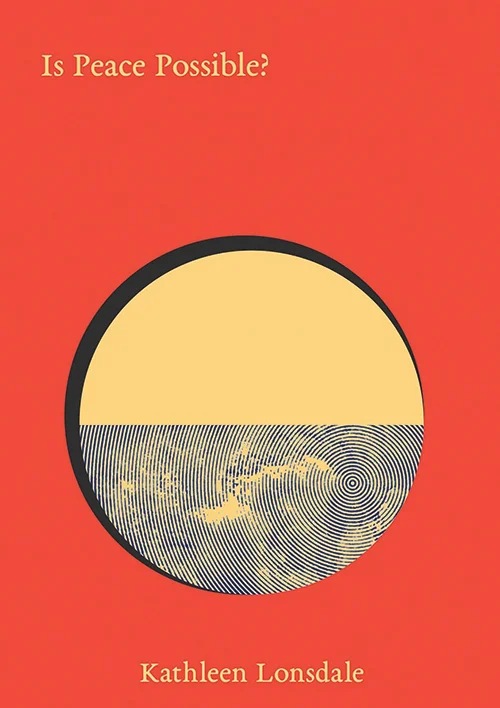
Is Peace Possible?
Reviewed by Cameron McWhirter
June 1, 2026
By Kathleen Lonsdale. Marginalian Editions, 2025. 144 pages. $24/hardcover; $11.99/eBook.
Kathleen Lonsdale (1903–1971) was a leading scientist in the UK in an era when a woman holding such a position was rare. She was the first female professor at University College London and the first woman president of the British Association for the Advancement of Science. Her expertise was the study of the atomic and molecular structure of crystals, and she produced abundant research that helped shape our modern understanding of how crystals form. She was so prominent in her field that a form of meteoric diamond is named “Lonsdaleite” in her honor.
Her determination and intellect, which served her so well in the chosen scientific field of crystallography, also served her in her long-standing commitment to pacifism. Lonsdale came to Quakerism in her 30s (along with her husband). She embraced her chosen faith with energy, even serving time in prison for refusing to participate in civil defense during World War II. She was active in Quaker organizations and worked for peace and penal reform throughout most of her life. From the 1940s through the 1960s, she delivered lectures and wrote papers on the importance of pacifism in our modern, messy, and often bloody world. Thankfully, one of her most important publications, Is Peace Possible? from 1957, has now been reprinted by McNally Jackson Books, under a new imprint in collaboration with writer Maria Popova, “who selects and introduces forgotten masterworks that deserve a second life.”
The short work was replete with candor and insight, and included self-deprecatory humor. In the first sentence, she stated she is a Quaker and “a convinced pacifist, but I find it very hard to convince other people.” Despite that acknowledgment, Lonsdale devoted the rest of her book to trying to convince readers of the rationality of pacifism. She set out not to win hearts but to win minds. Pacifism, she argued forcefully, wasn’t just morally right; it was also logical and essential for the preservation of humanity.
Lonsdale’s pacifism was not the wispy notion of someone who strikes a liberal pose or embraces peace because it seems nice. For Lonsdale, as a scientist who had lived through two world wars and was writing during the Cold War, pacifism made simple sense. War, especially in an age of nuclear weapons, was insanity, she argued. She brought her scientific mind to the problem of war. It is the book’s strength.
“The pacifist who argues that he is concerned only with principles, and that politics are not his business, is usually evading the discipline and the responsibility of hard thinking,” she wrote. Is Peace Possible? discussed specific crises of her day: post-war Europe, the Cold War, Israeli-Arab fighting. Her answer to these problems, which were all antecedents for today’s dilemmas, was one she likely would have provided for today: an international body for conflict resolution, a global reduction in the importance of the nation-state, and widespread appreciation and tolerance for other cultures and beliefs.
“Even from the scientific point of view, therefore, it seems clear that absolute national sovereignty cannot be maintained in a world that wishes to avoid slow but certain deterioration of human health and well-being,” she wrote.
I assume Lonsdale would be horrified by today’s world. She would find the diminishment of the United Nations and the breakdown of world order terrifying. Lonsdale abhorred the mistreatment of Arab people during the creation of Israel and predicted it would lead to perpetual violence in the region. But she always had hope that the world, ultimately, would see the logic of pacifism, and governments would embrace it. In the meantime, citizens must press their leaders to seek peaceful solutions to the world’s many challenges, she argued.
“[E]ventually deliberate planning for a world without war will be as necessary at Governmental level as planning for war has been in the past,” she wrote.
Cameron McWhirter is a journalist. He is coauthor of American Gun: The True Story of the AR-15 and author of Red Summer: The Summer of 1919 and the Awakening of Black America. He is a member of Atlanta (Ga.) Meeting. He has served on the Board of Trustees of Friends Publishing Corporation, publisher of Friends Journal.

We want to hear from you, not an AI! Please be thoughtful and use your own words. Comments on Friendsjournal.org may be used in the Forum of the print magazine and may be edited for length and clarity.