



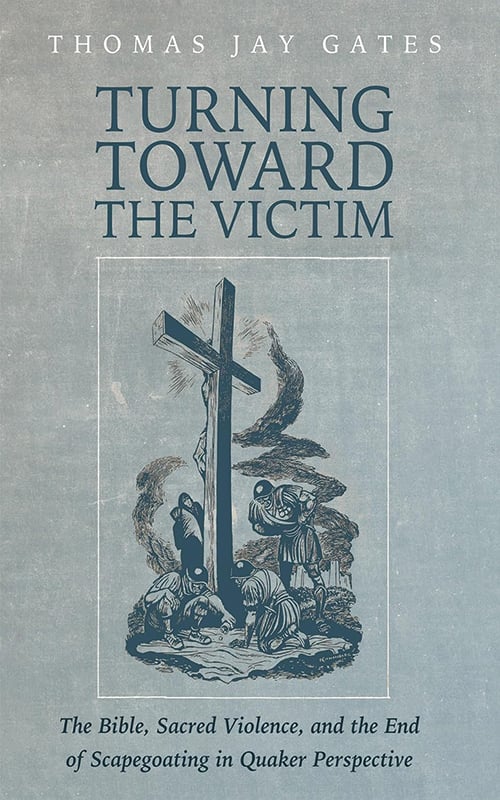
Turning Toward the Victim: The Bible, Sacred Violence, and the End of Scapegoating in Quaker Perspective
Reviewed by Ron Hogan
June 1, 2026
By Thomas Jay Gates. Wipf and Stock, 2025. 326 pages. $53/hardcover; $38/paperback or eBook.
The French scholar René Girard developed a theory about violence being the origin of religion—specifically, the process of scapegoating. People want what other successful and happy people want, in the belief that it will make them successful and happy as well, and are willing to commit violence upon each other to acquire it. This takes place across an entire society, and when the violence gets out of hand, the society selects one individual or group to blame. Punishing that scapegoat, usually by death, “eliminates” the cause of all the violence, and the society can carry on as usual.
The catch, of course, is that the scapegoat is innocent of the sin of which it has been accused—or, at least, no more guilty than anyone else. And that leads us to Girard’s second great insight, concerning the crucifixion of Jesus. Unlike any previous scapegoat, Jesus came back, forcing the world to recognize that it had put an innocent to death, that it was constantly putting innocents to death. The path the risen Christ offers us out of this vicious cycle, Girard argued, was to abandon our imitation of other people’s desires and choose instead to want what God wants.
So what does God want? That’s one of Thomas Gates’s main concerns in Turning Toward the Victim, which compares Girard’s models to the spiritual beliefs of early and modern Quakers. The glib answer is that God wants us to be the best that we can be; more precisely, we should love God and love one another, of our own free will, as intently and as intensely as God loves us. The Quaker framework of spiritual formation, Gates says, points us in that direction.
First comes the experience of “conviction,” the realization that one has been living in a state of sin or, as our modern sensibilities would put it, “a felt sense of complicity in social structures that were built on oppression, deceit, and coercion.” This is the moment described by many Friends when Spirit speaks to our condition or when the Inward Light shines upon us and reveals our character to us. It leads to “convincement”: Once we recognize and acknowledge our alienation from God, we want it to end, and we understand that it can end, because, as Gates writes, God is not “distant, judgmental, and punitive” but “near at hand, available to all, concerned for [our] salvation, and most of all loving.”
Finally, there is “conversion,” “a slow and gradual process of turning toward the Light, toward God.” Gates reminds us that early Quakers believed “atonement was something we participate in, not through an outward liturgy, but inwardly, through our ongoing experience of the Light.” As such, he says, “conversion of the heart” was the work of an entire lifetime, the internal spiritual struggle that the early Friend James Nayler described as “the Lamb’s war.”
Gates is dealing with some heavy, heady material here, but although he probes his subject matter in serious detail, he largely escapes getting stuck in the weeds. He carefully draws out the implications of Girard’s theories while keeping his own writing lively, even while discussing fairly academic subjects like process theology and narrative psychology. And those theories do provide a strong foundation, with a combination of literary, anthropological, and theological insights, for understanding Friends’ testimony of their spiritual experiences, from George Fox to the present-day.
Some modern Quakers have de-emphasized the Bible as a spiritual resource because they consider it too “violent” a text; Gates suggests that Girard enables us to see it as a document of a society grappling with the problem of violence: “the story of one people’s halting and largely unconscious effort to turn their attention away from the guilt of the scapegoat and toward the innocence of the victim.” Girard and Gates both see the crucified Jesus as “the hermeneutic key that opens and interprets Scripture,” the point at which the reality of scapegoating becomes impossible to ignore—but also the culmination of a pattern that had been building from the moment an angel intervened to prevent Abraham from sacrificing Isaac. And once we understand that we have been participants in a persecutorial society, as Gates summarizes Girard’s conclusion, “we can follow the beast to Armageddon; or we can follow the Lamb to the new Jerusalem.”
Turning Toward the Victim is also deeply concerned with the state of modern Quaker faith and practice: Gates draws as much upon contemporary figures like Ben Pink Dandelion and Lloyd Lee Wilson as he does the likes of Fox and Nayler. And here we come back to the matter of conviction, convincement, and conversion; more than anything else for Gates, Quakerism is about these profound spiritual transformations, and it must continue to provide fertile ground for others to experience them. That’s a big topic, one that isn’t always easily contained within the “box” of interpreting Girard. But it makes for thought-provoking reading, whether or not you approach Quaker faith from a Christian perspective or, for that matter, Christianity from a Quaker perspective.
Ron Hogan is the audience development specialist for Friends Publishing Corporation and webmaster for Quaker.org, where he writes a weekly message connecting Friends’ faith and practice to Scripture called Look to the Light. He is also the author of Our Endless and Proper Work.

We want to hear from you, not an AI! Please be thoughtful and use your own words. Comments on Friendsjournal.org may be used in the Forum of the print magazine and may be edited for length and clarity.