



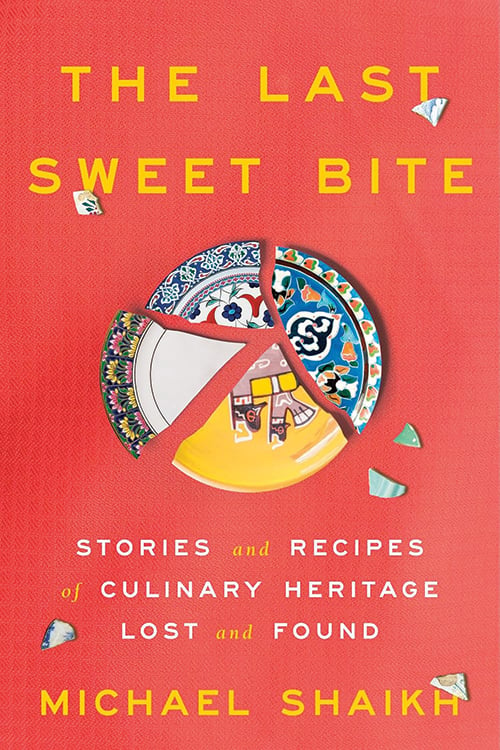
The Last Sweet Bite: Stories and Recipes of Culinary Heritage Lost and Found
Reviewed by Hope Ascher
June 1, 2026
By Michael Shaikh. Crown, 2025. 320 pages. $30/hardcover; $14.99/eBook.
I love culinary history and the way that food and recipes reveal something intangible about a group of people that we can’t really grasp in another way. So I was excited to read Michael Shaikh’s The Last Sweet Bite. Each chapter focuses on a different cultural group that has been impacted by violence. The chapters also contain both the context for two or three extraordinary dishes as well as the recipes themselves. The reader is invited into the kitchen to understand that context and then to make a traditional dish or two.
However, Shaikh’s book is far richer than simply a culinary history. Although it is indeed organized around recipes and stories from specific cultures, it is also partly a memoir of a brave man who has borne witness to the human cost of war. As Shaikh writes in the prologue, throughout his 20-year career as a human rights investigator, he has investigated war crimes in Afghanistan, Pakistan, and Sri Lanka; genocide in Myanmar; deadly coups in Bangladesh and Thailand; and civilian casualties in Mali and Syria for organizations like Human Rights Watch, the International Crisis Group, and the UN’s Office of the High Commissioner for Human Rights. In each chapter, he chronicles how violence alters human culture and traditions. He understands food to be a deep expression of culture and recognizes how history and traditions are handed down in recipes from generation to generation.
Some of the chapters contain interviews and recipes from groups that were victimized by nationwide violence in past decades. The chapters on the Czech Republic and Sri Lanka and the Tamil diaspora discuss cultures that are in the process of preserving food traditions while adjusting to very different worlds. The book reveals a side of government persecution that was largely unknown to the world. Yet the people survived, and the recipes included are testimony to that resilience.
Some of the chapters focus on cultures that are still under direct attack by government forces. The chapter “China and the Uyghurs” is one such chapter. Shaikh explains that at times “the party designated Uyghur Islamic customs as counterrevolutionary.” To disrupt the food tradition was a way to disrupt religious beliefs and cultural identity. There were strict policies regarding how mosques must display loyalty to the state, by draping flags of Mao Zedong on minarets for example, and “some Uyghur families were forced not only to rear pigs but also to turn their mosques into pork slaughterhouses.” The Chinese government understood that by disrupting agriculture and religious food traditions, they could attack an undesired minority from the inside.
Perhaps the hardest chapter for me to read was “The Pueblo Nations,” as it revealed in my own country an ongoing, systematic effort to destroy a culture by destroying a crop central to its cultural traditions. Believing it to be sacrilegious, colonial Spanish Catholics outlawed amaranth for hundreds of years. It is only recently that the Pueblo people began to be able to grow it again. Boarding schools removed Indigenous children from their homes and wrenched them from the culture and food traditions that undergirded their society. Shaikh carefully discusses how a government policy affecting what could be grown and what could be served to children in boarding schools impacted the children’s identity with their own tribal nation. Yet the traditions somehow manage to survive.
The Last Sweet Bite is also the story of a man who has the courage to travel to war-ravaged countries and investigate human rights violations. Shaikh has had harrowing adventures including being a “guest” of the Taliban for several days, yet he has continued to bear witness to the impact of violence on human civilization across the globe. His work includes a discussion on Gaza and how the destruction of the fishing fleet and the food traditions of the sea is yet another example of how violence destroys elements of cultural traditions.
The theme of resilience weaves throughout the book. Each chapter is heartbreaking and heartwarming as we see violence negatively impacting culture but culture enduring through human creativity. The recipes themselves make the book valuable as they take the reader around the world in food. The stories that undergird the recipes open the readers’ eyes to the depth of the impact of violence on persecuted groups. It is an important book for those concerned about global violence and a desire to understand its insidious impact. It also helps deepen understanding of refugees and immigrants as they face life in the United States. I highly recommend it for both individuals and reading groups.
Hope Ascher is a member of Melbourne Meeting in Rockledge, Fla. An educator, cook, and naturalist, she is active in her monthly meeting and in Southeastern Yearly Meeting. Hope convenes an antiracist book group whose goal is reading banned books so that those voices and stories are remembered and not stilled forever.
We want to hear from you, not an AI! Please be thoughtful and use your own words. Comments on Friendsjournal.org may be used in the Forum of the print magazine and may be edited for length and clarity.