



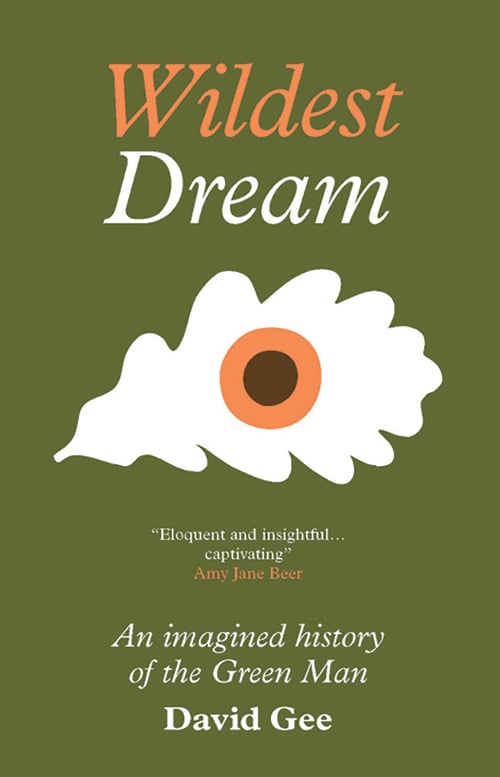
Wildest Dream: An Imagined History of the Green Man
Reviewed by John Andrew Gallery
June 1, 2026
By David Gee. Ember Press, 2025. 96 pages. £8.99 (about $12)/paperback.
David Gee was introduced to the Green Man when he was nine years old and read Gail E. Haley’s illustrated children’s book The Green Man, published in 1979. As Gee recalls, that book tells the story of a prince who was out for a hunt with friends and became lost in the woods. He comes across a lake and decides it would be refreshing to take a swim. So he leaves his clothes on the bank with his horse and plunges naked into the cool water. When he returns, his clothes and his horse are gone. He has no choice but to gather some leaves to cover his nakedness, thereby becoming a green man.
The greened prince spends about a year in the forest: getting to know the animals, living off what nature provides, and enjoying the peace and quiet. To use a phrase from Witter Bynner’s translation of the Tao Te Ching, he lets “nature renew / the sense of direction men undo.” That is the theme of Gee’s book; he calls it “a journey of becoming.”
Eventually, in Haley’s story, another nobleman comes along and also decides to take a swim. The Green Man steals his clothes and horse, leaving his mantle of leaves for the other to wear, and he returns to society. He returns, however, a changed man. Gee would say he is more human.
Gee pursues this theme in the five short chapters of Wildest Dream, each of which describes how nature in its wild form is—and has long been—an essential counterpoint to “the dominant founding myths of western civilisation [which] have betrayed a fear-soaked hostility to the wild.” Gee is British, so examples he uses are often more relevant to that country. In one chapter, he describes sculptures of the Green Man that adorn the churches in England and across Europe. In another, he laments the fencing of large land areas by wealthy landowners, converting what was once common land to private ownership for grazing sheep while displacing many families from farms that provided their sustenance and livelihood.
The most interesting chapter for me was the third, which begins with a discussion of a twelfth-century book about the life of Merlin, who goes mad when faced with the horrors of war. Gee uses this to discuss his own work with veterans and the adverse impact of military training in Britain (which is no different from that in the United States). The primary objective of such training is to destroy the qualities the Green Man personifies. Learning to kill another person requires dehumanizing that person: turning them into an object known as “the enemy.” He learns from veterans that “in doing violence to others, they’ve had to make themselves less of a person than they mean to be.” The result is a sense of shame that lasts long after war is over. War is inhumane, and those who conduct it are damaged as much as those who are its victims.
Gee’s comments about the benefits of time in the wild made me wonder if those returning from war might be required to spend a year working in a purely natural environment: as forest rangers, for example. Would such an immersion in nature reduce the dehumanizing influence of war and military training, the incidence of PTSD, or military suicides? I don’t know, but it is an intriguing idea.
The book includes a six-page bibliography of other books about the Green Man and issues Gee raises throughout the book. Gee wrote the majority of Wildest Dream with terminal cancer, finishing the manuscript just before he died in late 2024. In a sense, it is a parting gift—a kind of prayer—to remind us of the importance of preserving nature in the wild and of spending time in it.
John Andrew Gallery lives in Philadelphia, Pa., where he attends Chestnut Hill Meeting with frequent attendance via Zoom at Middletown Meeting in Lima, Pa. He is a frequent contributor to Friends Journal, and the author of four Pendle Hill pamphlets and two self-published spiritual books. Website: johnandrewgallery.com.
We want to hear from you, not an AI! Please be thoughtful and use your own words. Comments on Friendsjournal.org may be used in the Forum of the print magazine and may be edited for length and clarity.