




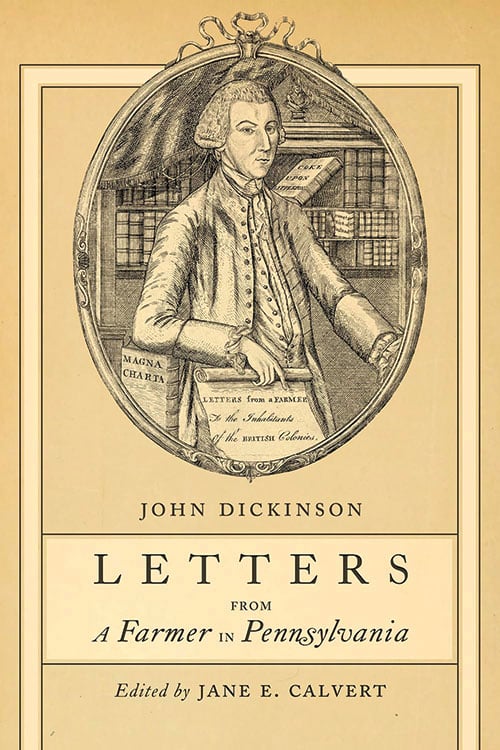
In Brief: Letters from a Farmer in Pennsylvania
Reviewed by Neal Burdick
August 1, 2026
Edited by Jane E. Calvert. Mercer University Press, 2026. 120 pages. $20/paperback.
Like many Quaker adherents, John Dickinson (1732–1808) was a suite of contradictions. He appreciated pacifism, but supported the American Revolution. He believed in radical equality and individual liberty, but opposed the Declaration of Independence—which arguably was what the Revolution was all about. The son of a half-hearted Quaker, he became an abolitionist and freed the people his father had enslaved.
All this and more is well documented in Jane E. Calvert’s preface and introduction to this annotated edition of Letters from a Farmer in Pennsylvania. The letters were written, sometimes under a pseudonym, by Dickinson, a Philadelphia lawyer, gentleman farmer in northern Delaware, and political theoretician who has gotten too little credit for formulating what it meant to be an American and not a British subject in a string of distant, ununited colonies. Dickinson, for example, popularized the critical “united we stand, divided we fall” mantra. And it was he who proposed that the U.S. legislature consist of two houses, one based on population and one on equal representation from every state.
The dozen letters, plainly worded treatises penned in 1767 and 1768, make engaging reading; Dickinson believed he would be more widely credible in a farmer’s voice than a lawyer’s. But it is Calvert’s prefatory essays that stand out. Displaying a solid understanding of 1760s colonial Quakerism, she delves extensively into how much Dickinson, while not an observant Friend, was influenced by Friendly positions such as peaceful conflict resolution and advocacy of civil disobedience. His Quaker-infused Letters in turn greatly influenced those who have been more mythologized as creators of this unlikely nation. Thus the relatively unheralded importance of Quakers in the shaping of America comes through.
But perhaps most important, Calvert weaves in a powerful comparison of the political situation then with that of today, with the threat of authoritarianism brooding over the land. We learn that speaking truth to power is not new, nor has it gone out of style.
Neal Burdick is a member of St. Lawrence Valley Meeting in Potsdam, N.Y.; an attender at Burlington (Vt.) Meeting; and a freelance writer and editor.
We want to hear from you, not an AI! Please be thoughtful and use your own words. Comments on Friendsjournal.org may be used in the Forum of the print magazine and may be edited for length and clarity.