



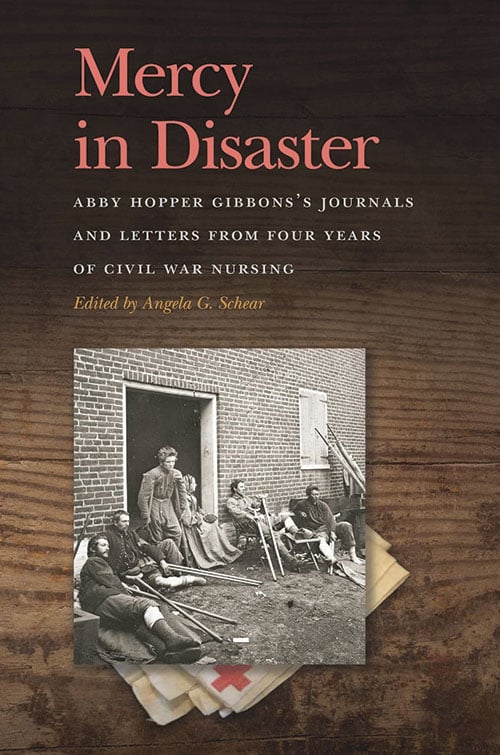
Mercy in Disaster: Abby Hopper Gibbons’s Journals and Letters from Four Years of Civil War Nursing
Reviewed by Gwen Gosney Erickson
September 1, 2026
Edited by Angela G. Schear. University of Georgia Press, 2026. 320 pages. $29.95/paperback or eBook.
Abby Hopper Gibbons’s lived experience included the bulk of the nineteenth century and played out on the front lines of progressive reforms. Mercy in Disaster focuses deeply on the specific years she served as a nurse embedded in the inner workings of Union wartime medical relief, just one of many commitments she undertook over decades of engagement. The book’s introduction shares that Gibbons’s contemporaries stated that she (at age 60 at the start of the Civil War) had a “strong Quaker sense of personal independence” and used her networks to get things accomplished. Part of a University of Georgia Press series called “New Perspectives on the Civil War Era,” this book brings a perspective that is more inclusive of diverse voices than those in more traditional Civil War biographies and military histories.
Some may recognize the Hopper name and already know Gibbons as the daughter of Isaac Hopper, and may already see her as an abolitionist and prison reformer in her own right. Like her father, Gibbons was a Quaker who grounded her practice in Quaker spirituality but was not a formal member for the bulk of her later life. Her work is informed by her Quaker ethos but practiced outside of Quaker-founded institutions. This book’s well-crafted introduction by longtime National Park Service ranger and historian John J. Hennessy sets the stage by introducing both the context of Civil War nursing and of Gibbons’s life leading up to the war. Those wanting to explore beyond the Civil War years can follow up with Margaret Hope Bacon’s Abby Hopper Gibbons: Prison Reformer and Social Activist (2000), which focuses on Gibbons’s abolitionism, institution building, and legislative lobbying, with the latter two topics especially directed toward prisons. Additional Gibbons writings not included in Mercy in Disaster are available online via Swarthmore College’s Friends Historical Library.
Gibbons’s writing illustrates her strong personality and advocacy for justice, even when it challenged assumptions of the day—especially as related to equitable treatment of and recognition for the full humanity of Black people, whether enslaved or free. Her writing is not plagued by the oversentimentality often found in Victorian journals and letters. She is forthright and candid in her assessment of wartime conditions, actions of individuals, and people she encountered, and she is most direct with her views of fellow nurse Dorothea Dix. The inclusion of visitation and conversation with Black people she meets is notable for her naming and referencing these relationships in much the same way that she describes her interactions with individual white people. She shows respect and admiration for all the challenges they are facing and seeks ways to protect them from deadly punishments through her networks and privileges. Lest she be presented as a paragon, she is shown to have biases in some examples offered in the editor’s notes. This is seen especially in her interactions with working-class women and Catholics.
Editor Angela G. Schear has served as a field hospital nurse in contemporary disasters. She draws on a combination of journal and letters to gather documents previously accessible only to researchers along with documents that remain in private family collections. The writings are presented in chronological order and divided into 11 chapters. In addition to the introduction by Hennessy, Schear provides an overview and some context at the start of each chapter. Also included is an appendix of selected excerpts of letters from Friends during the same time period, a listing of Hopper and Gibbons family members, and relevant images. Footnotes clarify and inform without distraction. The topic and presentation methods provide a resource accessible to both professionals and casual readers.
This edition of personal writings is not only for those with an interest in Gibbons. The subject is timely in that it showcases a time of civil disorder and upheaval and how to tangibly care for those caught in the crises, including a growing number of enslaved people who seek freedom on a contested landscape. The book is strengthened by the combined standards of an academic press and the intimacy of personal writing that is edited by a direct descendant.
Gwen Gosney Erickson is the Quaker archivist and librarian at Guilford College in Greensboro, N.C., who discovered her passion for archives from reading nineteenth-century Quaker correspondence.
We want to hear from you, not an AI! Please be thoughtful and use your own words. Comments on Friendsjournal.org may be used in the Forum of the print magazine and may be edited for length and clarity.