



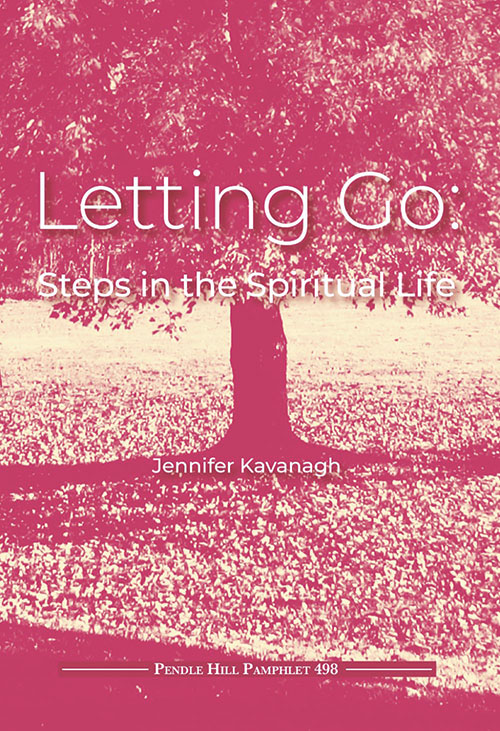
Letting Go: Steps in the Spiritual Life
Reviewed by Hope Ascher
September 1, 2026
By Jennifer Kavanagh. Pendle Hill Pamphlets (number 498), 2026. 31 pages. $8.50/pamphlet or eBook.
I’ve read Letting Go: Steps in the Spiritual Life several times now, and each time, I’ve been deeply touched by different sections. This Pendle Hill pamphlet could be read in one sitting, but reading it carefully and reflectively promises to offer new Light each time it is read. Although letting go of physical clutter in our lives is briefly addressed, it is more about letting go of spiritual clutter. Our spiritual life is like a closet that is sometimes overlooked when we focus on weaning out material clutter. In her pamphlet Kavanagh explores the question, “So why let go?” and suggests that in letting go we “enable grace. To clear a space for the still small voice, to allow Mystery to enter our souls, to be the person we are meant to be, and to breathe in the peace of God.”
Kavanagh herself lives in the UK and worships at Westminster Local Meeting. Her experiences and contributions to Quakers around the world are numerous: elder, local meeting clerk, area meeting clerk as well as an associate tutor at Woodbrooke Quaker Study Centre. She served as Friend-in-residence at Pendle Hill in the fall of 2024.
Kavanagh divides the pamphlet into sections with each focusing on a slightly different perspective on relinquishing control. Different sections spoke to me each time I read it. The last section “Dear Tree, Dear Leaf” contains a series of letters between a tree and its autumn leaves as they fall. The letters from the trees imagine what a mother tree might say to each leaf as it falls from her branches. The letters from the leaves respond to the mother tree with vision and gratitude as they face a new stage in their lives. This might be an interesting exercise for Friends to do if they, too, live in an area where leaves fall.
Kavanagh provides a list of discussion questions that lead the readers through the pamphlet and can be applied to their own spiritual journeys. The pamphlet could be a meaningful part of a daily spiritual practice of reading inspirational literature. Each section is brief and could be used to dig deeper into what the section means and how it applies to the reader’s life.
The pamphlet would also make an appropriate book-club reading. It can lead to sharing different insights as to what the pamphlet means to the members, as well as how it might lead them to “declutter” their own spiritual lives. We do not often take the time to share our own quest to live more uncluttered spiritual lives, and Kavanagh’s work provides an excellent tool to do that in a non-threatening way. She writes:
We are not helpless. We have gifts, abilities given for us to use in service of the Divine. God, it is said, has no other hands but ours. As we open ourselves, we become aware of leadings, often through synchronicities or connections with other people that might help us to discern what is ours to do.
I could not help but wonder how meetings might be different if this book were a tool to deepen and declutter the life of the meeting. How might meetings for worship with attention to business be different if we somehow decluttered our agendas and kept our focus on the spiritual life of the meeting? I like this discussion question from Kavanagh: “What practices have best supported you [or us] in hearing and heeding, the still, small voice?”
Kavanagh’s pamphlet is deceptively simple and relevant to all Friends, even though the individual clutter might be quite different depending on life experience. It is a pamphlet I will read yet again to assist me in my own journey of living more fully in the Light.
Hope Ascher is a member of Melbourne Meeting in Rockledge, Fla. An educator, cook, and naturalist, she is active in her meeting and yearly meeting. Hope convenes an antiracist book group whose goal is reading banned books so that those voices and stories are remembered and not stilled forever.
We want to hear from you, not an AI! Please be thoughtful and use your own words. Comments on Friendsjournal.org may be used in the Forum of the print magazine and may be edited for length and clarity.