



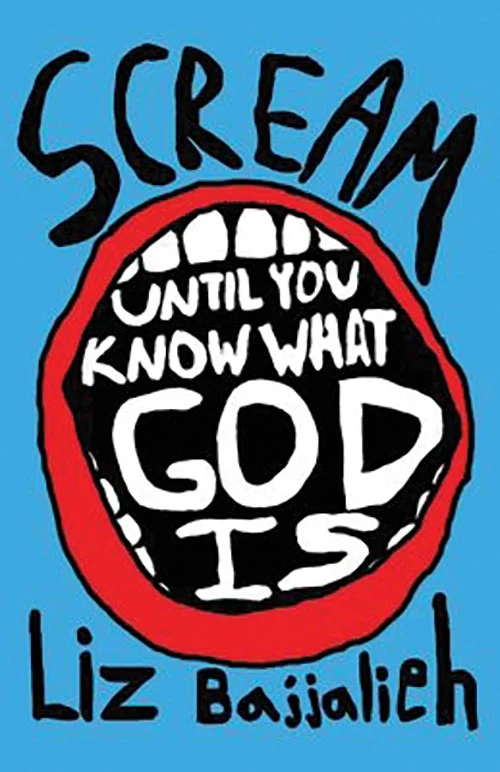
SCREAM until you know what God is
Reviewed by Rüdiger Herzing Rückmann
September 1, 2026
By Liz Bajjalieh. Fernwood Press, 2026. 132 pages. $22/paperback.
Reading SCREAM until you know what God is immediately reminded me of Dorothy Parker’s “A Telephone Call,” in which the protagonist attempts to reason with God while anxiously waiting for a phone call from someone she loves. Much like Parker’s short story, the collection of poems by Liz Bajjalieh is a complex, engrossing, loving, doubting, loving-to-doubt, ultimately rewarding interior conversation about God. The epigraph asks, “If God’s not dead, what is she?”
SCREAM is Bajjalieh’s attempt at a response to that self-imposed question. In a short note at the end of the book, we learn the effort is perhaps both fruitful and futile: “I could write ten million poems each day,” Bajjalieh reflects, “and not even scratch the surface unpacking such a rich spiritual question on what ‘God’ (Or ‘Light,’ ‘Love,’ ‘The Universe,’ whatever you want to call she/they/ze/fae/xi/he/it/etc) truly is.”
In fact, Bajjalieh has written 469 poems (they’re numbered); most are short and they appear one after the other as if one long poem unfolding over 113 pages. The high number might seem daunting, but Bajjalieh’s voice is active, mostly in the present tense, and usually unencumbered by punctuation, enticing the reader line by line to keep turning the pages to know more of the poet’s thoughts and relationship with God.
Friends may find themselves resonating with Bajjalieh’s ruminations about God being everywhere and in everything. Many read like answers to queries or questions posed for worship sharing and discussion. Bajjalieh is never shy in examining their faith and testing their beliefs about their own personal spiritual experience.
Nature plays a central role in many of Bajjalieh’s poems. On the first page, they state: “God is the horizon / At dusk, the dividing line / Between where the day takes its leave / And the night cycles in / The shivering hours of the unknown.” They make good use of indirect rhyme: “God is a meadow of goldenrod / Yellow flowers bursting open, blooming right as fall / Begins to cast its gaze toward the ground.”
A “Quaker(ish),” nonbinary, queer poet and visual artist who grew up in the suburbs of Chicago, Bajjalieh offers imagery as evocative as a coat of many colors: “God is a closet packed with vintage blazers / The doors are open wide, the sleeves rippling out like waves / Neon, flowered, a 1980s dream / So full of pounding personality / You can almost hear them scream.”
I never tired of the soft or loud screaming in Bajjalieh’s poems. Like any good writer, they left me savoring and reflecting on their words after I read them. For anyone who enjoys asking themself existential questions about God or life, I highly recommend Bajjalieh’s poetry.
A poet, teacher, civil rights and mental health advocate, Rüdiger Herzing Rückmann studied privately under acclaimed poets Tess Gallagher and Hayden Carruth. His poems have appeared in Friends Journal and Western Friend and have been presented at Baltimore Artscape and the Albright-Knox Gallery in Buffalo, N.Y. He is a plain Quaker living in Honolulu, Hawaii.
1 thought on “SCREAM until you know what God is”
Leave a Reply
We want to hear from you, not an AI! Please be thoughtful and use your own words. Comments on Friendsjournal.org may be used in the Forum of the print magazine and may be edited for length and clarity.
This is such a kind, well-thought out review of my work. I’m grateful you took the time to sit with my work and find meaning in it. So glad my work is reaching the world!