


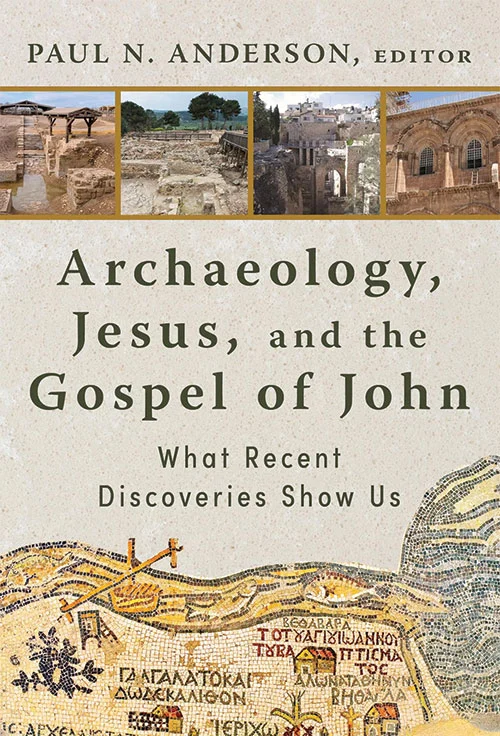
Archaeology, Jesus, and the Gospel of John: What Recent Discoveries Show Us
Reviewed by Brian Drayton
October 1, 2026
Edited by Paul N. Anderson. Eerdmans, 2026. 650 pages. $99.99/hardcover or eBook.
One important element of “the quest for the historical Jesus” lies in the search for independent evidence about the places and events recounted in the gospels. In the many instances where no such evidence exists, whether in documents or in archaeological data, doubt is cast on the reliability of the gospels’ narratives. In cases where history or archaeology provide concrete support, we feel that we can approach a little closer to a realistic view of the gospel stories—and to “Jesus’ awesome and mysterious personality,” to quote Hugh Barbour.
The first three gospels (Matthew, Mark, and Luke) have been regarded as more reliable as factual narratives than the Fourth Gospel. John’s difference in tone, incident, and detail have been interpreted as more highly “theological,” and more removed in time of composition from the events described. Yet this point of view has been challenged by recent scholarship that contends that John’s Gospel is probably not as late in its composition as once was thought, and that it draws on an authentic, independent tradition of story and incident about Jesus’s life and teaching. It can be argued (as Paul Anderson has done in his own scholarship on the Fourth Gospel) that John was composed to complement and enrich the testimony of the other three testimonies. Furthermore, it is a surprising fact that John’s Gospel includes more concrete and verifiable details about the times and the landscape of Jesus’s life than the other gospels. The “spiritual gospel” is notably well-grounded. As Anderson writes in the first chapter, John “features more links with archaeological discoveries and grounded realities than all the other gospels combined—canonical and otherwise.”
Archaeology, Jesus, and the Gospel of John reports on a range of recent archaeological research on various specific details in John’s narrative. Its 25 chapters are grouped in four thematic parts. Part 1 includes an overview of the “mundane” elements of John’s narrative: the place names, description of lifeways and customs, and the political setting. Then it describes what is known about the Galilee region around the time of Christ: who lived there, the evidence for Jewish community life there, and the major towns. The final chapter in the section includes a detailed reconstruction of the roadways (Roman and other) that are known from the time of Jesus, which provides a basis to evaluate the realism of John’s reports of Jesus’s movements from Galilee to Jerusalem, and points in between.
Part 2 continues a focus on archaeological investigations of various points north of Jerusalem mentioned in the gospel, including Bethsaida; Cana; Capernaum; and Samaria, including the setting for the incident in John 4 in which Jesus talks with the “woman at the well,” and recent discoveries of Samaritan worship sites on Mount Gerizim. The nature of the fishing industry around the Sea of Galilee is described, and the growing evidence of active Jewish life in Galilee (where historians for a long time considered gentiles of various types to be the dominant element in the population) is recounted, including discoveries of ritual baths and of stone jars (and associated ritual customs) of the sort mentioned in the story of the marriage feast at Cana in John 2.
Part 3 moves the focus toward Jerusalem, with articles on a variety of topics anchoring the gospel story in demonstrable facts on the ground: the construction of tombs with stone doors that can be rolled away (as in the story of Lazarus); food and clothing; and the pools of Bethesda and Siloam (both part of a complex system developed in Jerusalem to provide access to ritual baths for the crowds of visitors coming for major festivals). Several chapters focus on details in the passion story, including recent archaeology corroborating the details of Jesus’s crucifixion, the most probable location being Golgotha (Calvary), and the tomb of Jesus, with the area embraced by the Church of the Holy Sepulchre apparently the best candidate.
Part 4 contains two concluding chapters reviewing the state of archaeological research related to John’s narrative, nicely encapsulated by Anderson: “this book calls for a more inclusive quest—a Fourth Quest—in the new millennium. And, in the light of archaeological and material soundings, that quest has only just begun.”
This is a big book, and not always easily accessible, as some of the chapters are quite technical. This, plus its cost, means that most Friends and most meeting libraries will not want to purchase it. But Friends should be aware of it and seek it out (perhaps from interlibrary loans) when they come to study John’s Gospel. It provides a welcome, grounding complement to the text-focused scholarship on the “Quaker gospel.”
Brian Drayton worships with Wellesley (Mass.) Meeting. His most recent book, The Gospel in the Anthropocene: Letters from a Quaker Naturalist, appeared earlier this year. He blogs at Amorvincat.wordpress.com.
We want to hear from you, not an AI! Please be thoughtful and use your own words. Comments on Friendsjournal.org may be used in the Forum of the print magazine and may be edited for length and clarity.