



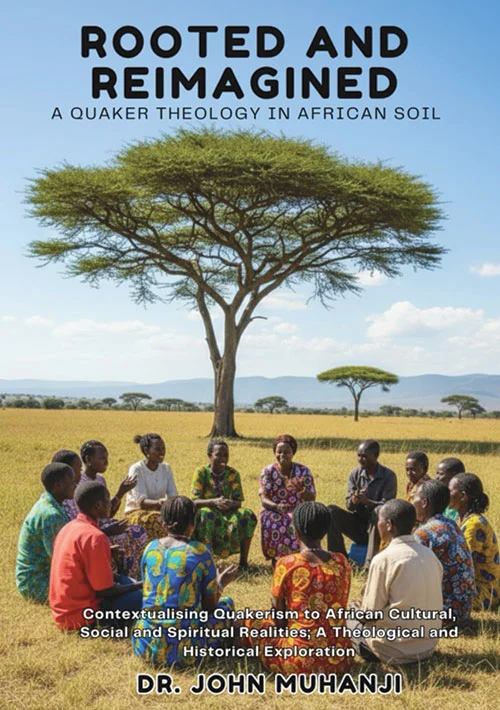
Rooted and Reimagined: A Quaker Theology in African Soil
Reviewed by Alfred Mbai
September 1, 2026
By John Muhanji. Chance Publishers, 2026. 480 pages. $25/paperback; $9.99/eBook.
I was born a Quaker and grew up within the confines of Quakerism because my great-grandmother was among the first female Quakers in Kenya. I attended Kaimosi Friends Junior School before later joining St. Paul’s University in Nairobi, an ecumenical institution by nature, and later, I moved to Switzerland for ecumenism training at the Bossey Ecumenical Institute. Throughout my time interacting with ecumenists, one question became increasingly important to me: What does it mean to be authentically African and authentically Quaker? It is the search for an answer to this question that led me with excitement and curiosity to approach John Muhanji’s Rooted and Reimagined: A Quaker Theology in African Soil.
An African Quaker theologian, church leader, and practitioner, Muhanji is well qualified to be a Quaker church elder. He recently served as director of Friends United Meeting’s Africa Ministries Office, a position he held for over 20 years before retiring this past March. His understanding of African Quakerism today arises from his experiences of seeing its growth, its institutional struggles, and its search for a theological identity.
Rooted and Reimagined was “born out of a long and prayerful reflection on the state of Quakerism in Africa,” writes Muhanji. He begins with a discussion on early Friends theology in 1600s England and North America followed by an examination of the first American Friends mission that landed on Kenyan soil in 1902. After Kenya gained independence from British colonial powers in 1964, many missionaries left the country, often with little notice, leaving African Friends ill-prepared to manage the institutions they helped to build, such as schools, hospitals, and churches. Muhanji identifies the tensions that have shaped Quakerism on the African continent: inherited and historical from the missionary era as well as later social and political realities. At the heart of his reflection are a set of questions:
What does it mean to be Quaker and African? How do we reclaim a faith that has nourished us while shedding the structures that have alienated us? How do we root the Quaker vision in African soil without compromising its spiritual essence?
Muhanji frames much of the book around a concept of contextualization—it is neither a rejection of inherited Quaker tradition nor a formation of a new tradition but a recovering of the radical spirit of Quaker faith in the context of Africa today. Muhanji is urging African Friends to create, interpret, and live their Quaker faith through African histories, cultures, art, music, languages, spiritual practice, and communal realities. It is an ambitious and passionate prophetic call.
In considering ways to carry out this call, Muhanji highlights practical concerns such as youth participation, women’s leadership, theological education, public witness, peacebuilding, and economic empowerment. He argues that contextualization is not merely translating Quaker ideas into African languages or adding African cultural elements to inherited church structures; it is the deeper work of allowing theology and practice to grow from the experiences, wisdom, and spiritual life of African communities.
During the Pastors and Leaders Conference held in Uganda last July, pastor Paul Kuloba of Uganda Friends Church reflected that God is not finished speaking and African Friends are not merely recipients of a finished tradition. I believe this strongly; it follows the Quaker belief in continuing revelation. As Muhanji would put it: Africans need not abandon Quaker essentials but instead listen to how the Spirit may be calling them to embody the testimonies and spiritual discernment within changing African contexts.
One question raised by the book is the role of individual African voices in this journey. Rather than treating Africa as an object of study, Muhanji draws extensively on African theologians, historical experiences, communal practices, and the lived realities of Friends who speak with and from African concerns. Still I would have loved to hear more voices in the book from ordinary African Friends: their stories, conversations, struggles, and experiences of worship and their testimonies.
Rooted and Reimagined took shape during Muhanji’s time as the 2025 Henry J. Cadbury Scholar at Pendle Hill study center outside Philadelphia, Pa. Frances Kreimer, director of education at Pendle Hill, writes in the foreword about Muhanji’s “joyful spirit and firm conviction that Quakerism must genuinely engage with African realities.”
I found Rooted and Reimagined inspiring, challenging, and necessary for setting the foundation of further study into African Quakerism. The book opens a conversation about African ownership, theological identity, and the future of the Quaker movement in Africa. Muhanji’s writing shows a conviction of urgency: pointing out that Quakerism cannot remain alive by repeating inherited forms, and believing that it has both a history to reckon with and a future to shape. The book is a hopeful invitation to the entire Quaker family to listen.
Alfred Mbai is a member of Friends Church Limuru in Kenya. He holds a master’s in communication from St. Paul’s University and a certificate of advanced ecumenical studies from the Bossey Ecumenical Institute in Switzerland. He is a champion for gender equity and rights and uses the written word as an advocacy tool. He is a corresponding editor for Africa for Friends Journal.
We want to hear from you, not an AI! Please be thoughtful and use your own words. Comments on Friendsjournal.org may be used in the Forum of the print magazine and may be edited for length and clarity.