


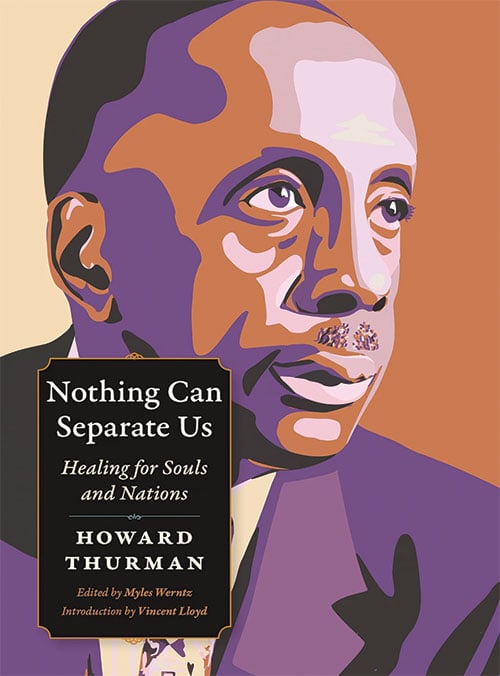
Nothing Can Separate Us: Healing for Souls and Nations
Reviewed by Stephen W. Angell
October 1, 2026
By Howard Thurman, edited by Myles Werntz. Plough Publishing House, 2026. 144 pages. $12.95/paperback; $9.99/eBook.
Howard Thurman, an African American theologian and pastor of the Church for the Fellowship of All Peoples, was perhaps the leading spiritual mentor and sensitive guide for notable twentieth-century persons, including many Quakers and leaders of the Civil Rights Movement, such as Martin Luther King Jr. Coming from a universalist perspective (“universalist” meaning drawing from all religious traditions, Christian and non-Christian), Thurman aimed in his sermons and writings to explore in depth spiritual situations that could confront all people, and ways the situations might be addressed and overcome. A “special student” in 1929 of Quaker theologian and Haverford College professor Rufus Jones (at a time when Haverford had a practice of not accepting African American students), Thurman drew on Jones’s mysticism for inspiration, and adapted his insights in the most compelling way of any of Jones’s students.
While Thurman once stated that he was a part of “the Wider Quaker Fellowship,” Thurman’s Quaker connections go unmentioned in this book. What it does instead is very valuable. It provides an excellent assortment of highlights from Thurman’s books and papers to inspire anew twenty-first-century readers with Thurman’s wise insights and guidance.
Its nine chapters (all a compilation of Thurman’s excerpts) start with the human condition, with the first chapter title recalling Socrates with his imperative to “Know Thyself.” Thurman asks, “When have you last had a good session with yourself? Or have you ever had it out with you?” Thurman urges his readers to cut through superficiality and triviality to arrive at their own “very nerve center.” He goes on to profound meditations about not postponing living, avoiding the temptations of pride, revitalizing one’s existence so that one is fully awake, meeting unfulfilled hungers. Much of the power of this work is provided by the editor’s (Myles Werntz) inspired juxtapositions, drawing on 15 of Thurman’s published works and his papers.
The following eight chapters offer similarly rich selections from Thurman’s thought. Chapters 2 and 3 are “Love Your Neighbor” and “Love Your Enemies.” The third chapter draws especially from Thurman’s most loved and most widely known work, Jesus and the Disinherited, offering an incisive exploration of the condition of those whose “backs [are] against the wall,” such as the Jews under Roman occupation during Jesus’s lifetime, and African Americans living under Jim Crow rule during Thurman’s boyhood in Florida. This was the book that Martin Luther King Jr. carried with him often, including on the 1965 march from Selma to Montgomery. Thurman was a leading advocate of nonviolence, as this chapter makes clear.
The middle section of the book contains Thurman’s reflections on God, focusing on such matters as prayer and surrendering to God. The book closes with Thurman’s thoughts on living in community, something that Thurman viewed with great hopefulness. This theme was at the core of Thurman’s late summarizing work, The Search for Common Ground, one that was reprinted in 1986 by Friends United Press, which, as a Quaker publisher, has done much to keep Thurman’s spirituality before a broader public through its reprinting of many of Thurman’s works.
Werntz, as editor, provides the reader with a concise and eloquent introduction to Thurman’s life to open this volume, ably drawing together many of the intellectual and social themes that animated his life’s witness. In a second introductory essay, African American theologian and philosopher Vincent W. Lloyd offers moving personal reflections on Thurman, drawing, in part, on Lloyd’s own life.
Rarely does one find so much wisdom packed into a book of about 130 pages in length. This is one to read slowly and savor. Thurman himself was a much-prized speaker before all branches of Friends during his lifetime, including Conservative Friends, Friends United Meeting, and Friends General Conference. And now—more than four decades after Thurman’s death in 1981—may he continue to speak to the conditions of a wide variety of spiritual seekers, as we confront our own divided, violent, and contentious age.
Stephen W. Angell is a member of Oxford (Ohio) Meeting in Ohio Valley Yearly Meeting. His latest book, coedited with Ben Pink Dandelion and David Harrington Watt, is Global Quakerism, 1938–2018, from Penn State University Press. He teaches Quaker studies at Earlham School of Religion in Richmond, Ind.

We want to hear from you, not an AI! Please be thoughtful and use your own words. Comments on Friendsjournal.org may be used in the Forum of the print magazine and may be edited for length and clarity.