



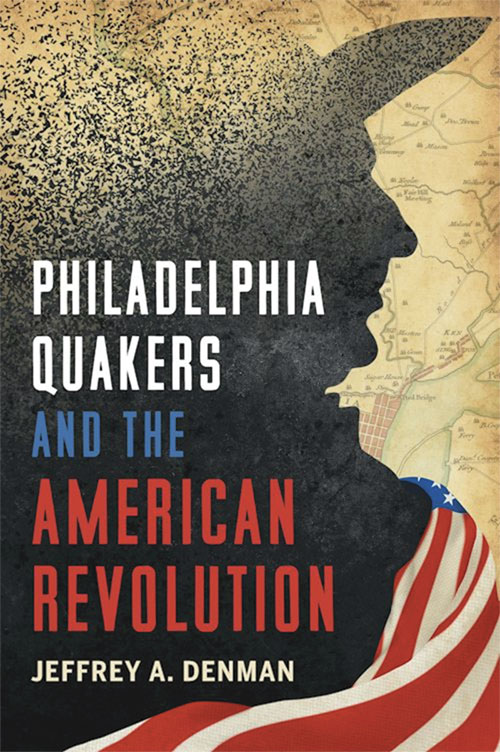
Philadelphia Quakers and the American Revolution
Reviewed by Thomas D. Hamm
November 1, 2026
By Jeffrey A. Denman. The History Press, 2026. 160 pages. $24.99/paperback; $9.99/eBook.
As the United States observes the 250th anniversary of the Declaration of Independence, many residents of this country have felt almost as badly divided as were Americans in 1776. Many Friends have felt led to offer a counter-witness to uncritical celebrations of American exceptionalism and accomplishment. Jeffrey A. Denman’s book shows that such Friends are following in the footsteps of Friends in 1776.
Philadelphia, Pa., was both the spiritual center of North American Quakerism and, for most of the Revolutionary War, the seat of the new American government. Beginning with the meeting of the First Continental Congress in 1774, Friends found themselves in conflict with revolutionary firebrands. In the 1760s and early 1770s, many Friends had joined in opposition to British policies, but when after 1774 opposition seemed likely to lead to violence, they drew back. The fact that the revolutionary effort in Pennsylvania was led by Scots-Irish Presbyterians who had been in conflict with Friends for decades exacerbated tensions. When war broke out in the spring of 1775, Philadelphia Friends had already called on Friends “to discountenance and avoid every measure tending to excite disaffection to the King,” as recorded in meeting minutes from that year. Quaker refusal to bear arms or provide supplies for the military was regarded as treasonable by the new national and state governments.
Things grew worse late in the summer of 1777, when the British invaded the Delaware Valley. The American and British armies confronted each other along the Brandywine in Chester County and fought another battle at Germantown. After the British occupied Philadelphia in October 1777, George Washington and his Continental Army went into winter quarters among Quaker farms at Valley Forge. Meanwhile, American authorities, convinced that Friends were British collaborators, sent a number of leading Friends off to exile in Virginia. Things improved slightly after the British evacuated Philadelphia in the spring of 1778, but two Friends were hanged as British collaborators, and Friends found themselves disenfranchised by oaths that required them to forswear allegiance to the British government.
Not all Friends opposed the movement for independence. In Philadelphia, a breakaway group of “Free Quakers” decided that their faith could be reconciled with supporting independence and military service. Hundreds of Quaker men would be disowned for bearing arms during the war, although it is often unclear which side they were supporting.
Denman’s work raises a perplexing question. He sees Friends committed to pacifism as neutrals, refusing to bear arms for either side. Yet an argument could be made that Quaker exhortations to abjure rebellion and to refuse support for revolutionary governments was in effect loyalism. Certainly that was the judgment of contemporaries.
This is a readable and engaging book. Specialists can argue a few fine points, such as how integral pacifism was to seventeenth-century Quakerism, but these do not detract from the work. Its worst fault is the lack of an index.
Thomas D. Hamm is a member of West Richmond (Ind.) Meeting in the New Association of Friends, and emeritus professor of history at Earlham College.
We want to hear from you, not an AI! Please be thoughtful and use your own words. Comments on Friendsjournal.org may be used in the Forum of the print magazine and may be edited for length and clarity.