



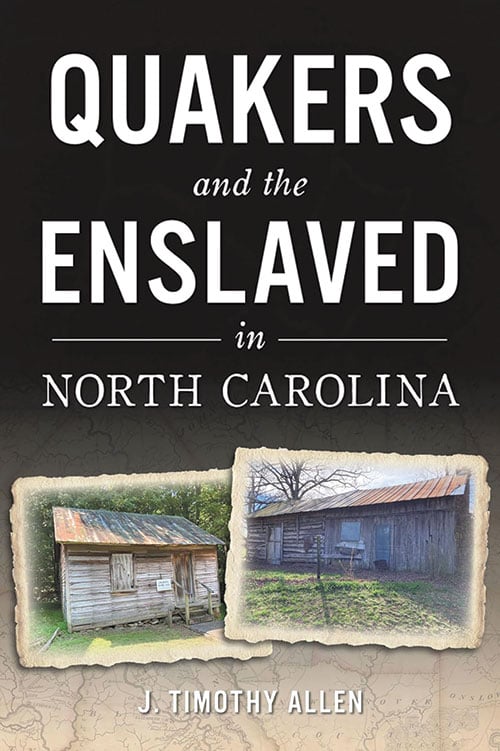
Quakers and the Enslaved in North Carolina
Reviewed by Max L. Carter
November 1, 2026
By J. Timothy Allen. The History Press, 2026. 176 pages. $24.99/paperback.
In popular thought, Quakers are often perceived as being among the very few who have been free from the taint of involvement with slavery. Instead, they are portrayed as heroic opponents, organizing the Underground Railroad and risking life and possessions in illegal activity to free the oppressed. Neither are Quakers immune to this mythology. As a youth growing up in a community of Friends in Indiana that previously had been at the center of Underground Railroad activity in the mid-1800s, I took the stories of that work, along with the presence of Friends of Color who were descended from freed Blacks, as evidence of Quaker non-complicity—and even immunity to racial prejudice.
I was wrong, and J. Timothy Allen’s book Quakers and the Enslaved in North Carolina details with extensive archival research just how involved Friends were in slavery, how complex the history is of their path to antislavery, and their response of how to address the issue of supporting those newly freed.
Allen examines early Quaker attitudes about slavery and notes the response of important figures such as George Fox. Fox, who preached in Barbados before his 1672 arrival in the Carolinas, was aware of the use of enslaved labor on the sugar plantations but encouraged only kind treatment, education in Christian principles, and possible application of Jubilee principles following years of enslavement. Meanwhile, Quaker-owned ships carried more enslaved persons to the island.
As the coastal areas of North Carolina were settled by Quakers in the late 1600s and early 1700s, they utilized enslaved labor on the wealthy plantations made lucrative by the soil of the Great Dismal Swamp drained by canals dug by the enslaved. Allen’s research details the number of persons enslaved by Quakers with familiar surnames: Francis Toms, 8; Patrick Henley, 11; Amos Trueblood, “around 20”; and together Thomas Newby, Caleb White, Zach Nixon, George Walton, and five others held 134.
Gradually, however, the growing sentiments against slavery expressed by William Edmundson, John Woolman, and others were being felt by Friends in the South. John Woolman’s 1746 and 1757 journeys to North Carolina and his visits with Quaker enslavers had an effect. When Newby and over a dozen Friends in Perquimans County chose in early 1776 to manumit their enslaved persons, only to see them captured and re-enslaved, processes began in North Carolina Yearly Meeting to address the situation.
That presented a dilemma for Quaker enslavers. Some chose to accept disownment and hold on to their enslaved persons. Some chose to leave Friends. Those choosing to remain Friends then had to face the reality that manumitting their enslaved persons was against North Carolina law. In response, the migration of Quakers out of the South began, with a trickle in the late 1700s becoming a torrent by the 1820s.
Those who remained in North Carolina worked around the law in various ways. “Colonization” societies raised funds to ship freed Blacks to Haiti, Liberia, and other locations. But that proved to be problematic for many reasons. Manumission societies were formed to advocate for a change in the laws. They ceased to exist by the early 1830s.
An idea was finally adopted by the Yearly Meeting in consort with an antislavery jurist who advised that, since religious bodies could hold property, Friends could hand over title to their enslaved persons to the Yearly Meeting for their protection as “owned,” while being allowed to live as “Quaker Free Negroes.” By the 1820s, North Carolina Yearly Meeting held title to more than 700 formerly enslaved persons, making it perhaps the largest “enslaver” in the state!
Care and oversight for the Quaker Free Negroes became the responsibility of the Meeting for Sufferings, and they had to raise enormous sums of money for that work, including clothing, food, training, and transportation. Donations from beyond North Carolina were received, but a dramatically declining population of Friends in the state was hard-pressed to address the need.
Meanwhile, North Carolina, as were other Southern states, was growing increasingly concerned about large populations of free Blacks: fearing slave revolts. As the work to maintain legal responses to the choice of freeing their enslaved continued, some Friends, as Levi Coffin explained, found the laws to be in contradiction to human decency, and so “we ignored the law.” Beginning with a “Maritime Railroad” along the waterways of eastern North Carolina and the “Aboveground Railroad” of Friends taking free Blacks with them as they migrated to free states in the North, a system eventually evolved of an “Underground Railroad” that aided in the escape of both the enslaved and free Blacks, who continued to face the threat of kidnapping.
Throughout it all, there were ongoing debates among Friends about the propriety of legal vs. illegal activity, gradual emancipation vs. abolitionism, and a continuing undercurrent of racism.
Allen’s work is important to consider as Friends today continue to wrestle with the legacy of slavery and our complicity, as well as with contemporary issues of justice that have Friends divided about the proper ways to address those issues. Our own history can be a helpful guide in considering the ramifications of our decisions.
Max L. Carter is the emeritus William R. Rogers Director of Friends Center and Quaker Studies at Guilford College. He is a member of New Garden Meeting in Greensboro, N.C., and serves on the board of Friends Publishing Corporation, publisher of Friends Journal.
We want to hear from you, not an AI! Please be thoughtful and use your own words. Comments on Friendsjournal.org may be used in the Forum of the print magazine and may be edited for length and clarity.