



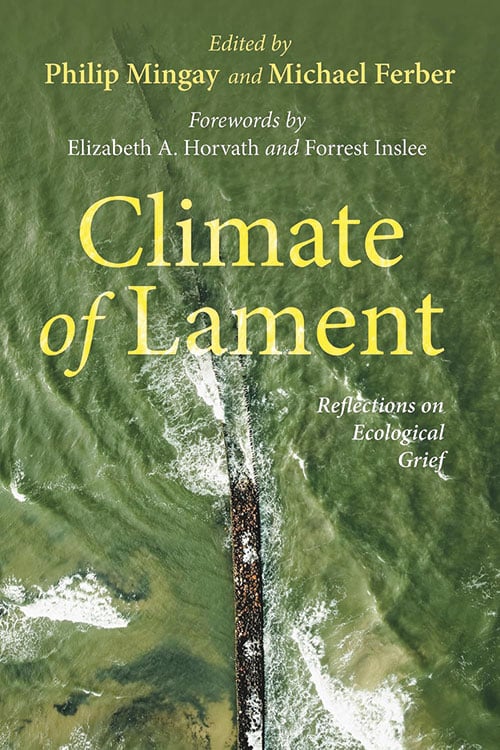
Climate of Lament: Reflections on Ecological Grief
Reviewed by Harvey Gillman
November 1, 2026
Edited by Philip Mingay and Michael Ferber. Wipf & Stock, 2026. 212 pages. $44/hardcover; $29/paperback; $14.99/eBook.
Poetry is booming because it’s the only language for these times of violence and chaos. —Charlotte Higgins in The Guardian (August 10, 2026)
I am writing this review in the south of England on one of the hottest days of the century. Plants are dying in the garden. Insects are in decline. There is news of food shortages, fires to the north, and both floods and fires throughout the world. The country is almost entirely in drought. How do humans perceive our own responsibility for what is happening? If we do, how do we share our feelings? How do we mourn together? How do we—can we—continue living as we do? Indeed, how do we continue living at all?
Poetry has always been for me an alternative voice to the bland rationalism and cynicism that views creation as a source of profit and exploitation. It is an expression of the human as part of the natural and also sacred world—humans not as isolated individuals seeking domination and power but as vulnerable creatures in a fragmented universe. In the foreword to this book, we are told that “poetry is a form of art that can touch both soul and heart.” Poetry then is a form of envisioning.
Climate of Lament is an anthology of 22 poems, each accompanied by a short reflection describing the genesis of the poem and the concern of the poet. The poets, all based in North America, are witnessing the degradation of the world around them. Some have never written poems before; some are very experienced poets. You cannot always tell the difference. It can be hard to find words, however imaginatively, to express deep raw feelings in a way that is illuminating and moving, rather than despairing and overwhelming. And yet there is great wisdom here, a desire to find connection and to express the grief felt at the brokenness of the world.
Lamentation is not part of the Quaker tradition. I have often found Friends reluctant to see grief and negativity as part of the spiritual adventure. There is sometimes a ruthless pursuit of optimism, a modern version of Fox’s not playing up sin and striving for the Light. I have to remember, however, that Quakers are also human beings, and grief, hence lamentation, is also part of the human experience, an acceptance of which is part of the recognition of truth.
This book is influenced by Walter Brueggemann’s “prophetic triad of ‘Reality,’ ‘Grief,’ and ‘Hope.’” The poems observe, feel, and react, leaving the reader with questions as to how we might dare to hope. One of the most moving of the poems for me was “I Saw You Coming” by Michael Ferber. It is based on a visit to a canyon with some students. The canyon had been devastated by fire. In the poem, Ferber speaks of the canyon’s antiquity and its destruction but also of its resilience:
The ash is all you see,
but beneath it,
roots are already listening.
Fireweed presses upward through the cinders.
The mycelium did not die,
it waits,
networked in patience beneath your feet.In his accompanying reflection, Ferber describes the canyon as a “sacred pedagogical place.” Humankind has destroyed much, but the natural world has much to teach, slowly and patiently.
Lamentation is a recognition of our own grief, our need to repent, and make amends. Traditionally, it is a ritual that the community does together. It takes us beyond our isolation to a sense that the grief is universal. In this, we may find solidarity. In her psalm “My God!,” Cassidhe Hart goes through grief to a vision of hope, based on the progression in Psalm 22, “an psalm of Earth”:
My oceans are like wax,
congealed with pockets of petroleum.
My springs are dried up,
soil cracked like pottery.
My skies redden not with dawn
but with smoky haze;
I am set down in the sludge of death.
And yet toward the end of the poem, the tone changes:
All your dirt-bound creatures
will kiss the ground in reverence.
Our being lives for you. . . .
In her reflection, Hart writes: “through our laments . . . we can connect the dots between the suffering we see in our local ecosystems and the larger global climate picture—and, perhaps, walk ever closer to justice.”
This is not a book written by Quakers, but I believe it appeals directly to Quaker sensibilities. It takes for granted a sacred depth in the whole of the natural world, without defining that religious understanding. It concentrates on broken relationships and the need for their restoration, be they political, racial, economic, environmental, or social.
We need a language that somehow meets the needs of a desperate, hope-seeking world. In her reflection, Connie Braun, one of whose poems is titled “Vigil for the Seven Children Who Died in Migrant Detainment Camps,” wrote: “The poetry of lament is a refusal to look away, a refusal to remain silent. It is the poetry of witness.” For Quakers, witness is at the heart of testimony. Perhaps poetry is one way we can witness to a larger, more inclusive vision of creation, imaginatively restoring connections in our disconnected world. This book is certainly a resource for this process.
Harvey Gillman served as outreach secretary for Britain Yearly Meeting for 18 years. He has traveled widely among Friends both at home and abroad, exploring the Quaker way and reflecting on issues of spirituality, outreach, inclusivity, language, and hospitality, both in his writings and in workshops and retreats. His most recent publication is an anthology of poems titled Epiphanies.
We want to hear from you, not an AI! Please be thoughtful and use your own words. Comments on Friendsjournal.org may be used in the Forum of the print magazine and may be edited for length and clarity.