



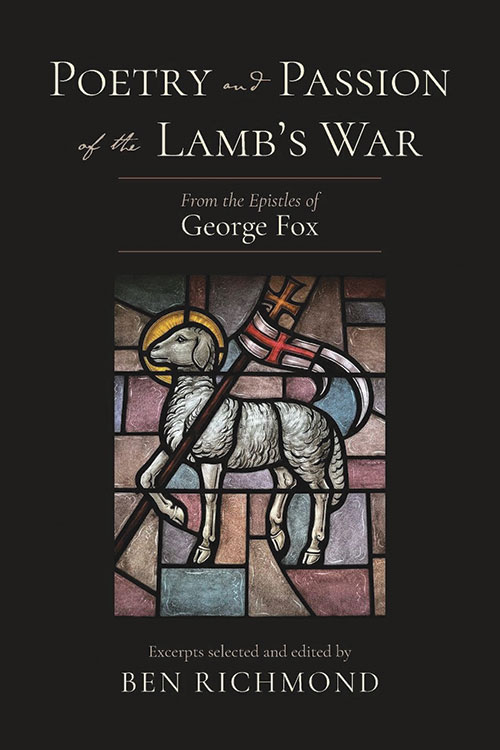
Poetry and Passion of the Lamb’s War: From the Epistles of George Fox
Reviewed by Ron Hogan
November 1, 2026
Excerpts selected and edited by Ben Richmond. Barclay Press, 2026. 262 pages. $28/paperback.
When he began reading George Fox’s epistles, Ben Richmond was profoundly affected by their spiritual power—but, as we learn in his introduction to Poetry and Passion of the Lamb’s War, he “also found Fox’s seventeenth-century English was sometimes obscure, his style dense and repetitive.” Then he started to experiment with the text’s formatting, breaking the long sentences up into poetic lines, and found that it gave him “joy to listen for the melodious movements of the Word in Fox’s letters.”
Poetry and Passion takes on a wide swath of Fox’s public correspondence in this playful manner. Richmond organizes his selections into broad categories, such as “The Light that Enlightens Everyone” or “The Victory of the Lamb Who Was Slain.” He writes a short introduction to each extract, introducing the epistle’s themes and explaining any archaic vocabulary, then helpfully identifies Bible verses that informed the composition of the epistle. Finally, we have the extracts themselves; though Richmond occasionally maintains the original prose structure, most are transformed into a type of free verse. We read, for example, that “every man and woman / must come to truth in the inward parts, / and to the spirit of God / within themselves.”
Occasionally, Richmond uses his introductory remarks to point out that Fox’s messages might speak to our condition. When Fox writes, in a 1655 epistle of “the authority of God, / which is not usurped, / which gives the dominion over all the usurped authority,” Richmond proposes that privilege rooted in race, class, or gender represents modern forms of “usurped authority,” a human corruption of the divine order in which “ye live in the unity, / ye live in the peace, // ye live all in the subjection / one to another / in the fear of the Lord.” (Fear in this case is not a matter of terror but a respectful recognition that God and God’s power exist on a scale far, far greater than we can comprehend, a realization that properly makes us humble.)
Do Richmond’s tweaks and commentaries bring greater clarity to Fox’s epistles? Absolutely. I’ve read essays by Fox and other early Friends that have been preserved online, and teasing the messages out of all those long, winding clauses as they pile atop one another can require intense focus on the reader’s part. The poetic format doesn’t nullify the complexities of Fox’s spiritual arguments, but it does provide the reader with a highly navigable road map—one that enables us to see just how deeply Scripture was embedded in Fox’s thought processes and how it provided him with a language to make sense of the revelations he had received from Spirit.
The majority of Poetry and Passion deals with Fox’s spiritual messages, but Richmond also focuses on a batch of epistles in which Fox lays out some ideas about the shape of the Religious Society dedicated to that spirituality:
So Friends are not to meet
like a company of people
about town or parish business,
neither in their men’s
nor women’s meetings,
but to wait upon the Lord;. . . . . . . . . . . . . . . . . . . . .
that so whatsoever they may do,
they may do it to the praise and glory of God.
Although, as this extract suggests, men and women were often segregated into separate meetings for worship, Fox makes it clear that he considered women’s ministry just as vital and as Spirit-filled:
for women are heirs of life
as well as the men,
and heirs of grace,
and of the light of Christ Jesus,
as well as the men,
and so stewards of the manifold grace of God.
Richmond embraces this plain assertion of equality as a principle that remains true for today’s Friends, as he celebrates the existence of a faith community where “[b]usiness conducted with the intent of listening for the living Voice of God within each of us and drawing us into unity still has power to answer that of God in men and women and draw them into the eternal fellowship.”
Richmond makes several such observations, which are scattered throughout his preliminary remarks, along with some suggestions for spiritual reflection. I sometimes found myself wishing, however, that these observations would coalesce into one clear thesis. Certainly, as a former member of the American Friends Service Committee peace education team and a longtime staffer at Friends United Meeting, he’s in a position to offer a compelling take on modern Quakerism and how effectively it has (or, perhaps, hasn’t) held onto Fox’s vision. If anything, though, Richmond seems to deliberately step back, to keep the spotlight firmly on Fox and his writings.
You can’t really fault him for that decision, of course. Contemporary Quakers often have limited familiarity with Fox’s words. We know about the “one, even Christ Jesus, that can speak to thy condition,” and most of us hear, at some point, about the exhortation to “be patterns, be examples.” And then . . . not so much. So we should welcome anything that helps us better understand how Fox shaped Quaker faith and practice. I still might wish for more of a helping hand—not to tell readers exactly what to think about George Fox—I wouldn’t want that—but to bind all his many thoughts even more tightly together for our contemplation.
Ron Hogan is the audience development specialist for Friends Publishing Corporation and webmaster for Quaker.org, where he writes a weekly message connecting Friends’ faith and practice to Scripture called Look to the Light. He is also the author of Our Endless and Proper Work.

We want to hear from you, not an AI! Please be thoughtful and use your own words. Comments on Friendsjournal.org may be used in the Forum of the print magazine and may be edited for length and clarity.