



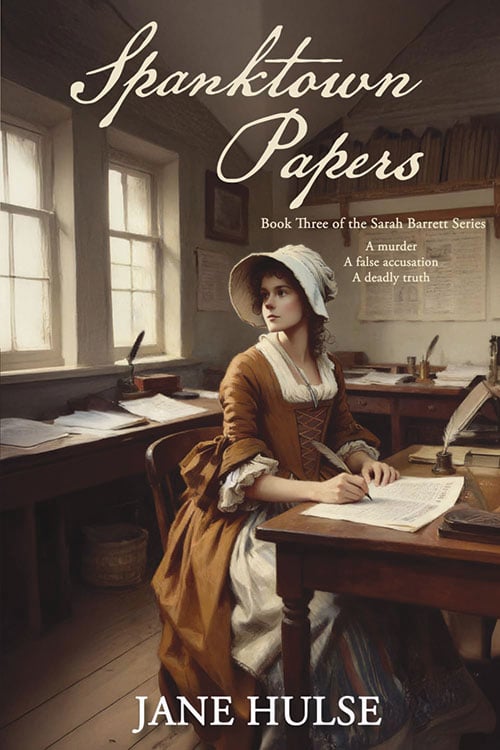
Spanktown Papers
Reviewed by Abigail E. Adams
November 1, 2026
By Jane Hulse. Open Books, 2026. 278 pages. $19.95/paperback; $9.99/eBook.
This novel, the third and last in a series set during the American Revolution, places Philadelphia Quakers in the spotlight during the event of the Spanktown Papers. In 1777, a Continental Army general claimed to have intercepted documents from Spanktown (today’s Rahway, N.J.) Quakers that proved they were spying for the British. The papers were clearly faked; nevertheless, 20 Quaker men, most of them well-to-do merchants and elderly, were seized, transported, and held in Winchester, Va., without habeas corpus or charges. Quaker women formed a delegation to travel to the Continental Army and congressional leaders and petition for the release of the men in their families; historians have described this as possibly the first women’s collective political action of the new republic.
Author Jane Hulse uses the essentials of the event to center the narrative on the women, both Quaker and non-Quakers, of the households who were left to fend for themselves. The protagonist, the young journalist Sarah Barrett, is one of an ensemble featured throughout the series; all of whom are closely tied to loved ones on opposing sides of that conflict. This volume focuses on those who refused to “take sides,” the Quakers, who further aroused suspicion and anger when they would not engage in direct or indirect acts that supported the war, such as using the worthless currency created by the rebels. Friends today will resonate with that testimony.
A subplot involves Sarah’s boss, a wealthy white newspaper publisher, and the formerly enslaved woman he emancipated and then hired as a servant in his home and business. He also takes her as his concubine, and the author’s framing of this coerced control growing into a love story begs credibility or compassion.
Spanktown Papers is a plot-driven novel, and I read to the end, despite the thin writing. I found the young women of the series’ recurring characters anachronistically modern in their perspective and language.
I appreciated how Hulse addressed the wealth—and privileged oblivion—of many of the Philadelphia Quakers. Sarah, the non-Quaker journalist rooming with a Friends family, is not blind; she is critical of Quaker contradictions and their seeming to be unaware of the differences in their suffering and that of the soldiers quartered at Valley Forge or of others suffering under British rule. It was thought-provoking to consider how non-Quakers experienced the actions and positions of economically powerful yet ideologically marginal Philadelphia Friends. I also enjoyed the explorations of how people negotiate their love and connections with those who take opposing sides on the issues of the times.
Abigail E. Adams worships with New Haven (Conn.) Meeting and serves on Friends Committee on National Legislation’s General Committee and Woolman Hill Retreat Center’s board. A recently retired anthropology professor, she continues work in urban forestry, in Central America, and on immigrant concerns. Although she was unexpectedly elected to town office, she dreams of serving as a Connecticut tree warden.
We want to hear from you, not an AI! Please be thoughtful and use your own words. Comments on Friendsjournal.org may be used in the Forum of the print magazine and may be edited for length and clarity.