



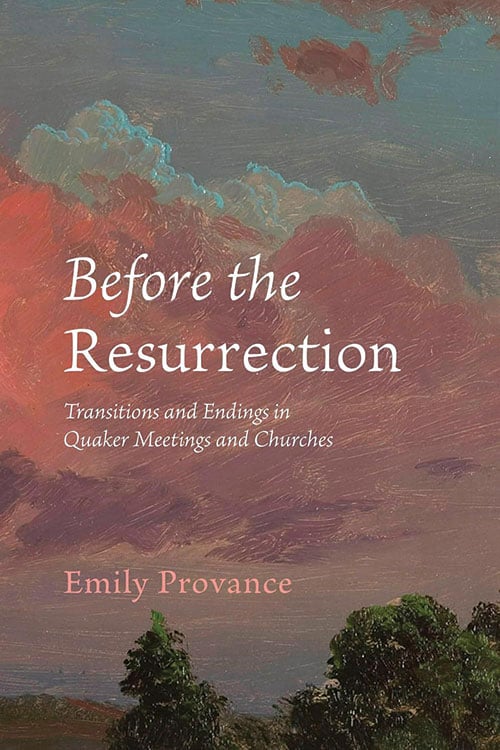
Before the Resurrection: Transitions and Endings in Quaker Meetings and Churches
Reviewed by Diane Randall
February 1, 2026
By Emily Provance. Resource Publications, 2025. 150 pages. $35/hardcover; $20/paperback or eBook.
Before the Resurrection offers provocative and pragmatic challenges to Friends regarding the health and well-being of our institutions. The theme of this book, reflected in the subtitle, frames the essential Quaker spiritual practice of corporate discernment as the grounding for resurrection of our institutions. “For Quakers, collective faithfulness starts with deep listening to the Holy Spirit in the context of corporate discernment,” writes Emily Provance. “Our regular practice of deep listening in worship (regardless of whether our worship is programmed or unprogrammed) prepares us to hear and act on God’s promptings.”
It is through the practice of corporate discernment that Friends can take on what for many is a difficult challenge: recognizing the diminishment and eventual death of their Quaker meeting or church, and taking the pragmatic steps of accompaniment and care in the process of ending or transitioning that community.
People who have encountered Provance as a traveling minister among Friends have likely observed her keen listening and her plain speaking. This book is based on her work, over many months in 2022 and 2023, of listening in consultations with Friends (in 148 local meetings) on the life cycle of meetings. It is written in a plain-spoken manner. That is to say, her words may be difficult to encounter in their directness, but her overall message is accessible to read and vital to the health of our Religious Society of Friends.
Early on in the book, Provance clearly points out the distinction between an institution and a community; the former represents the legal, administrative, and structural aspects of a Quaker meeting, and the latter refers to the covenant community united by the Divine and a “collective commitment to faithfulness.” If the purpose of the institution is to support the community, but the community exists mainly to support the institution, it is time to ask the difficult questions such as “Are we able to care for one another?” and “Can we carry out the basic functions of a Quaker meeting?”
Through queries and advice on processes for adaptation, Provance provides a pragmatic guide for how meetings and churches can be faithful to the changes that, while difficult to confront and implement, can ultimately strengthen a faith community. The book outlines the roles of clerks, pastors, record keepers, trustees, and regional or yearly meeting clerks and staff in this process. And Provance challenges us to not only look at local meetings and churches but also consider the viability of regional and yearly meetings to discern if the current structures are working.
Shrinking numbers of attenders and members is a frequent concern in many Friends meetings—especially the longing for more young people and families with children. While many Quaker meetings and churches in the United States have aging members and few new attenders, it is also true that some meetings (especially in urban areas) are seeing an increase in seekers—people looking for a community in which they can find a spiritual life. My meeting, Friends Meeting of Washington (D.C.), is currently relishing an influx of new people; we find ourselves considering how to be responsive and inclusive of new seekers, offering various opportunities for worship, education, and social engagement.
The notion of Quakers as a “resurrection people,” a people open to spiritual transformation and inbreaking of the Holy Spirit, requires us to be attentive to our discernment—both at a personal level and in our corporate practice. Some may see Before the Resurrection as a handbook only for Friends considering whether and how to lay down or transition their meetings; it certainly provides practical guidance for that, but it also offers clear encouragement and way forward for any transitions a meeting might take that differ from the status quo. Because in navigating changes to the grounding institutions in our lives, we also need to be prepared for conflict and ready to offer pastoral care.
In an era where our society, culture, and political lives are in upheaval, we long for constancy and community in our Quaker meetings. This book is a reminder that it is in the corporate discernment of our gathered community that we will find a way forward. I encourage all Friends who think about the health and flourishing of the Religious Society of Friends to read this book and take heed of Provance’s advice.
Diane Randall is a member of Friends Meeting of Washington (D.C.). Diane served as general secretary of Friends Committee on National Legislation from 2011–2021. Friends’ faith and practice as manifested in worship and through public ministry provide her with a continuous source of hope.

We want to hear from you, not an AI! Please be thoughtful and use your own words. Comments on Friendsjournal.org may be used in the Forum of the print magazine and may be edited for length and clarity.