



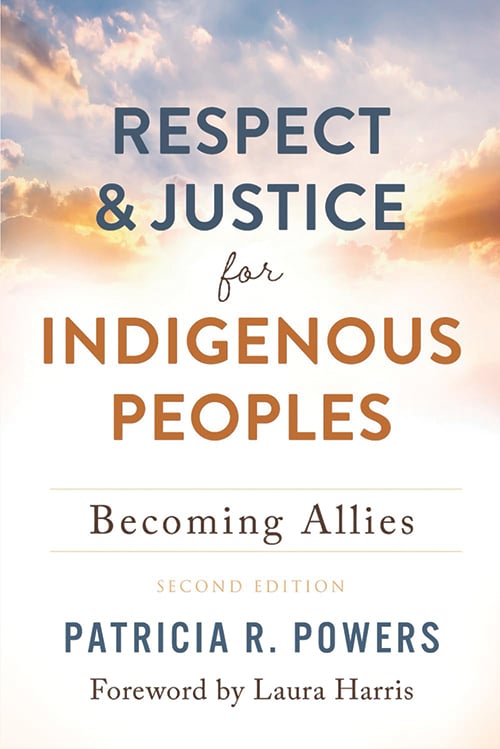
Respect and Justice for Indigenous Peoples: Becoming Allies
Reviewed by Brian Drayton
April 1, 2026
By Patricia R. Powers. Self-published, 2025. 414 pages. $19.95/paperback.
Friends have had a long engagement with the Native peoples of North America. We have at different times worshiped with them, exploited them, respected them, and we have tried to “civilize” them, to learn from them, to advocate for them, and to accompany them. Many yearly meetings have had committees that are concerned for Indigenous affairs, and it is probably safe to say that over the past three centuries our understanding has changed on the way to enact our concern, sometimes changed in dramatic ways.
This book, “designed to give the reader a sense of the ‘long haul’ of modest efforts that help to keep the flame alive,” describes many aspects of Baltimore Yearly Meeting’s (BYM) attempts to act in conscience in relation to Indigenous peoples. There are times when the book reads like a compendium of brief accounts or even a scrapbook: an organized collection of “chronicles and history highlights,” as the title page describes. In fact, the story is coherent, and the diversity of topics covered reveals in valuable detail the complexity of the challenge that faces any authentic engagement between a group such as the Quakers and Indigenous peoples. Patricia Powers, who for a number of years worked with Friends Committee on National Legislation advocating for Native American issues, frames every chapter as a story about listening and learning, which are both foundational to this kind of effort.
The book has two major sections. The first details the organization, funding, alliances, and evolution of the yearly meeting’s Indian Affairs Committee since its post-Revolutionary War beginning in 1795. Powers pays close attention to the changing ways in which BYM Friends understood their mission. In the early decades, the focus was both charitable and paternalistic. That is, there was compassion at work, but the understanding of the task was shaped by the idea that the Native peoples in North America—diminished and marginalized as they were—could only be seen as participating in a dying culture. Assimilation seemed the best way to a better life in the world that the colonizers had imposed on them. On this view, a compassionate response was focused on the “improvement” of the Indians, as the committee put it. This included attention to “their welfare, their religious instruction, knowledge of agriculture, and the useful mechanic arts.”
This general orientation was widely shared among Friends and others who had any philanthropic interest in the Native peoples who persisted among them. It is no surprise, therefore, that Friends came to take an active role in the Indigenous boarding school movement, whose effects were destructive, cruel, and persistent down to our own day. As we have found in New England Yearly Meeting, we are presented over and over with the paradox that well-respected Friends, whose judgment was trusted and supported by their meetings, proceeded with an invincible conviction that they were doing the Lord’s work, while contributing to the further destruction of Native cultures and wreaking havoc in many thousands of individual lives.
The book recounts the growth in understanding of Friends with a concern for Native peoples that occurred by the end of the twentieth century and the beginning of the twenty-first, which led to the committee “aligning itself with the priorities set by Indigenous organizations.” The emphasis was shifting from doing things for the Indians to doing things with the Indians. Friends were beginning to hear Native peoples’ insistence that the loving concern which they welcomed be seasoned by Quaker acknowledgment of the truth of past and present relationships. Questions such as aid, reparations, and advocacy needed to take place in a context where Quakers came to understand what they did in the past and what mistakes and harm were done, and to acknowledge these to their Native American interlocutors.
An important part of this first section of the book is the unpacking of the network of allies and partners within which BYM Friends have been working. These include Friends groups and other yearly meetings, civil groups of various kinds, and groups and movements found among Indigenous peoples themselves. There is an extensive account of the many opportunities that Friends have helped with, including gatherings between Native and non-Native peoples for mutual information, relationship building, and sometimes shared action.
The second part of the book is a history of the committee’s activities from the 1940s to recent times. This section recounts many specific concerns undertaken by individuals or groups of BYM Friends, including support for language revitalization; for recognition of Native land rights; activity against stereotypes and disrespectful uses of the images, traditions, costumes, etc., of Native peoples, e.g., in branding or the naming of sports team; and reparations in land and in money. The closing paragraph in the book provides a valuable vantage point from which to look back at the history of Quaker engagement with Native peoples and forward to the next phases of those relationships:
Today, Indigenous peoples have far more advocates and the Committee is too small to function as a “partner” at more than a local level. Do Committee activities add any value? Ideally, this decision would be made with input from the Indigenous community. In the meantime, Committee members strive to be more than well-wishers, to do more than make gestures of assistance.
I recommend this book to any Friends who are or who hope to be engaged in right relationship with Native peoples, and also to Friends who would like to reflect on the persistence, attention to detail, and teachableness that is entailed in carrying out a long-term concern.
Brian Drayton worships with Wellesley (Mass.) Meeting in New England Yearly Meeting. He blogs at Amorvincat.wordpress.com. His latest book, The Gospel in the Anthropocene: Letters from a Quaker Naturalist, will appear in April 2026 from Inner Light Books.
We want to hear from you, not an AI! Please be thoughtful and use your own words. Comments on Friendsjournal.org may be used in the Forum of the print magazine and may be edited for length and clarity.