



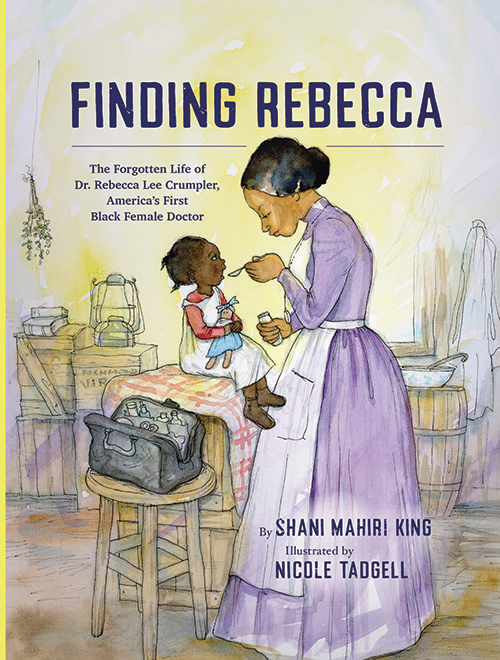
Finding Rebecca: The Forgotten Life of Dr. Rebecca Lee Crumpler, America’s First Black Female Doctor
Reviewed by Jerry Mizell Williams
December 1, 2025
By Shani Mahiri King, illustrated by Nicole Tadgell. Tilbury House Publishers, 2024. 64 pages. $19.99/hardcover; $17.48/eBook. Recommended for ages 6–12.
It is a challenge to reconstruct the lives of individuals whose history is riddled with information gaps. In the case of nineteenth-century doctor Rebecca Lee Crumpler, the incompleteness is more pronounced because few family records have survived. Born in Christiana, Del., in 1831, she had little information of her early life recorded. There is evidence her parents sent her to an aunt in Philadelphia, Pa., whose work as a community health worker greatly impressed her young niece. At age 17, Rebecca began studying at West Newton English and Classical School outside Boston, Mass., where principal Nathaniel Allen nurtured her interest in the natural sciences.
In 1852, Rebecca married formerly enslaved Wyatt Lee and focused her budding nursing practice on caring for mothers and young children. In 1860, the New England Female Medical College accepted Rebecca as its first Black student. Wyatt Lee died in 1863, and Rebecca married Arthur Crumpler in 1865. The couple traveled to Richmond, Va., and worked for the Freedmen’s Bureau for four years. They then returned to Boston where they welcomed the birth of daughter Lizzie in 1870. Although Rebecca retired in the 1870s from her practice in midwifery and pediatric care, she found time to teach at West Newton School.
Rebecca is remembered for being the first Black woman physician to publish a treatise on medicine, A Book of Medical Discourses, in 1883. In the book, she advocated for women’s study of medicine, but there are few details about the author and her family. The book is dedicated to “mothers, nurses, and all who may desire to mitigate the afflictions of the human race.” Its two parts consist of infant care up to age five, and womanhood and complaints of both sexes. Rebecca strongly championed equal access to medical care for both the rich and the poor. Her death in 1895 might have been the end of her story, were it not for the research of Finding Rebecca author, Shani Mahiri King, and others.
As a way of countering the lack of records, King tactically centers Rebecca’s experiences to reflect the context of sociocultural values and political realities of the nineteenth century for a free Black woman. With the aid of informative marginal notes, King engages students in the life of free Blacks in the border state of Delaware: travel restrictions Blacks endured, the presence and force of Quaker abolitionists, and educational opportunities in the North. The result is a book that captures the imagination of readers and invites them—as budding historians and researchers—to participate in discussion and writing activities designed to have them reflect on how to uncover the past. Beautiful illustrations by Nicole Tadgell draw readers closer into the narrative as we picture Rebecca in her professional and personal worlds.
Friends, teachers, and librarians will appreciate the work King has done to uncover the lost story of Dr. Rebecca Crumpler and bring greater awareness to her achievements. In recent years, her legacy continues to be honored at state and national levels, including the city of Boston proclaiming a day to officially honor her (February 8, her birthday), and by medical schools for her pioneering work with women and infants.
Jerry Mizell Williams is a member of Green Street Meeting in Philadelphia, Pa., where he serves as archivist. He is the author of numerous books and articles on colonial Latin America.

We want to hear from you, not an AI! Please be thoughtful and use your own words. Comments on Friendsjournal.org may be used in the Forum of the print magazine and may be edited for length and clarity.