



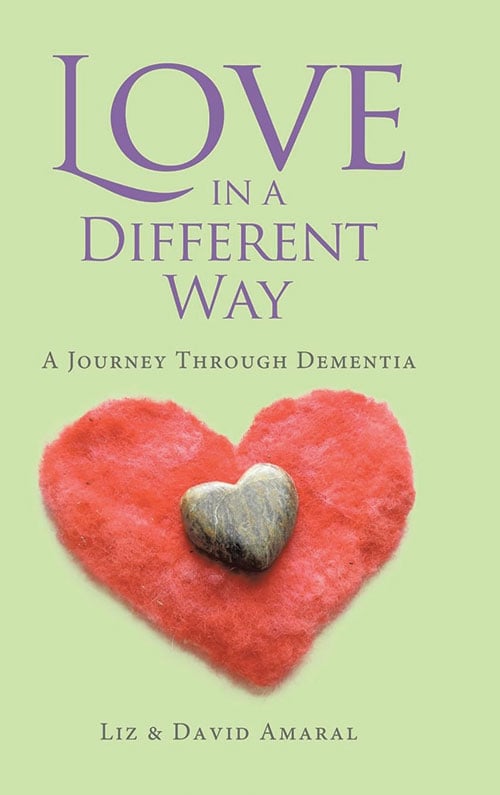
Love in a Different Way: A Journey Through Dementia
Reviewed by Brad Sheeks
November 1, 2026
By Liz Amaral and David Amaral. Tellwell Talent, 2025. 110 pages. $28/hardcover; $19.10/paperback; $2.99/eBook.
Where does my pill box go? I’d just returned from a family visit in Minnesota, and while unpacking my bag, I pulled out my pill box and was flustered when I couldn’t remember where I keep my pill box. In the bathroom? Nope. I glance at my bedside table. Oh yes! Of course. It goes on my bedside table. Hello, Dementia. I see you’re back. What do you have to teach me today?
Liz Amaral has gifted us with Love in a Different Way: A Journey Through Dementia using her husband’s drawings and notes along with her own stories of her 50-year marriage to David Amaral. During their last few years together, he descended into the darkness of what initially was called Alzheimer’s, then the diagnosis was refined to be frontotemporal dementia, a brain disease that causes such symptoms as dramatic changes in personality, behavior, and language.
I couldn’t put the book down. The parallels between Liz and David’s marriage and my marriage to Pat McBee are too close for comfort. They met in 1970, fell immediately in love, and married soon thereafter. “We saw life through a shared spiritual lens,” writes Liz, a member of Argenta Meeting in British Columbia. Pat and I met in 1971, fell in love, and married within a few months. Now, 55 years later, I’m in an early stage of progressive dementia.
David wanted his drawings to show what it was like to live with his disease. The book contains 32 pictures, followed by his notes and Liz’s interpretations and stories as his life partner and caregiver. David used a canoe as a metaphor for their life together. An early drawing shows them in a canoe, floating backward, trapped in the rushing current. The river banks are lined with rocks. There is a waterfall just downstream. He notes, “I am destined to launch off the waterfall and fall forward in the ‘Lights’ mist.” David’s drawings pull you into his story. His notes are painful to read. Hers are even more so.
Sixteen drawings later, we see David sitting in the middle of the canoe, empty-handed. Liz is standing on the riverbank holding both life jackets. The canoe is yellow: David’s color for God’s presence. The gunwale is black: his color for dementia. Seeing David in the middle of that canoe without a paddle sends me back to a painful time in 2024 when I wrote to family and friends that I had to give up driving. David had to learn to ask for help; something I also had to learn. Dementia teaches hard lessons.
One of David’s early drawings, “Disorientation,” is of a blue hallway extending down to a dead end. Locked doors with no signage are on either side. He writes that once while in a dementia support group, he needed to go to the bathroom and got lost in the hallway. Liz recalled that it was around then that she realized the need to be more open and disclosing about their situation. Recently, I had a similar moment of confusion as I got off an elevator: “Where am I? Why am I here?”
David’s drawing of a dining table with a dozen slices of pizza stacked on top of each other is titled, “Overwhelm.” He couldn’t filter out peripheral sights and sounds: everything came at him at once. He needed to reduce sights and sounds, including the usual things in their home. Pictures had to come off the walls. Shelves had to be emptied. Curtains had to be drawn to shut out the light. Their lives were turned upside down.
David thought his sundowner’s syndrome was caused by his worry that he might not be able to sleep. It was a vicious cycle. The more he worried, the worse his sleeplessness got. His drawing has dark lines splitting the picture into pieces.
When Liz could no longer care for David at their farm home outside Nelson, British Columbia, she applied for assisted living housing for him, but unfortunately the application was rejected because David “wasn’t disabled enough.” So she found him a small cottage in town and made arrangements with an adult daycare program. As his symptoms worsened, Liz tried again for the assisted living facility and this time it was approved. It was a big relief for Liz: “I could finally stop being absorbed in errands, medications, risks, and worries. When I visited with him at his new home, we could just be together.”
David died in May 2021, with Liz at his side. She writes, “I knew he’d gone over the waterfall.”
Love in a Different Way is a treasure. David’s drawings and notes drew me into his story. Liz and David Amaral have given me a deeper sense of what it is to live with dementia.
Brad Sheeks, a retired hospice nurse, is a member of Newtown (Pa.) Meeting.

We want to hear from you, not an AI! Please be thoughtful and use your own words. Comments on Friendsjournal.org may be used in the Forum of the print magazine and may be edited for length and clarity.