



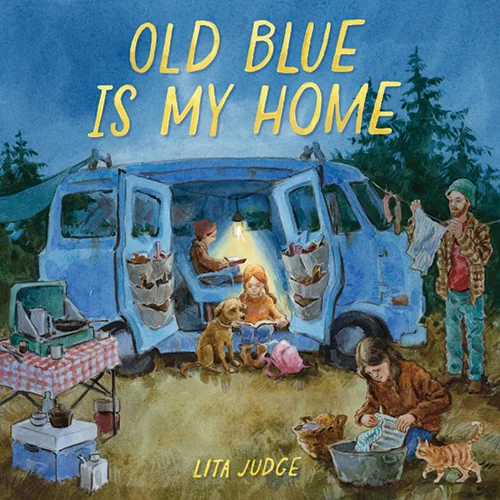
Old Blue Is My Home
Reviewed by Anne Nydam
May 1, 2026
By Lita Judge. Abrams Books for Young Readers, 2025. 40 pages. $18.99/hardcover; $17.09/eBook.
Old Blue Is My Home is a picture book written and illustrated by Lita Judge about housing insecurity, but if you’re looking for a book to emphasize the horrors of homelessness, this is not it. The narrator of the story lives with her family in a van, which may not be a house but is nevertheless a home. She describes some of the ways her family manages the logistics of not having a house, and the note at the end of the book explains some of the different ways housing insecurity may be experienced. Within the story, the young narrator does mention some of the disadvantages of her family’s itinerant life, especially that other children don’t come over to play with her. Yet the majority of the book celebrates all the ways that she loves her home in the van.
The beautiful watercolors by Judge capture life in the van in different places, weather, and times of day. They convey the warmth and affection the child and her family feel, as well as the occasional loneliness. For the most part, however, life in Old Blue may look to a child like one, long, idyllic camping trip. This is not a book that tries to evoke sympathy. Instead, it fosters understanding. Rather than moving us to feel sorry for the disadvantaged, it invites us to understand that people in very different circumstances can nevertheless share many of the same joys and concerns to which we can relate.
If your meeting’s First-day school collects groceries for food pantries, toys and school supplies for children in shelters, or toiletries and socks for those living on the street, this book can provide a sensitive look at another facet of the problem of housing insecurity. Widening our understanding of the range of circumstances families may face, as well as our empathy for the lives that they build for themselves, Judge offers us a different perspective on an issue for which many Friends meetings hold a concern. It may be necessary to share resources about some of the other forms homelessness may take, especially if your meeting does more work with the urban unhoused population.
This book is valuable in presenting this family not as “others” to receive charity but as people very much like ourselves, who summon creativity and dignity in finding solutions and making the best of their situation. The simple, gentle prose is appropriate for children as young as four, who could understand the difficulties imposed by housing insecurity, while also being reassured that love can flourish in all circumstances.
Anne Nydam is a member of Wellesley (Mass.) Meeting. A former middle-school art teacher, she now works as an author and artist.
We want to hear from you, not an AI! Please be thoughtful and use your own words. Comments on Friendsjournal.org may be used in the Forum of the print magazine and may be edited for length and clarity.