



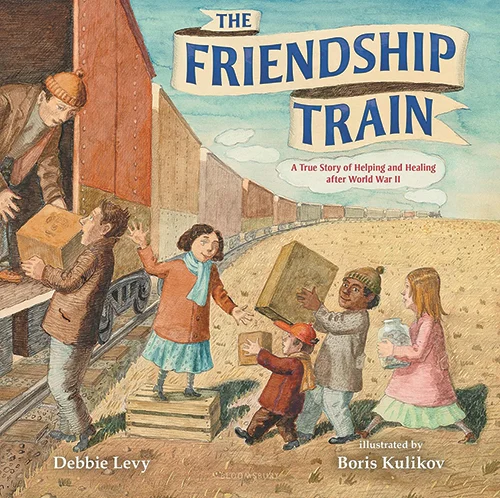
The Friendship Train: A True Story of Helping and Healing after World War II
Reviewed by Karen Clark
May 1, 2026
By Debbie Levy, illustrated by Boris Kulikov. Bloomsbury Children’s Books, 2025. 48 pages. $20.99/hardcover; $14.69/eBook.
The Friendship Train begins with a question: “How can I help?” Drew Pearson asked this of himself when he learned of the hunger in Europe at the end of World War II. Farms had been destroyed; farmers had been busy fighting; and winter was coming. Fortunately, Pearson was a writer for many newspapers in the United States, and he took this question to his readers. Their response was enthusiastic, and the idea of filling a Friendship Train with food for European families was hatched.
Pearson originally thought of filling one boxcar with food, but the generosity of children and families expanded that thought into a reality of 12 full boxcars before the train left Los Angeles, Calif. This beautiful blossoming of donations continued like a runaway train, pun certainly intended. Eighty cars pulled into Chicago, and 100 boxcars left on a journey to the East Coast, and 200 boxcars arrived in New York after a journey of just 11 days. Donations from people who lived out of the train’s path swelled the bounty to 500 boxcars, which filled four ships. These gifts of food filled countless empty bellies in Europe, and the recipients asked a new question: “How can I show my gratitude?” European children and families gathered toys and gifts to ship to the United States in a heartfelt gesture of thanks.
Readers of all ages will be inspired by this story and these important questions: “How can I help?” and “How can I show my gratitude?” Children can apply the themes of empathy, generosity, and the power of collective effort to any problem that seems too big. The inclusion of people beyond the borders of one country as members of a global community is particularly timely. It is not surprising to learn that Pearson was a Friend, born to Quaker parents in Illinois. While his journalistic style was seen as fierce by many, those who knew him described him as a gentle soul.
Debbie Levy’s text is accessible to young readers as a read-aloud and robust enough to inform and entertain readers through elementary school. The lovely, muted tones of Boris Kulikov’s illustrations beautifully evoke the postwar era. The Friendship Train has the feel of a cherished family story that is passed down to the newest generation.
Karen Clark, a convinced Friend, is a member of Little Falls Meeting in Fallston, Md., and a third-grade teacher at Friends School of Baltimore. She has taught in independent schools for 24 years.

We want to hear from you, not an AI! Please be thoughtful and use your own words. Comments on Friendsjournal.org may be used in the Forum of the print magazine and may be edited for length and clarity.