



A Quaker Reviews the Shaker Film The Testament of Ann Lee
The Testament of Ann Lee (2025). Directed by Mona Fastvold. Screenplay by Mona Fastvold and Brady Corbet. 137 minutes. Rating: R. Now playing in select theaters.
I’ve seen The Testament of Ann Lee twice now, and my mind keeps coming back to an image near the very end of the film, as male and female Shakers gather to dance at Ann Lee’s funeral. The camera takes position above the mourners as they shift into a pattern with four women at the center, rotating around a fixed point like the leaves of a paper windmill, surrounded by larger groups who hold them in a series of clockwise- and counterclockwise-rotating circles.
The shot feels like something from a 1930s Busby Berkeley production, the sort of image that, if a director uses it at all these days, gets treated as a visual joke, a knowing wink to the audience about the artificiality of musical numbers—silly, yes, but aren’t we all having fun at the movies? Under Mona Fastvold’s direction, though, it comes across (at least, it came across to me) as a sincere attempt to depict a moment of religious ecstasy, as the grief experienced by the Shakers after the loss of their founder overlaps with the joy of the life they’ve found through her and through each other.
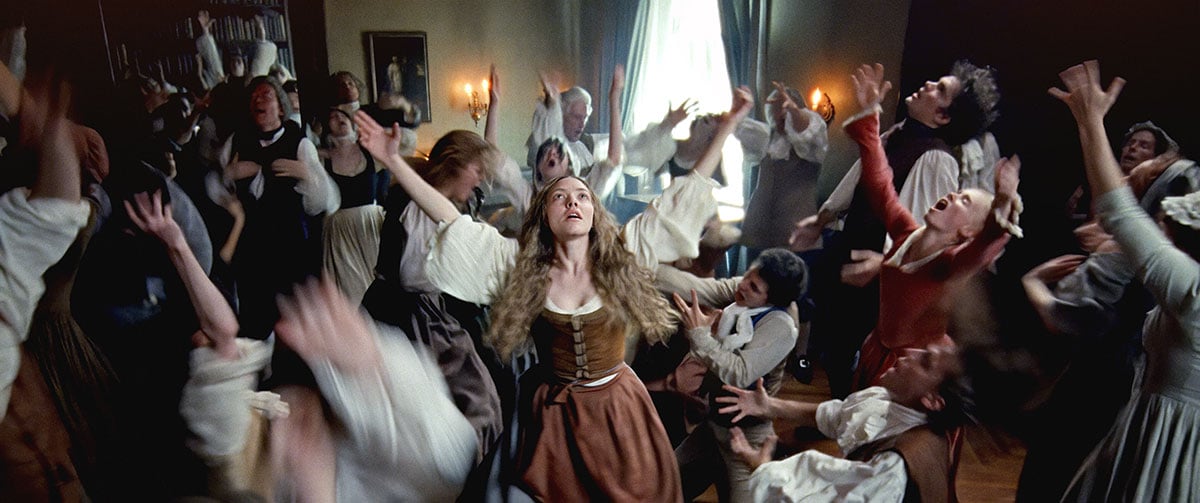
Through the centuries, people have sought to find a way to communicate such transcendent experiences with others. Words rarely seem adequate, almost always coming up short somehow. And even if you had a camera present when someone was overcome by ecstatic fervor, naturalistic photography couldn’t capture what it felt like, what they saw, what they heard. For a long time, painting and other graphic arts may have offered the most immediately compelling representations of the effect of a mystical encounter on the human consciousness. I would argue that film has great potential in this regard, although the results can still strike us as cryptic (think 2001: A Space Odyssey) or over-the-top (Altered States, or almost any other Ken Russell film).
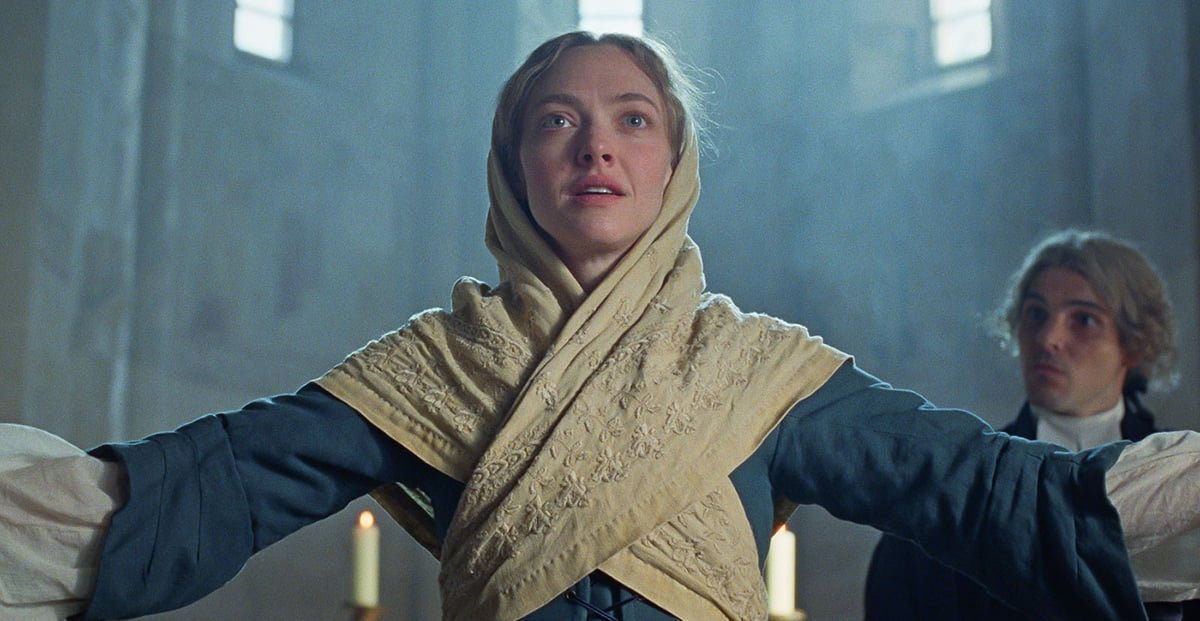
I can’t remember, though, the last time I’ve seen a film that does as consistently good a job of this as Ann Lee does. I think the effort to show us the intrusion of the mystic in the mundane realm drives many of the film’s artistic choices, including its existence as “a musical.” When Amanda Seyfried, as Ann, sings “Hunger and Thirst” from a straw-floored prison cell, for example, we see it as the culmination of a religious vision—one that began with flashes of biblical imagery which we understand as glimpses into Ann’s consciousness. (Think about how our familiarity with the visual “language” of cinema, honed over more than a century, enables us to instinctively distinguish between “what the camera sees” and “what the mind sees.”)
As a director, and as a co-writer with her partner, Brady Corbet, Fastvold wants us to feel the uncanniness of the Shaker movement, and I think the film does a lot to convey just how disruptive and downright weird the secular and religious authorities in Manchester found Ann and her sect. Although the film elides over Ann’s birthright Quaker status, it does show how she found her way to the Wardley Society, a small group led by another former Friend, Jane Wardley (played by Stacy Martin), with her husband, James (Scott Handy), as her first disciple.
At Ann’s first meeting with the “Shaking Quakers,” as they were first known, Jane and James compel her to confess her sins. She admits to an excess of sorrow and humility, but then the next person to offer his “unflinching testimony” describes incestuous thoughts toward his sister. The disclosure unsettles us, but the discomfort grows stronger as first he, then a woman standing next to him, groan and shake, and then the behavior spreads throughout the room until we abruptly cut to Ann taking part in one of the Shakers’ wild dances.
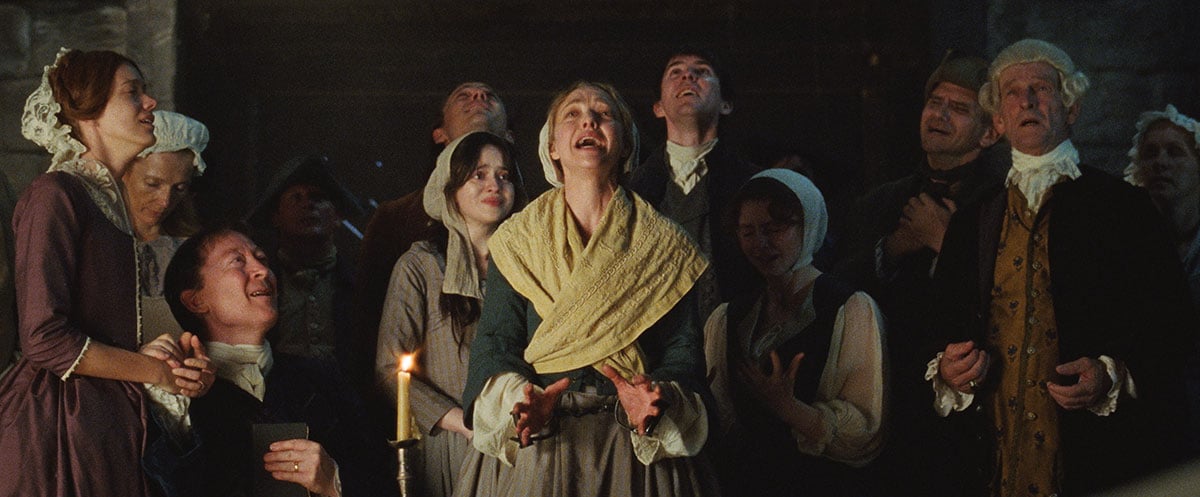
These disturbing scenes accumulate; though the film doesn’t editorialize, it also doesn’t shy away from acknowledging how much the growth of the Shaker community relied upon cult-like recruitment tactics, such as another uncomfortable forced confession after Mother Ann, as her followers called her after she revealed her prophetic vision, begins attracting seekers in the American colonies. We also see a brutally violent example of the backlash against a new social order where men and women held equal status and Black and White disciples intermingled freely, two conditions that surely contributed to the simultaneous accusations of treason and witchcraft. Add Daniel Blumberg’s foreboding musical score to the mix, and I found myself thinking a lot about “folk horror” films like The Blood on Satan’s Claw and the original version of The Wicker Man.
Fastvold clearly doesn’t want us to think of Ann Lee as a supernatural horror—she does, however, want us to understand how profoundly Ann’s vision (whatever we may think of its source) disturbed eighteenth-century England and America. Perhaps we need to see it underlined so heavily, given how her following has dwindled down from a peak of around 6,000 in the 1840s to a mere three adherents in our time, allowing us to forget its impact on a young nation still sorting out its cultural identity.
The Shaker vision will still strike people as weird, of course. I heard more than a few nervous titters in the audience when Ann declares, “There is one single cause for humanity’s separation from God: fornication.” And it can take a while to adjust to characters seamlessly transitioning from normal speech to song when overcome by powerful emotions. With one notable exception, the film doesn’t have much of a sense of humor, and though it tries hard to sell us on the transformative power of Mother Ann’s leadership, it may still strike some viewers as relentlessly grim. (Our senior editor, Martin Kelley, also writes at his personal blog about how the film distorts the history of the cultural development of the Shakers in America in order to bolster its account of her impact.)
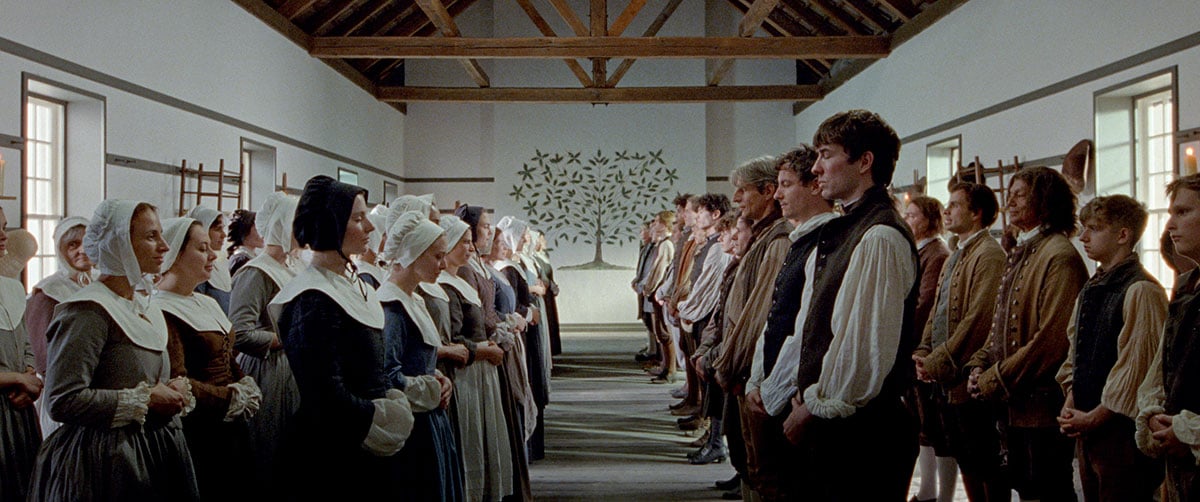
Still, I keep coming back to the intensity of the film’s portrayal of Ann Lee’s faith. Fastvold takes that faith, and the shape it gave to Ann’s life, seriously at a level I’ve rarely seen in movies—I’m thinking primarily of Martin Scorsese films like The Last Temptation of Christ, Kundun, and Silence. (I also highly recommend the 2010 French film Of Gods and Men, about a community of Catholic monks martyred during the Algerian Civil War.) Given the Shakers’ roots in the Religious Society of Friends, it seems to me that the Quaker language of “continuing revelation” and “leadings” provides a useful frame of reference for Ann’s vision . . . but, also, that her story provides a useful frame of reference for Friends wondering how to live a spiritual life in a material world.

How do I watch the Ann Lee film? Barbara
In the U.S. the film is still only playing in movie theaters. It will be available online starting March 10 as a rental or purchase via Amazon Prime Video, Apple TV, and Fandango at Home.
Thanks Ron! I enjoyed your article and glad I had already watched the movie. The shaking and pounding really gave voice to “that which cannot be described.” I’m was reminded that just before a message is given a friend can experience an array of feelings in their body that are not usually visible, and yet the meeting can sense the presence and movement of spirit among us. There is no way that moment of ecstatic sensation can be described by words.
The shaking and pounding of Ann and the congregation was a wonderful way for viewers to get a glimpse of what was happening inside of each person… Staten